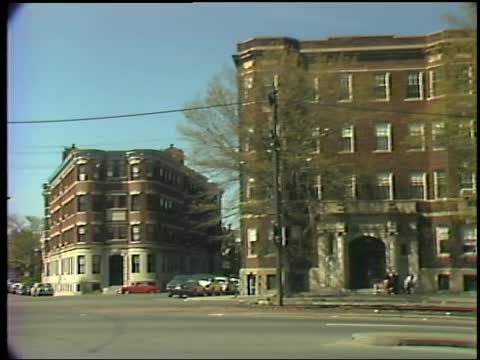
Description: BACK BAY AND SOUTH END REALTORS, CONDOS, APARTMENTS, SUNNY, BROWNSTONES, CONSTRUCTION. FOR SALE and FOR RENT SIGNS
Collection: Ten O'Clock News
Date Created: 06/18/1982
Description: Public health commissioner Bailus Walker talks about cleaning up Boston Harbor and the risk of contamination from sludge and toxic effluents. MWRA meeting chaired by secretary of environmental affairs James Hoyte. They discuss options for waste water treatment plants. Attendees drink coffee from Dunkin' Donuts cups.
Collection: Ten O'Clock News
Date Created: 07/01/1985
Description: DANCERS AUDITIONING IN BALLET COMPETITION (10 MIN IN).
Collection: Ten O'Clock News
Date Created: 03/26/1982
Description: Callie Crossley reports on the documentary film Street Cop, set in Roxbury. Interview with Roxbury community activists Georgette Watson and Ben Haith about the documentary's portrayal of crime and drug traffic in the community. Watson complains about the negative images of Roxbury in the media and about the negative attitude of many police officers toward African Americans. Crossley's report includes footage from Street Cop and footage of Crossley, Watson, and Haith walking in Dudley Square. Interview with Larry Brown of the Boston Minority Police Association, who says that the documentary gave a realistic and effective portrayal of law enforcement. This edition of the Ten O'Clock News also included the following item: David Boeri reports that William Celester has been accused of sexual assault by a female employee of the Police Department
1:00:00: Visual: Footage from Street Cop, a documentary film produced for Frontline. The footage shows a police plainclothes police officer entering a family's apartment. Women and children in the apartment are screaming and crying. Callie Crossley reports that Street Cop is a gritty documentary set in Roxbury; that the documentary profiles police officers from Area B headquarters in Roxbury; that the documentary examines crime and drug traffic. Crossley reports that some Roxbury activists say that the film shows the disrepectful attitude of the police toward citizens in the community. V: Footage of Crossley interviewing Georgette Watson (Roxbury community activist) and Ben Haith (Roxbury community activist). Watson says that police show less respect and restraint in Roxbury than they do in other communities. Watson wonders if the police are helping the community or destroying it. Crossley reports that Watson and Haith are concerned about the portrayal the Roxbury community in the documentary. V: Footage from Street Cop of a police officer breaking down an apartment door with a sledgehammer. Footage of Watson saying that drug problems exist all over the city, not just in Roxbury. Footage of Haith saying that the documentary showed the police attacking the neighborhood as if they were engaged in warfare. Footage from Street Cop of police officers searching for drugs in an apartment. Footage of Crossley, Watson, and Haith walking across the street in Dudley Square in Roxbury. Watson says that there are massive drug deals taking place across from the police station; that police are more concerned with forcefully entering homes to search for nickel bags of marijuana. Footage from Street Cop. Stanley Philbin (Boston Police Department) drives by a depressed housing project in Roxbury, saying that if he were young, black and living in that housing project, he would probably sell drugs; that "being black is no bargain." Crossley reports that Roxbury activists say that comments by police officers in the documentary reflect racist attitudes. V: Footage from Street Cop of a white police officer grabbing an African American girl as he tries to chase some African American kids away from a residential home. Footage of Watson saying that Roxbury needs police officers who understand the community; that police officers from South Boston do not understand the culture of African Americans. Watson says that Roxbury needs police officers who do not have a negative attitude toward African Americans. Footage of Larry Brown (Boston Minority Police Association) saying that the documentary was realistic and effective portrayal of law enforcement. Footage from Street Cop of a police officer reaching down the shirt of an old woman to pull out drugs. Footage of Brown saying that drugs and guns are a huge problem in communities; that police officers need to protect themselves from violence. Footage from Street Cop of police officers making an arrest. Footage of Brown saying that the community needs to support the police officers in the fight against the drug problem; that tough tactics are necessary to eradicate the drug problem. Footage from Street Cop of a uniformed African American police officer in a cruiser.
Collection: Ten O'Clock News
Date Created: 03/31/1987
Description: Callie Crossley interviews Boyce Slayman (Rainbow Coalition) about African American perceptions of US President, Ronald Reagan. Slayman criticizes Reagan's policies and talks about racism in the campaign. Slayman says that the Democratic Party needs to address civil rights issues and other issues important to the African American community. Slayman adds that African Americans will become more politically active at the local level; he says that Reagan cannot afford to ignore the minority population. The tape includes footage of African American and white voters lining up at a polling station to vote. Voters enter and exit voting booths. Slayman and other campaign workers hold campaign signs in front of a polling station; the workers approach voters as they enter the polling station. Crossley interviews an African American man outside of the polling station. The man talks about why he voted for Walter Mondale and Reagan's proposed cutbacks. The man says that Reagan does not care about issues affecting the African American community. Crossley interviews a white woman and a white man. The woman says that she voted for Mondale and Geraldine Ferraro because she is a democrat and a supporter of women's issues. The man says that he voted for Mondale and that Ferraro's presence on the ticket did not affect his decision.
1:00:11: Visual: Callie Crossley interviews Boyce Slayman (Rainbow Coalition) near Washington Street. Crossley asks Slayman about African American perceptions of Ronald Reagan (US President). Slayman says that African Americans have suffered under the Reagan administration; that Reagan has cut programs in education, healthcare, and nutrition programs; that Reagan has rolled back affirmative action programs. Crossley asks Slayman about racism in the campaign. Crossley notes that most African Americans are supporting Mondale; that the majority of white voters are supporting Reagan. Slayman says that racism is a factor in the election. Slayman says that Jesse Jackson (candidate for US President) was treated poorly by the media during the primary elections. Slayman says that the Democratic Party is not speaking to the issues of African American voters; that the Democratic Party needs to address civil rights issues. Crossley asks what African Americans can expect if Reagan wins the election. Slayman says that African Americans can only hope that Reagan will change his policies. Slayman lists the policies that need to be changed under the Reagan administration. Slayman says that the nation will see declines in the areas of employment, civil rights and housing if Reagan does not change his policies. Crossley asks if a continuation of Reagan's policies will lead to unrest or riots. Slayman says that he would not expect riots; that riots would ensue if Jackson were assassinated. Slayman says that people of color will become more politically active at the local level; that African Americans are ignored at the national level of politics; that African Americans cannot be ignored if they take control of their immediate environment. Slayman says that African Americans will not support growth at their expense. Slayman says that an increase in African American political activity grew from African American opposition to Reagan's policies. Slayman says that Reagan cannot afford to ignore minority populations; that these populations need to benefit from the nation's growth and economic recovery. 1:07:23: V: The camera crew takes cutaway shots of Crossley and Slayman. Crossley and Slayman speak informally. Crossley and Slayman discuss whether the Democrats will retain control of Congress. Slayman talks about voting patterns in the South. 1:08:26: V: African American and white voters are lined up to vote in a hallway outside of a polling station. Poll workers sit behind a table. The poll workers flip through voter lists as they check in the voters. Shots of voters entering and exiting voting booths. An African American woman directs voters to the voting booths. Shots of the voting booths with curtains closed; of poll workers checking in voters. Shot of a voting machine with levers inside of a voting booth. 1:12:41: V: An African American man hands out flyers outside of a polling station. Slayman campaigns for a candidate outside of the polling station. Slayman and other African American campaign workers approach voters outside of the polling station. Shots of campaign signs for John Kerry (candidate for US Senate) and Walter Mondale (candidate for US President). The campaign workers continue to campaign outside of the polling station. A pick-up truck passes by, playing music from a loudspeaker. A sign on the truck reads, "Jesse yes. Walter no. Independent is the way to go." Shots of campaign signs. 1:14:51: V: Crossley interviews an African American man and an African American woman. The man says that he voted for Mondale because he is the best candidate. Crossley asks if Reagan has any understanding or caring for the needs of African Americans. The man says that Reagan does not; that Reagan's past performance shows that he does not care. The man fears that Reagan will make more cutbacks if reelected. Crossley asks if the man was influenced by Mondale's choice of Geraldine Ferraro as his running mate. The man says that Mondale sent a positive message by choosing Ferraro; that the ERA (Equal Rights Amendment) is a good thing. Crossley asks the woman about her vote. The woman says that she voted for Mondale. The woman says that she does not want to be interviewed. 1:16:33: V: Crossley interviews a white woman and a white man. The woman says that she voted for the Mondale/Ferraro ticket because she is a Democrat and supports women's issues. The woman says that she would have voted Democratic even if Ferraro had not been on the ticket. The woman says that the ERA must be passed. Crossley asks the man about his vote. The man says that he voted for the Mondale/Ferraro ticket because he is embarrassed to have Reagan as the leader of the country. The man says that he was more influenced by issues than he was by the presence of Ferraro on the ticket.
Collection: Ten O'Clock News
Date Created: 11/06/1984
Description: Dr. Gloria White-Hammond (pediatrician) examines a young Latina child in an examining room. The child cries and White-Hammond comforts her, speaking in English and in Spanish. White-Hammond speaks to the child's mother about treatments for the child. White-Hammond examines the child with a stethoscope. Interview with White-Hammond about a program designed to increase the number of African American physicians across the nation. She says that medical schools lack the financial, academic and other kinds of support necessary to retain some students. She discusses the need for more minority physicians, who bring a "sensitivity" to the treatment of minority patients. Video cuts out and then comes back with stills of infographics on new Boston University medical school program and minority doctors.
1:03:41: V: The camera crew sets up a shot of the doctor examining the child. The child begins to cry. White-Hammond examines the rash on the child's leg. The child grows upset as she sits on the examining table. The child's mother removes her dress. White-Hammond comforts the child in Spanish. White-Hammond examines the child with a stethoscope. White-Hammond tries to comfort the child as she cries. 1:06:32: V: White-Hammond talks to Callie Crossley (WGBH reporter) and the camera crew. Crossley asks White-Hammond her opinion on a program designed to increase the number of African American physicians across the nation. White-Hammond says that she is not very familiar with the program; that the program sounds like a good idea. Crossley explains some of the features of the program. Crossley notes that the program eliminates the MCAT entrance exam for medical school. White-Hammond says that the program has potential; that the structure of the program and the selection process will be important. White-Hammond says that medical schools lack the kind of support system needed to retain some students; that financial, academic and other kinds of support are necesssary for students to do well in medical school. White-Hammond says that the medical field needs more minority doctors; that minority patients request to be treated by minority doctors. White-Hammond says that minority doctors bring a "sensitivity" to the treatment of minority patients; that many minority students have the intellectual capability and the determination to become successful doctors. Crossley closes the interview.
Collection: Ten O'Clock News
Date Created: 06/28/1984
Description: Boston State Hospital exteriors, mental health, snow on ground. .
Collection: Ten O'Clock News
Date Created: 08/14/1982
Description: BU NURSING SCHOOL LIKELY TO CLOSE FOR LACK OF FUNDS, LOW ENROLLMENT
Collection: Ten O'Clock News
Date Created: 04/13/1987
Description: Interiors scenes in the Somerville Boxing Club. Trainers working with boxers. Two boxers sparring in the ring. Callie Crossley interviews boxers and trainers on the alleged dangers of boxing compared to other sports and the American Medical Association's proposal to ban amateur and professional boxing.
Collection: Ten O'Clock News
Date Created: 12/12/1984
Description: Man preparing slices of brain tissue in lab. Alzheimer's disease.
Collection: Ten O'Clock News
Date Created: 10/01/1984