Description:
Christy George reports that City Councilor James Kelly objects to an interfaith, interracial prayer service to be held in South Boston because he fears that the meeting could be seen as an endorsement of the city's plan to integrate South Boston housing projects. Kelly has called for the meeting to be moved to another location. Interview with Father Thomas McDonnell of St. Augustine's Church in South Boston and Reverend John Borders of the Morningstar Baptist Church. McDonnell and Borders say that South Boston is not a racist neighborhood. Interview with Jim Kelly. George quotes Kelly as saying that he opposes forced busing, racial quotas, and forced housing. Community leaders have met with Mayor Ray Flynn to discuss the peaceful integration of public housing projects, and hold a press conference. Doris Bunte of the Boston Housing Authority, Charles Stith of the Union United Methodist Church, John O'Bryant of the Boston School Committee, and Don Muhammad of the Nation of Islam, Roxbury speak at the press conference. George reports that Bernard Cardinal Law (Archdiocese of Boston) endorses the meeting. George notes that Flynn is pushing for housing integration over the objections of South Boston residents. Footage of Flynn at a community meeting in South Boston and footage of anti-busing activity in South Boston in 1977.
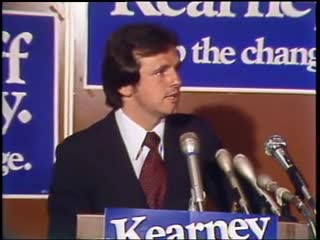
1:00:05: Visual: Footage of Father Thomas McDonnell (St. Augustine's Church in South Boston) and Reverend John M. Borders, III (Morningstar Baptist Church in Mattapan) sitting together for an interview in South Boston. McDonnell says that both men believe in the power of prayer. Christy George reports that religious leaders want to hold an interfaith, interracial prayer meeting at St. Monica's Church in South Boston; that James Kelly (Boston City Council) has taken out a half-page advertisement in the South Boston Tribune; that the ad calls on the Catholic Church to move the prayer meeting to another location. George reports that Kelly fears that the prayer meeting could be seen as an endorsement of the city's plan to desegregate public housing projects in South Boston. V: Shot of the exterior of St. Monica's Church; of Kelly's advertisement in the South Boston Tribune; of a statue in front of the church. Footage of McDonnell saying that racism is a moral issue. Borders says that prayer is a means to change the people's hearts. Footage of police arresting two women on G Street in South Boston on May 12, 1977. Shots of police cruisers escorting school buses along a city street; of a housing project in South Boston. Shots of a sign for the Old Colony Housing Project; of a white woman and children in front of a housing project building. George notes that South Boston became a battleground during school desegregation. George reports that Ray Flynn (Mayor of Boston) has announced that the public housing projects in South Boston will be integrated; that Flynn alienated many South Boston voters by pushing for public housing integration. V: Shot of Flynn approaching the stage at a community meeting in South Boston on January 12, 1988. The crowd jeers and boos as Flynn walks on to the stage. Shot of audience members seated at long tables. Footage of Kelly at the community meeting. Kelly says that South Boston residents will serve time for civil rights violations if the public housing projects are integrated. The crowd applauds Kelly. George reports that community leaders met with Flynn today to talk about peaceful desegregation of the projects; that attendees at the meeting expressed thinly disguised scorn for Kelly. V: Shot of Doris Bunte (Boston Housing Authority) speaking at a press conference. Charles Stith (Union United Methodist Church) and two other African American community leaders stand behind her. Footage of John O'Bryant (Boston School Committee) at a press conference. A reporter asks him if Kelly's name was mentioned in the meeting with Flynn. O'Bryant replies, "Who's he?" George reports that Kelly believes that affirmative action is reverse racism. George quotes Kelly as saying that "assigning the needy to public housing based on race is morally and legally wrong." V: Shot of Kelly at his desk. A quote from Kelly is written out in text on-screen. Footage of Kelly saying that supporters of equal opportunity must oppose forced busing, racial quotas, and forced housing. Footage of Stith saying that there are some elected officials who insist on keeping the city divided; that religious leaders are making an effort to unite the city. Footage of Minister Don Muhammad (Nation of Islam, Roxbury) saying that not all Irish residents are racist; that African Americans in Roxbury are not all drug addicts. George reports that Bernard Cardinal Law (Archdiocese of Boston) endorsed the prayer meeting. George quotes Law as saying that publicity "could lead to the erroneous impression that racial discrimination is a problem of geography, which it is not. . . . Racial discrimination is a problem of the human heart." V: Shot of Law addressing an audience. A quote from Law is written out in text on-screen. George reports that one of the goals of the prayer meeting is to debunk the myth of South Boston as a racist neighborhood. V: Shot of a white family walking in front of St. Monica's Church. Footage of Borders saying that Kelly does not represent the views of all South Bostonians. Borders says that he had no problems in South Boston when he drove to today's interview at the church. George reports that religious leaders say that the prayer meeting is not about politics; that the controversy surrounding the meeting has become political despite the efforts of religious leaders.
Date Created:
05/20/1988