Description: Hope Kelly reports that Superintendent Laval Wilson proposed a set of reforms to improve the Boston Public Schools in the beginning of his tenure as superintendent. Kelly reviews Wilson's proposals for school reforms and notes that the programs were backed by the Boston School Committee. Kelly's report includes footage of Wilson in 1985 and footage of Wilson announcing his school reform package. The Boston School Committee has recently cut Wilson's budget by $8.5 million. Kelly reviews the budget cuts. Interviews with John Nucci (Boston School Committee), Sam Tyler (Boston Municipal Research Bureau), and Ellen Guiney (Educational Advisor to Mayor Flynn) about the budget cuts. Kelly reviews the budget figures for municipal spending on education from 1984 to 1989 and budget figures for overall city spending from 1986 to 1988. Kelly notes that the city's spending on education has greatly increased from 1984. She notes that critics believe that the School Department is not spending its money wisely. Kelly reports that the city will need to curb its spending in the next few years due to the absence of budget surpluses. Kelly's report is accompanied by footage of students in the Boston Public Schools.
1:00:19: Visual: Footage of Dr. Laval Wilson (Superintendent, Boston Public Schools) being interviewed by the Boston School Committee for the position of superintendent of schools on July 19, 1985. Wilson says that his goal is to convince the members of the Boston School Committee that he is the best candidate for the position. Hope Kelly reports that Wilson took over the Boston Public School System at a time when the average graduating senior reads at a seventh-grade level. Kelly notes that the average drop-out rate is 43%. V: Shots of high school students outside of a high school; of students descending a stairs in a school building. Kelly notes that Wilson approached the job with determination. V: Footage of Wilson saying that his goal is to lift the educational level of the students coming out of the Boston public school system. On-screen text and visuals detail the specifics of Wilson's proposed educational programs. Kelly reports that Wilson proposed a set of reforms called the Boston Education Plan. Kelly notes that Wilson proposed a $3.1 million dollar program for after-school remedial reading; that Wilson proposed a $1.3 million program to standardize remedial reading programs city-wide. Kelly notes that the School Committee backed Wilson's programs when he arrived. Kelly reports that the School Committee cut Wilson's budget by $8.5 million on Wednesday. V: On-screen text detail the specifics of the budget cuts. Kelly reports that Wilson proposed a budget of $364.6 million; that the School Committee cut his budget to $355.9 million; that Ray Flynn (Mayor of Boston) has refused to spend more than $350.0 million on the school budget. V: Shot of Flynn talking to reporters. Footage of John Nucci (President, Boston School Committee) saying that the city administration does not understand the impact of its cuts to the school budget. Kelly reports that Sam Tyler (Boston Municipal Research Bureau) runs an agency which monitors city spending. V: Footage of Tyler being interviewed by Kelly. Tyler says that city officials were thinking about the future when they asked the School Department to keep its spending to within $350 million. Tyler says that the superintendent cannot introduce new programs and expect them all to be funded. Footage of Ellen Guiney (Flynn's Education Advisor) being interviewed by Kelly. Guiney says that $350 million is what the city can afford to spend on education. On-screen text and visuals detail the city of Boston's spending on education from 1984 to 1989. Kelly reports that the city has increased its spending on schools from $245 million in 1984 to $341.1 million in 1989. V: Footage of Guiney says that some city officials in other departments think that the School Department already receives too much money. Kelly reports that some critics wonder if the School Department is spending its money wisely. V: Shot of two elementary-school students in front of a computer terminal. Footage of Tyler saying that the school system has improved. Kelly reports that Nucci points to a 1% decrease in the drop-out rate. Kelly notes that Guiney points to improved teacher salaries and more teachers; that Guiney admits that there have been few actual performance gains by students. V: Shot of Nucci; of Guiney; of a white male teacher in a classroom. Footage of Guiney saying that she would have liked to have seen greater improvements in the last five years. Shot of an African American girl coloring a picture in a classroom. Kelly reports that spending by the city has risen overall in the past five years. V: On-screen text compares the rise in city spending to the rise in school spending from 1986 to 1988. Kelly reports that city spending has risen 34% since 1986; that school spending has risen 23% since 1986. Kelly stands in front of the offices of the Boston School Committee. Kelly reports that the city had surpluses from 1986 to 1988; that it is less certain that surpluses will exist in future city budgets. V: Footage of Tyler saying that the city needs to put a brake on its spending. Shot of elementary school students entering a classroom.
Collection: Ten O'Clock News
Date Created: 05/06/1988
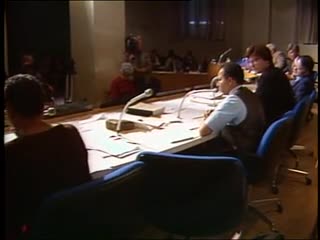
Description: Boston School Committee in typical meeting behavior: John Grady, Daniel Burke, John Nucci, Rita Walsh-Tomasini, Kevin McCluskey, Jean McGuire, Grace Romero, Abigail Browne, Supt. Laval Wilson.
Collection: Ten O'Clock News
Date Created: 11/01/1985
Description: Meg Vaillancourt reports that the Boston City Council has delayed voting on the school reform package proposed by Mayor Ray Flynn, which includes a home rule petition that transfers decision-making power from the Boston School Committee to the superintendent of schools. Reverend Bruce Wall of the Twelfth Baptist Church delivers an invocation before a City Council meeting, presided over by President Bruce Bolling. Some councilors, including Dapper O'Neil, are opposed to the plan. O'Neil criticizes the plan because it gives too much power to the superintendent. Jim Kelly and Joseph Tierney also speak at the meeting. Critics accuse the Boston City Council of delaying their vote on the proposal in order to garner media attention. Interview with Boston School Committee member John Nucci. Vaillancourt notes that school reform is an important issue for voters. Shots of a newspaper article criticizing the City Council. Interview with City Councilor Christopher Ianella, who says that the councilors are practicing "the art of politics" and that they will eventually vote in favor of the proposal. This edition of the Ten O'Clock News also included the following item: Callie Crossley reports on a proposal to allow for AIDS testing by insurance companies
1:00:01: Visual: Footage of Reverend Bruce Wall (Twelfth Baptist Church) delivering an invocation before a meeting of the Boston City Council in the City Council Chambers. City Councillors Charles Yancey and Bruce Bolling stand behind him. Shots of the City Councillors in the Chambers. Bruce Bolling presides over the meeting. The other councillors sit behind desks. Meg Vaillancourt reports that the Boston City Council met to consider the school reform package proposed by Ray Flynn (Mayor of Boston). Vaillancourt notes that the package includes the home rule petition, which is the "cornerstone" of school reform in Boston. V: Footage of Dapper O'Neil (Boston City Council) saying that the Boston School Commitee is "crucifying the teachers"; that the School Committee is giving too much power to the superintendent. O'Neill compares Wilson's power to that of Adolph Hitler. O'Neil says that he will never vote for the school reform package. Vaillancourt reports that O'Neil was the only City Councillor to say that he would vote against the package; that consensus is never easy in an election year. V: Shot of the stenographer in the center of the Chambers. Footage of James Kelly (Boston City Council) saying that there is no rush to vote on the home rule petition; that the state legislature will not meet to approve the petition until September. Vaillancourt reports that most City Councillors agree with the petition; that the petition transfers power from the School Committee to the superintendent. V: Shots of a School Committee meeting in session. Vaillancourt reports that the School Committee has agreed to share power; that the proposal to allow Wilson to make personnel decisions has strong backing in the business community. Vaillancourt notes that Flynn's proposal includes changes suggested by councillors; that Boston newspapers called the councillors' suggested changes "absurd." V: Shots of the City Council meeting; of a newspaper editorial with a headline reading, "Games Councillors Play." Vaillancourt reports from outside of the City Council Chambers. Vaillancourt reports that the City Council delayed voting on the package; that the Council referred the school reform package to its Education Committee for review. Vaillancourt notes that the Council objected to the package last week. Vaillancourt speculates that the Council did not want to appear to back down from their objections by approving the package; that the Council did not want to open themselves up to criticism by rejecting the package. V: Footage of Bolling preciding over a vote in the Coucil Chambers. Shot of Joseph Tierney (Boston City Council) addressing the Council. Vaillancourt reports that politics may be behind the City Council's delay. Vaillancourt adds that school reform is the focus of Tierney's mayoral campaign. V: Footage of Tierney saying that he will not vote in favor of the package until he has the opportunity to make an "intelligent, informed vote." Footage of John Nucci (President, Boston School Committee) saying that the City Council is delaying on the issue in order to garner attention from the media. Vaillancourt speculates that Nucci is correct; that school reform is a major issue for voters; that most City Councillors will probably endorse the plan. V: Shot of students playing ring-around-the rosey at the Jackson Mann Elementary School. Footage of Christopher Ianella (Boston City Council) being interviewed by Vaillancourt. Ianella says that Councillors are practicing the "art of politics"; that the vote will eventually come out in favor of the package.
Collection: Ten O'Clock News
Date Created: 08/03/1987
Description: Meg Vaillancourt reports that members of the Citywide Parents Council have criticized the Boston School Committee's decision to release superintendent Laval Wilson from his contract. Press conference with Council members Jackie van Leeuwen and Glenola Mitchell. Van Leeuwen says that School Committee members acted unethically and unfairly in firing Wilson. Mitchell says that she believes that race played a role in Wilson's firing. School Committee members were critical of Wilson's communication skills, but rated him as fair or better in all other categories. School Committee members deny that race played a role in the firing. Parents are demanding a voice in the selection of Wilson's successor. Vaillancourt adds that the School Committee has been forced to cut back on spending and that money will be tight for the next year. Vaillancourt's report is accompanied by footage of a Boston School Committee meeting and footage of Wilson speaking to the media.
1:00:06: Visual: Footage of Dr. Laval Wilson (Superintendent, Boston Public Schools) speaking to the media on February 14, 1990. Wilson says that he is Boston's first African American superintendent of schools; that he has been a successful superintendent who has worked hard for all groups. Meg Vaillancourt reports that the Boston School Committee voted to replace Wilson last week. Wilson notes that Wilson has had problems in the past with the Citywide Parents Council; that the organization spoke out in support of Wilson today. V: Footage of Jackie van Leeuwen (Citywide Parents Council) at a press conference. Van Leeuwen says that members of the Boston School Committee acted unethically and unfairly in firing Wilson; that Wilson should have been provided an opportunity to discuss his evaluation. Vaillancourt reports that the School Committee evaluation rated Wilson as fair or better in all categories; that members were critical of his communication skills. V: Shot of John O'Bryant (Boston School Committee) speaking to members of the School Committee during a break in a meeting in February of 1989. Wilson looks on. Vaillancourt reports that Wilson's supporters believe that his professionalism is more important than his personality; that Wilson's supporters question the professionalism of the School Committee. V: Shots of a white female teacher teaching students in a classroom. Shots of individual white and African American students. Footage of Glenola Mitchell (Citywide Parents Council) at the press conference. Mitchell questions how the School Committee found the money to buy out Wilson's contract. Mitchell says that the School Committee could not find any money for crucial programs or teacher contracts. Footage of Von Leeuwen saying that the School Committee is supposed to represent the interests of parents and schoolchildren. Von Leeuwen says that the School Committee has shown no regard for the opinions of parents and students. Shot of members of the media in the audience. Vaillancourt asks Mitchell if race played a role in the School Committee's vote against Wilson. Mitchell says that the pattern of the vote shows that race did play a role for some members. Footage from a School Committee meeting in February of 1989. Shots of the members of the School Committee seated at the front of the School Committee chambers; of audience members crowded into the School Committee chambers. Shot of Wilson standing alone as he drinks from a cup. Shots of School Committee members Daniel Burke, Peggy Davis-Mullen, Kitty Bowman, and Robert Cappucci conferring during a break in the meeting. Vaillancourt reports that white members of the School Committee deny that race played a part in the decision; that Wilson declined comment on camera today. Vaillancourt reports that Wilson is being considered for superintendent's post in Florida. V: Shot of the audience at the press conference of the members of the Citywide Parents Council. Vaillancourt notes that the Miami Herald has quoted Davis-Mullen as saying that Wilson is a "rigid, inflexible centralist." Vaillancourt notes that the Miami Herald quoted Davis-Mullen as saying that Wilson is unable to take criticism or move with the flow. V: Shot of Davis-Mullen speaking at a School Committee meeting. The quote by Davis-Mullen appears written in text on-screen. Vaillancourt reports that parents have demanded to meet with the School Committee; that parents want a voice in the selection of Wilson's replacement. V: Shots of attendees at the Citywide Parents Council press conference. Shot of Julio Henriquez (aide to School Committee member Daniel Burke) standing at the rear of the room. Footage of Mitchell saying that she is concerned about the members who do not have children in the school system; that those members are not users of the system. Vaillancourt reports that the School Committee's decison to fire Wilson comes at a bad time; that the state budget crunch has forced the School Committee to cut back on spending. Vaillancourt notes that the Boston City Council has not come up with funding for next year's teacher contracts; that a new student-assignment plan was scheduled to go into effect in the fall. Vaillancourt adds that Wilson will have to meet those challenges as "a lame-duck superintendent."
Collection: Ten O'Clock News
Date Created: 02/20/1990
Description: SCHOOL COMMITTEE DEBATES DISPENSING CONTRACEPTIVES IN SCHOOLS. birth control. Laval Wilson, Joseph Casper, Abigail Browne.
Collection: Ten O'Clock News
Date Created: 09/09/1986
Description: Hope Kelly reports on school desegregation in Lowell. Kelly notes that the minority student population in the Lowell Public Schools has doubled over the past ten years. She adds that Lowell has become a magnet for immigrants from Southeast Asia. Kelly interviews students in the Lowell public schools about school desegregation. Kelly interviews Jane Mullen (guidance counselor) about the diversity of the school population. Kelly notes that students are currently bused in order to achieve racial balance in the schools. She reports that opponents of school desegregation are fighting for neighborhood schools. Kelly reviews the racial breakdown of the student population at the Bartlett School in Lowell. Kelly's report is accompanied by footage of ethnically diverse students in a classroom and school cafeteria. Kelly's report also includes footage of a bilingual class and footage of the Merrimac River. This edition of the Ten O'Clock News also included the following item: Marcus Jones reports on school desegregation in Lynn, Massachusetts
1:00:07: Visual: Shots of industrial machinery in operation; of children playing at a playground; of industrial buildings; of two women sitting on a park bench; of historic buildings in Lowell; of a child looking out from a window of an apartment building; of the Merrimac River running through Lowell. Hope Kelly reports that tension in the city of Lowell stems from school desegregation. V: Shots of a bird on the shore of the Merrimac River; of an old brick building; of the water of the Merrimac River. Footage of a white female student saying that adults want students to be able to choose which schools to attend. Footage of a white male student sitting with an Asian American female student. The white male student says that adults are arguing about politics and where kids of different races should go to school. Shots of a students getting lunch in a school cafeteria. Footage of a Latino male student saying that it is good for students to meet different people from different backgrounds. Shots of students boarding a school bus. Kelly reports that opponents of school desegregation in Lowell are arguing for neighborhood schools. V: Shots of an African American female student in the cafeteria; of Asian American students in the school cafeteria. Footage of students in a classroom in the Bartlett School in Lowell. Shots of individual students. Most of the students are Asian American. Kelly reports that the student population of the Bartlett School in Lowell is 20% Latino and 25% Asian American. Kelly notes that the minority population in Lowell Public Schools has doubled in the past ten years; that the schools enroll 450 new bilingual students each year; that 100 new Southeast Asian immigrants come to Lowell every week. V: Shot of an Asian teacher in a third- and fourth-grade Cambodian bilingual classroom. The teacher teaches a lesson to the students. Footage of Mary Jane Mullen (guidance counselor) giving Kelly a tour of the school. Mullen says that there was a large Latino population in the school ten years ago; that there is still a significant Latino population; that there were many Greek-speaking students at the school ten years ago; that there are no longer many Greek-speaking students at the school. Footage of an Asian male student named Paul, who says that he is not very good at reading books; that homework is hard. Kelly reports that Paul is one of 160 Southeast Asian students at the Bartlett School. Footage of Kelly interviewing a group of students sitting at a table. A white male student talks about how people used to come to Lowell to work in the mills. Shots of a mill building with broken windows; of a renovated mill building. Kelly reports that Lowell has always had a significant immigrant population; that buses bring children to schools across the city in order to achieve a racial balance. Shots of students standing outside of a school building.
Collection: Ten O'Clock News
Date Created: 10/23/1987
Description: The Boston School Committee holds a meeting in the School Committee chambers. Members of the School Committee discuss school business. John O'Bryant (Boston School Committee) reports on the need for school repairs; Robert Spillane (Superintendent, Boston Public Schools) reports on staffing issues. Sharon Stevens (WGBH reporter) interviews Kathleen Kelly (President, Boston Teachers Union) about a proposed school choice plan. Kelly says that many parents support a school choice plan because the current system allows little flexibility. Kelly says that the school choice plan must be considered carefully to prevent a return to segregated schools. Stevens interviews O'Bryant about the proposed school choice plan. O'Bryant says that the plan promotes greater access to schools across the city; that the current system is archaic and inflexible. Stevens interviews Barbara Gray (parent) about the proposed school choice plan. Gray says that parents should be allowed to choose a school with programs suited to the needs of their children. Gray says that the schools need to be improved; that the Boston Public Schools are not truly integrated because there are few white students. Stevens has extended conversations with interviewees while cutaways are shot. Takes of Stevens doing standup about supporters of the school choice plan working on an official proposal for the end of the month. The audio quality on this tape is uneven.
1:00:12: Visual: A Boston School Committee meeting is held in the chambers of the Boston School Committee. School committee members Jean McGuire, John O'Bryant, Jean Sullivan McKeigue, Kevin McCluskey, and Rita Walsh Tomasini are seated at the front of the room. Robert Spillane (Superintendent, Boston Public Schools) sits at the front with the members of the School Committee. Community members and the press are seated in the audience. O'Bryant talks about the need for $40 million to make school repairs. He says that the mayor, the Boston City Council, and the community must be made aware of the money needed for repairs. Shots of the various committee members. McKeigue agrees that school repairs are needed. A vote is taken on approving a draft of a letter to the mayor and the Boston City Council. O'Bryant thanks Spillane for his report. O'Bryant asks Spillane a question about staffing. Spillane says that more staff is needed before instituting a certain program. Audio is muffled. Shots of Sharon Stevens (WGBH reporter); of members of the audience; of the stenographer; of the committee; of the audience. The committee members discuss school business. Audio remains muffled. Shot of the committee members from the perspective of the audience. 1:05:10: Visual: Spillane talks about setting objectives for the school Social Studies programs. Shots of the committee members; of the audience. Audio is muffled. The committee members take a vote. Committee members discuss school contract issues. Shot of Stevens; of Kathleen Kelly (President, Boston Teachers Union) speaking to another audience member; of audience members. 1:08:15: V: Stevens sets up an interview with Kelly. Stevens asks Kelly about a "freedom of choice" proposal supported by some African American parents. Kelly says that she has not yet seen the proposal; that many African American and white parents support a "freedom of choice" plan because the geocode system allows little flexibility; that parents are more interested in good education than racial statistics. Kelly says that a control mechanism must be put in place to prevent a return to segregated schools; that the plan must be given careful thought. Kelly says that the choice of educational programs is more important than the choice of school location. Stevens asks Kelly if busing is "almost dead." Kelly says that busing is no longer the only remedy for Boston schools; that busing can serve as a tool to further the goals of desegregation and educational quality. The crew takes cutaway shots of Stevens and Kelly. Stevens and Kelly speak informally. 1:12:36: V: Stevens sets up an interview with O'Bryant. Stevens asks for O'Bryant's opinion of the "freedom of choice" proposal. O'Bryant says that parents are trying to reform the rigid geocode system; that students have been denied access to schools because of the geocode system. O'Bryant mentions students who have been denied access to the Trotter School. O'Bryant says that the parents are asking for more accessibility to the schools; that the "freedom of choice" proposal has been made into a bigger issue than it should be. O'Bryant says that the geocode system assigns students to schools based upon their residence; that the geocode system is archaic and inflexible; that the geocode system must be addressed in the consent decrees put forth by the court; that leaving the geocode system in place would have "disastrous" consequences. Stevens asks O'Bryant about NAACP intervention in the court case, and NAACP opposition to the "freedom of choice" plan. O'Bryant says that there is a lack of communication between the NAACP and supporters of the plan; that supporters of the plan want greater access to the schools. Stevens asks if the "freedom of choice" plan could result in a return to segregated schools. O'Bryant says that schools in Boston are already segregated because white parents refuse to send their children to most schools located in African American communities; that African American parents want greater access to quality schools all over the city. The crew takes cutaway shots of Stevens and O'Bryant. O'Bryant says again that the "freedom of choice" plan does not represent a return to segregated schools. 1:16:13: V: Stevens sets up an interview with Barbara Gray (parent), who supports the "freedom of choice" plan. Gray says that the supporters of the plan want greater access to all of the schools; that supporters of the plan want an end to the rigid geocode system. Gray explains that the geocode system assigns children to schools according to address and race. Gray says that all of Boston schools need to have high standards; that the each of the schools should have different programs designed to suit specific needs; that students should be able to choose a school whose programs suit their needs. Gray says that education needs to be improved so that all of the schools are equally competitive and able to provide a good education. Stevens asks if the "freedom of choice" plan could result in a return to segregated schools. Gray says that she does not want to go back to segregated schools; that true integration does not exist in Boston because there are not enough white students in the school system; that white students might return to the system if the schools are reformed. The crew takes cutaway shots of Stevens and Gray. Gray says that parents want more control over the education of their children. 1:19:59: V: Stevens records the closing segment of the story from outside of the headquarters of the Boston School Committee. She reports that the supporters of the "freedom of choice" plan are working on an official proposal for the end of the month; that the Massachusetts State Board of Education will propose an end to court intervention in the Boston School System. Stevens does two more takes of the closing segment.
Collection: Ten O'Clock News
Date Created: 03/08/1982
Description: Parent criticizes school committee's decision to close several Boston schools. Municipal Research Bureau recommends school committee be appointed, not elected. Sam Tyler, Laval Wilson.
Collection: Ten O'Clock News
Date Created: 07/26/1989
Description: Parents question judgement and political motives of school committee in voting to close and consolidate nine schools. Judge will review validity of decision. Laval Wilson, Thomas O'Reilly.
Collection: Ten O'Clock News
Date Created: 08/14/1989
Description: Acting superintendent Joseph McDonough tells City Council that School Department needs more money. Thomas Menino says they must live within their means. Albert O'Neil, Bruce Bolling, Rosaria Salerno, Michael McCormack in council chamber.
Collection: Ten O'Clock News
Date Created: 12/06/1990