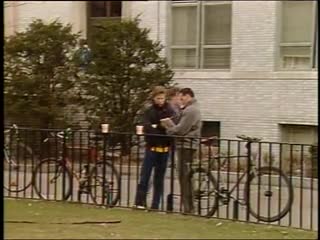
Description: Originally broadcast as a WGBH news special, this tape was later used as source material for Ten O'Clock News stories. Roger Fisher moderates discussion among students, administrators, faculty about student strike at Harvard over ROTC, Afro-American studies, expansion into Boston and Cambridge. Louis Lyons starts by reading the news from Harvard. Participants include Jim Kiernan, a WGBH consultant; Brey O'Connell, a member of the Committee for Radical Structural Reform; Richard Rubinowitz, a representative of Harvard New College; Hugh Calkins, a member of the Harvard Corporation; and Norman Daniels, a member of the Strike Committee and of the Student for a Democratic Society. First segment of the program provides some radical Harvard students the opportunity to speak to a member of the Harvard Corporation. Another students, King Collins, starts using explicit language, and the audio was cut during the original broadcast. Much argument over who has right to speak. reel 1 of 2.
Collection: Ten O'Clock News
Date Created: 04/17/1969
Description: Part of this tape is a repeat of the end of Part 1. Originally broadcast as a WGBH news special, this tape was later used as source material for Ten O'Clock News stories. Roger Fisher moderates discussion among students, administrators, faculty about student strike at Harvard over ROTC, Afro-American studies, expansion into Boston and Cambridge. Participants include Jim Kiernan, a WGBH consultant; Brey O'Connell, a member of the Committee for Radical Structural Reform; Richard Rubinowitz, a representative of Harvard New College; Hugh Calkins, a member of the Harvard Corporation; and Norman Daniels, a member of the Strike Committee and of the Student for a Democratic Society. Several other students join in the conversation. Much argument over who has right to speak. Professors James Ackerman and Jerome Bruner join the table. Fisher tries to define points of contention. reel 2 of 2.
Collection: Ten O'Clock News
Date Created: 04/17/1969
Description: Medical schools advise students to plan early for debt incurred by high cost of medical education.
Collection: Ten O'Clock News
Date Created: 08/31/1987
Description: Wide shot of stark, modern concrete exterior of Holyoke Community College.
Collection: Ten O'Clock News
Date Created: 04/03/1978
Description: Conference on hunger at Harvard School of Public Health.
Collection: Ten O'Clock News
Date Created: 02/26/1985
Description: ELL CENTER AT NORTHEASTERN University, pubs, package store, liquor store ON HUNTINGTON AVENUE
Collection: Ten O'Clock News
Date Created: 02/22/1985
Description: Chancellor Joseph Duffey says UMass Amherst has improved its reputation in his tenure. Students worry about higher fees, budget cuts, value of their degrees. Small discussion class. Students walking on campus.
Collection: Ten O'Clock News
Date Created: 03/06/1991
Description: JERRY FALWELL AT HARVARD LAW SCHOOL SPEAKS ON RELIGION AND POLITICS, MORAL MAJORITY
Collection: Ten O'Clock News
Date Created: 09/20/1984
Description: Meg Vaillancourt reports that Jesse Jackson visited Harvard Law School to join student protests over the school's minority hiring practices. Vaillancourt notes that Jackson supports Derrick Bell (Professor, Harvard Law School), who has announced that he will leave his post to protest the school's poor affirmative action record. Derrick Bell is Harvard's first African-American tenured professor. Vaillancourt reports that there are only five tenured female professors and three tenured African American male professors out of sixty-one tenured professors at the school. Vaillancourt's report includes footage of Jackson addressing students at the school. Barack Obama is seen among students in the background. Jackson shakes hands with Bell and condemns the school's affirmative action record. Vaillancourt notes that the school administration has refused Jackson's offer to act as a mediator on the issue. Vaillancourt reports that Jackson accused Harvard Law School of institutional racism and sexism. She adds that Robert Clark (Dean, Harvard Law School) issued a statement defending the school's hiring practices. Vaillancourt's report features footage of Bell at a student demonstration at Harvard Law School in April 1990 and footage of Jackson at a student demonstration. This tape includes additional footage of Jackson addressing demonstrators at Harvard Law School.
1:00:05: Visual: Footage of Jesse Jackson (African American political leader) speaking at Harvard Law School. Jackson says that affirmative action is a response to years of denial by law. Shots of the audience listening to Jackson in a lecture hall at the school. Meg Vaillancourt reports that Jackson's visit to Harvard Law School attracted national attention to the controversy over the school's minority hiring practices. V: Footage of Jackson addressing the audience. Jackson says that it is an error and an insult to say that there is no African American woman qualified to be a tenured professor at Harvard Law School. Shots of the audience. Vaillancourt reports that Jackson visited the school to support Derrick Bell (Professor, Harvard Law School). Vaillancourt notes that Bell was the first African American to be granted tenure at Harvard Law School. Vaillancourt reports that Bell has announced that he will leave his post to protest the school's poor affirmative action record. V: Shot of Jackson and Bell shaking hands in the conference hall. Footage from April 24, 1990 of Bell at a demonstration on the campus of Harvard Law School. Bell addresses student demonstrators. Bell says that he he has urged students to take risks to further their beliefs; that he must now do the same. Shot of demonstrators holding a sign reading, "Where are our tenured black women professors?" Vaillancourt reports that Bell will take a leave of absence until the school adds a woman of color to the faculty. Vaillancourt notes that there are 61 tenured professors at the school; that three of those professors are African American; that the African American professors are all male. Vaillancourt reports that half of the students at Harvard Law School are women; that there are only five tenured female professors; that there are no Latino or Asian law professors at the school. V: Shots of Bell and Jackson entering the lecture hall; of students standing and applauding for Bell and Jackson. Shots of white and African American female students in the audience. Shot of Jackson, Bell and a white woman raising linked arms at the front of the lecture hall. The students applaud. Vaillancourt reports that the school seems ready to accept Bell's departure; that Robert Clark (Dean of Harvard Law School) declined to speak on camera about the school's hiring practices. Vaillancourt reports that Clark issued a statement in which he defended the slow pace of change at Harvard Law School. Vaillancourt reports that Jackson has accused Harvard of institutional racism and sexism. V: Shot of students demonstrators on the Harvard Law School campus on April 24, 1990. Footage of Jackson addressing student demonstrators outside on the campus of Harvard Law School. Student supporters stand behind him. Jackson says that Harvard should negotiate with Bell and the student demonstrators. The demonstrators applaud Jackson. Vaillancourt stands outside of a building on the Harvard Law School campus. Vaillancourt reports that Jackson met briefly with Clark today; that the school has refused Jackson's offer to act as a mediator on the issue of faculty diversity. Vaillancourt reports that Jackson called for a reexamination of race relations in the US during his speech at Harvard Law School. V: Footage of Jackson addressing an audience in a lecture hall at Harvard Law School. Jackson says that most people in the world are not white nor are they males. Jackson says that these people cannot wait for some archaic standard to allow them to be appraised as worthy by white males. Shots of students in the audience. Shot of Jackson entering a room. Jackson shakes hands and embraces Bell. Jackson shakes hands with other Harvard Law School professors and officials. Vaillancourt reports that Jackson has called for a new Kerner Commission; that the Kerner Commission issued a study twenty years ago which concluded that white America and black America were separate and unequal. Vaillancourt reports that Jackson praised Bell for his courage; that Jackson called on Harvard Law School faculty to support Bell. V: Footage of Jackson addressing an audience in the lecture hall. Jackson talks about the sacrifices made by Rosa Parks (civil rights activist) and Martin Luther King (civil rights leader). Jackson says that Bell is taking a principled stand; that Bell is drawing attention to the problem of racism and sexism at Harvard. Shots of Bell at a demonstration on the Harvard Law School campus on April 24, 1990. Shots of Bell addressing a demonstration outside of a building on the Harvard Law School campus today. Jackson stands beside Bell. Student demonstrators stand behind them. The demonstrators raise their linked arms. A demonstrator holds a sign reading, "diversity now." Vaillancourt reports that faculty were scheduled to vote today on a resolution encouraging diversity. Vaillancourt notes that Harvard officials say that a personal matter forced the dean to end the meeting before the resolution came to a vote. Vaillancourt notes that the vote was not rescheduled.
Collection: Ten O'Clock News
Date Created: 05/09/1990
Description: David Boeri reports that Jesse Jackson spoke at the Massachusetts State House about the importance of access to higher education. Boeri notes that some students cannot afford higher education because of the increasing costs of higher education and federal cuts in student aid. Many supporters turned out to listen to Jackson. Jackson talks to the audience about the importance of education. Jackson addresses the media after his speech.
1:00:10: Visual: Footage of Kevin Sheehan (State Student Association of Massachusetts) talking about college students who must work forty hours per week on top of taking classes. Footage of Mike Ferrigno (State Student Association of Massachusetts) addressing a crowd at the State House about the debt incurred by many students in college. David Boeri reports that many low- and middle-income college students are incurring heavy debt in colleges; that some students can not afford to go to college. V: Shot of students walking on a campus. Boeri reports that speakers at a State House rally attacked federal cuts in federal aid to students. Boeri notes that the cuts come at a time when tuition and the cost of living are increasing; that grants are less easy to obtain. V: Shot of speakers and the audience inside the State House. Footage of Jesse Jackson (African American political leader) speaking about the importance of access to education. Boeri reports that Jackson said that universities have let the enrollment numbers fall for African American, minority, and low-income students. V: Shots of the members of the audience, including Mel King (community activist), Bill Owens (former state senator) and Shirley Owens Hicks (state representative). Footage of Jackson urging students to protest cuts in student aid. Jackson condemns the priorities of Ronald Reagan (US President). Jackson says that Reagan is "embarking on a trillion dollar misadventure in space." Jackson tells students that they need to stay sober, fight the Star Wars program and to "vote with Red Sox fever." The audience applauds as members rise to their feet. Footage of Jackson speaking to the media after his speech. Jackson uses the parable of Jesus Christ to illustrate society's obligation to cater to the needs of the poor and needy. Jackson says that many children are "locked out and living in the manger." Bruce Bolling (Boston City Council) is visible behind Jackson. Boeri reports that the State Student Association has registered over 5,000 new student voters; that the students will vote for more affordable education in November.
Collection: Ten O'Clock News
Date Created: 10/17/1986