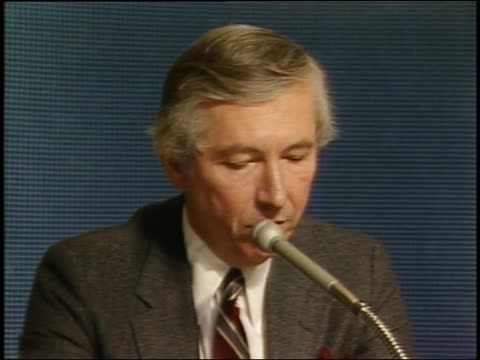
Description: School committee meeting. Chairman John McDonough, Elvira Pixie Palladino, Paul Tierney, David Finnegan, Kathleen Sullivan. McDonough accuses Superintendent Marion Fahey of political expediency. She responds. Committee member Elvira Pixie Palladino comments on the situation and states her position on anti-bussing.
Collection: Ten O'Clock News
Date Created: 02/02/1976
Description: Boston School Committee meeting proceedings. Chair John McDonough, David Finnegan, and Kathleen Sullivan criticize Superintendent Marion Fahey for negative remarks she made about the school committee in a newspaper interview. Paul Tierney supports Fahey, and Pixie Palladino comes down in the middle of the issue. Fahey defends her right to speak out on the Hyde Park High incident.
Collection: Ten O'Clock News
Date Created: 02/02/1976
Description: Boston school committee debates who should have power to hire and fire; endorses shift of personnel administration to superintendent. Joseph Casper, Abigail Browne, John Grady.
Collection: Ten O'Clock News
Date Created: 07/21/1987
Description: The Boston School Committee holds a meeting in its chambers. Grace Romero (Boston School Committee) accuses School Committee members of playing political games during the process of electing a new superintendent. John Grady (Boston School Committee) reads a statement from Joseph Casper (Boston School Committee). The statement reads that Casper will vote for one of the other candidates because Joseph McDonough (Interim Superintendent, Boston Public Schools) withdrew his name from consideration. Jean McGuire (Boston School Committee) voices her support for one of the candidates. John Nucci (President, Boston School Committee) talks about the search process. Edward Winter (Secretary, Boston School Committee) calls the roll. Dr. Laval Wilson wins the election, 9 to 4. Romero objects to a motion to make Wilson's election unanimous. School Committee members prepare to leave the room. Eileen Jones interviews Felix Arroyo (Latino community activist) about the vote. Arroyo says that he will support Wilson as superintendent. Jones interviews Jack E. Robinson (NAACP) about the vote. Robinson says that he is pleased that the three finalists were all minority candidates. Robinson says that Wilson was the right candidate for the job. Jones interviews Romero outside of the School Committee chambers. Romero says that she objected to making the vote unanimous because the record needs to reflect how each member voted. Jones interviews O'Bryant about the vote. O'Bryant says that he had never committed himself to a single candidate before the vote. O'Bryant says that Wilson is a strong candidate. He denies accusations that he switched his vote from another candidate. Jones does several takes of her reportage for the story.
0:59:53: Audio of Boston School Committee proceedings. Visual: The Boston School Committee meets in its chambers. A large crowd has gathered in the audience, including members of the media. Grace Romero (member, Boston School Committee) chastises members of the school committee for playing politics. Romero says that school committee members must conduct themselves better in the future. She briefly mentions relations between School Committee members and Hispanic voters. Joseph Casper (member, Boston School Committee) says that he cannot speak because he has lost his voice. Someone jokes that Casper "lost his voice two weeks too late." The audience applauds. John Grady (member, Boston School Committee) reads a statement from Casper. The statement reads that Joe McDonough (Interim Superintendent, Boston Public Schools) was his first choice to be superintendent; that McDonough has withdrawn his name from consideration. The statement reads that Casper will vote for another candidate this evening. The statement urges school committee members to salute the work of McDonough. Casper speaks softly to the other members after Grady reads the statement. 1:03:38: V: Jean McGuire (member, Boston School Committee) talks about the importance of the post of superintendent of schools. She voices her support for Dr. Peter Negroni (candidate for Superintendent of Boston Public Schools). John Nucci (President, Boston School Committee) talks about the value of the search process for the candidates. He urges the committee to select a new superintendent with a significant majority. Nucci says that each of the candidates is qualified for the job. Nucci calls on Edward Winter (Secretary, Boston School Committee) to call the roll. Winter calls the roll of members, and each member indicates his or her choice for superintendent. School Committee members Abigail Browne, William Marcione, Kevin McCluskey and McGuire vote for Negroni. School Committee members Daniel Burke, Casper, Grady, John O'Bryant, Thomas O'Reilly, Shirley Owen-Hicks, Romero, Rita Walsh-Tomasini and Nucci vote for Dr. Laval Wilson (candidate for Superintendent, Boston Public Schools). The audience applauds after the vote has been taken. Marcione moves to make the election of Wilson unanimous. Romero objects to the motion. She explains that she does not want the record to reflect that Negroni received no votes. Shots of Winter; of Romero. Grady makes a reference to the rules pertaining to the motion. 1:08:26: V: Owens Hicks gathers her papers and prepares to leave the chambers. Romero does the same. Members of the audience are rising to leave the chambers. Groups of people stand speaking to one another. McGuire and Nucci stand at the front of the room, preparing to leave the chambers. O'Bryant greets an audience member. Burke and Julio Henriquez (aide to Burke) confer in the chambers. Two white men confer at the front of the chambers. 1:09:00: V: Eileen Jones interviews Felix Arroyo (Latino community activist) about the school committee vote. Arroyo says that the vote gives Wilson a clear mandate; that the city of Boston must work with Wilson to improve the schools. Arroyo says that he was not surprised at Wilson's election to the post. Arroyo says that he would have liked to have seen Negroni win the post; that he will fully support Wilson now that he has been elected. Jones asks for Arroyo's reaction to Romero's remarks. Arroyo says that he did not understand what Romero was trying to say in her remarks; that many Hispanics do not believe that Romero is representative of their community. 1:10:39: V: Jones asks Jack E. Robinson (NAACP) about his reaction to the vote. Robinson says that he is pleased with the result of the vote; that the School Committee made the right choice and acted with maturity in electing Wilson. Robinson says that it is significant that three minority candidates were the finalists for the post. Robinson says that the committee members elected Wilson on the basis of his qualifications. Robinson says that he was not surprised with the results; that the committee members had decided to put politics aside and vote for the best candidate. 1:11:43: V: Jones interviews Romero about the vote. Jones asks Romero why she objected to a unanimous vote for Wilson. Romero says that Negroni was a qualified candidate with support; that she does not want the record to show that he did not get any votes. Romero says that the motion for a unanimous vote is part of "a game" played by some members of the school committee. Jones notes that a unanimous vote would show full support for the winning candidate. Romero says that the committee should have showed unanimous support in the beginning; that the record needs to show how each member voted. Jones asks Romero what she had been trying to say to the Hispanic community in her earlier remarks. Romero says that O'Bryant has not delivered on his promises to the Hispanic community. 1:12:54: V: Jones sets up an interview with O'Bryant. Jones asks O'Bryant if he switched his vote from Negroni to Wilson. O'Bryant says that he never made a commitment to any candidate; that many assumed that he would support Negroni because he supported him in 1981. O'Bryant says that he initiated the search committee process for the Boston School Committee in 1978. O'Bryant emphasizes that he never committed to any candidate. O'Bryant says that he decided to support Wilson after making site visits; that his support for Wilson never wavered. Jones notes that Romero's earlier comments were directed at him. Jones says that Romero accused O'Bryant of making a promise to the Hispanic community that he would vote for Negroni. O'Bryant says that Romero is lying. O'Bryant says that he did not promise anything to any community. Jones asks O'Bryant if he was suprised at the vote. O'Bryant says that he was not surprised because Wilson is a strong candidate. O'Bryant says that the vote might have gone the other way if he had supported Negroni. 1:15:08: V: Jones stands in the Boston School Committee chambers. Jones reports that members of the school committee hope that Wilson visit Boston by the end of the week to work out details of his contract and to meet the community. Jones does two takes to the closing of the news story. Jones records an alternate closing in which she reports on Romero's objection to a motion to make the vote unanimous. Jones does two takes of the alternate closing to the news story.
Collection: Ten O'Clock News
Date Created: 07/31/1985
Description: Marcus Jones reports that the Boston School Committee voted eight to five in favor of renewing the contract of superintendent Dr. Laval Wilson. Some members are opposed to renewing Wilson's contract and made an effort to postpone the vote on his contract renewal. Footage from a Boston School Committee meeting. Committee member Peggy Davis-Mullen proposes to postpone the vote on Wilson's contract. Committee member John O'Bryant says that he supports the renewal of Wilson's contract. Committee member Daniel Burke questions Wilson about the high drop-out rate in the Boston Public Schools. Wilson responds. Jones reports that Wilson has acknowledged the complaints of some critics by pledging to increase parental involvement in the schools and by pledging to improve the School Department's relations with unions.
1:00:09: Visual: Footage of Daniel Burke (Boston School Committee) at a meeting of the Boston School Committee. Burke remarks that a certain motion is out of order. Shots of the School Committee members seated at the meeting; of Dr. Laval Wilson (Superintendent, Boston Public Schools) seated at the meeting. Marcus Jones reports that some members of the School Committee are opposed to the renewal of Wilson's contract; that those members made an effort to take the matter of Wilson's contract off of the agenda. V: Footage of Peggy Davis-Mullen (Boston School Committee) at the meeting. Davis-Mullen says that the decision is being forced; that the decision should wait until January. Davis-Mullen says that she does not like the way in which the decision is being made. Shot of Jones in the audience of the meeting. Jones reports that Wilson's supporters on the School Committee were able to keep the debate open. V: Footage of John O'Bryant (Boston School Committee) saying that he is prepared to support the renegotiation of Wilson's contract. Footage of Wilson saying that he has a good understanding of the school system; that he has made progress in improving the school system. Footage of Burke asking Wilson about the student drop-out rate. Wilson responds to Burke. Wilson says that reading and math scores have gone up and the drop-out rate has declined. Shots of the audience at the meeting. Jones reports that Wilson admits that he has not done enough to involve parents in the educational process. Jones notes that Wilson says that he will try to increase parental involvement and to improve the school department's relations with unions. V: Footage of O'Bryant saying that Wilson has made a lot of progress in improving the system. Shots of the members as they vote on a motion. Jones reports that the School Committee voted eight to five in favor of renewing Wilson's contract; that the details of the contract remain to be discussed.
Collection: Ten O'Clock News
Date Created: 10/11/1988
Description: Superintendent Laval Wilson recommends Boston School Committee close underenrolled schools and relocate and consolidate others. Plan does not meet with approval, though it is intended to save $3.9 million in the education budget. Jean McGuire.
Collection: Ten O'Clock News
Date Created: 05/06/1986
Description: South Boston High exterior on first day of school. Press photographers stand around outside waiting for something to happen. Three upperclassmen say it is quieter inside since desegregation furor has died down, and learning can take place. They discuss news programs in the school. Several takes of reporter standup. Graffiti “stop forced busing” still visible on street. School bus arrives, lets off two black girls. Interview in front of School Committee headquarters with woman from Citywide Education Coalition who appraises current state of Boston schools: parents are involved and important to educational improvement; vocational education is woefully lacking; must upgrade reading and basic skills. “City can someday have an attractive and credible public school system.” She cautions that just because it is quiet now compared to the first years of busing, people should not assume the school system is okay; it still needs criticism and community input. Editor's note: Content given off the record was edited out of this footage.
Collection: Ten O'Clock News
Date Created: 09/06/1978
Description: Evening Compass special. In-studio operators take phone calls from parents with questions about school assignments and busing for the next school year. Ed Baumeister gives the answers to several true-or-false questions regarding the state plan to achieve racial balance in Boston schools. Judy Stoia gives statistics for the maximum travel distance of students and the racial makeup of schools in each elementary and intermediate school district. Paul deGive reports on a plan proposed by the Boston School Department to hire aids to help care for children and locate parents in case of sickness or family emergency. Baumeister and Pam Bullard (Boston Herald American) interview John Coakley (Boston School Department) and Dr. Charles Glenn (Massachusetts State Department of Education) about implementation of the racial balance plan. Both men respond to questions about the busing of kindergarten students. Judy Stoia explains the term geocode. Stoia and Bob Murray (Boston School Department) give on-air answers to some of the most common questions received by the operators. In studio Bullard, Baumeister and Dr. John Finger of Rhode Island College discuss plan developed to integrate schools. WGBH reporter and Bob Murray have question-and-answer session with questions from callers. Joan Buckley, representative from Boston Teachers Union, discusses plan for teachers with Bullard and Baumeister.
0:02:11: Visual: Introduction to A Compass Special: September in April, a special broadcast concerning the state racial balance plan for the Boston schools. Ed Baumeister is in the studio, along with several volunteers covering the phones. Baumeister introduces the program as informational, designed to answer parents' questions about the plan and its implementation. Baumeister gives out a number for parents to call to reach volunteers in the studio. Baumeister provides true/false answers to basic questions about the plan. Questions touch on the reimbursement of transportation costs, general travel distances for students of various ages and numbers of white and non-white students to be bused. 0:06:08: V: Paul deGive reports on parents who worry about being able to reach their child at a distant school in the case of sickness or emergency. He reports that the Boston School Department will propose a plan to hire transitional aids at each school to contact parents and to care for children in an emergency. 0:09:15: V: Baumeister encourages parents to call studio for information. Volunteers answer the phones. 0:09:55: Report on the Boston elementary school districts under the racial balance plan. Narrator describes the standardization of grade structure in elementary schools and the changes to various elementary school districts. The districts are as follows: Hennigan Kennedy, Bacon Dearborn, Tobin Farragut, Washington Park, Sumner-Conley, Tileston Chittick Greenwood, Lee, Murphy, Marshall Dever Mason, Mendell-Parkman, Paine-Audobon, Milmore, Prince, Faneuil, Lincoln Quincy, Hurley-Bates, Carter, Eliot, South Boston, Hyde Park, Cannon, Ohrenburger, Parker Longfellow. V: Shot of a map of Boston's elementary school districts. Narrator gives information for each district, including district boundaries, names of schools within the district, maximum travel distance for any student in the district and projected non-white enrollment for each school in the district. A map of each district is shown as the narrator reads the information for that district. 0:20:11: V: Judy Stoia encourages parents to call the studio for information concerning their child's school assignment. Shots of telephone volunteers. Stoia mentions that the volunteers are from the Citywide Education Coalition, the Teachers Union and the Boston School Department. Stoia talks to volunteer Lee Grant and explains the term "geocode." Stoia talks to volunteer Scott Campbell about what kind of information he can give to parents over the phone. 0:23:30: V: Baumeister introduces Pam Bullard (Boston Herald American) and John Coakley (Education Planning Center of the Boston School Department). Baumeister refers to Coakley as the man charged with making the racial balance plan work. Coakley refutes the claim that he is in charge of the plan, but discusses preparation for implementation of the plan. Baumeister asks Coakley if the School Department has any flexibility in implementing the plan. Bullard asks Coakley to respond to parental complaints about kindergarten assignments. Bullard presses kindergarten issue, asking if kindergarten children will be bused to the Martha Baker School or to kindergarten centers. Coakley summarizes School Department efforts to minimize busing of kindergarten students and cites the inadequacies of state plan concerning kindergarten students. Baumeister asks Coakley how he would change plan if he could. Coakley cites preliminary plans for integration by the Boston School Department and the Boston School Committee. Coakley says these plans were never developed. Baumeister thanks Coakley. 0:33:27: V: Baumeister provides answers to more true/false questions about the racial balance plan. Questions touch on the following issues: state reimbursement for travel under the desegregation plan, reimbursement of MBTA travel under the plan, major thoroughfares as school district boundaries, classification of Spanish-speaking students, overcrowding of Boston schools. 0:35:14: Report on intermediate school districts under the racial balance plan. Narrator talks about the redistricting of intermediate schools under the plan. Narrator gives the following information for each district: district boundaries, maximum travel distance for any student in the district and percentage of non-white students within each intermediate district school. Narrator reads the information for each district over a map of that district and a shot of the district school. The districts follow: Cleveland, Curley, Dearborn, Edison, Gavin, Holmes, Irving, King, Lewenberg, Lewis, Mackey, McCormack, Michelangelo, Roosevelt, Shaw, Taft, Thompson, Timilty, Wilson. V: Shot of a map of Boston's intermediate school districts. 0:44:41: V: An in-studio reporter asks a volunteer named Fran to describe the phone calls she has received. The reporter addresses a specific situation concerning the placement of 6th grade students in Hyde Park. 0:46:31: V: Baumeister and Bullard interview Dr. Charles Glenn (Office of Equal Education Opportunity of the State Department of Education). Baumeister asks Glenn how the plan determines which children will be bused at the high school level. Bullard asks Glenn about the busing of kindergarten students under the state plan. Glenn explains the intricacies of the plan and its implementation. Baumeister asks Glenn why the state plan to desegregate schools is better than any put forth by the Boston School Committee. Glenn explains that the state desegregation plan goes as far as it can under state law. Bullard questions Glenn about hurried implementation of the racial balance plan, and if the communities involved will be adequately prepared. Glenn responds that the plan has been implemented as well as can be expected in the time given. 0:55:15: V: Baumeister provides answers to more true/false questions. Questions touch on the following issues: definition of non-white students, school assignments and school assignment changes, Massachusetts state racial imbalance regulations, teacher assignments. 0:56:49: V: Stoia and Bob Murray (Education Planning Center of the Boston School Department) answer the most difficult questions received by phone volunteers. Questions involve travel distance within a school district, whether Dr. Glenn lives in Boston, the assignment of students in sub-system schools (Trotter school, Lewis school and Copley High School), and the assignment of seniors in the high schools.
Collection: Evening Compass, The
Date Created: 04/22/1974
Description: Evening Compass special features updates and information on the court-ordered busing for integration of Boston schools. Opens with footage of Racial Harmony Now Committee in WGBH studio. Ed Baumeister introduces news topics and gives a brief history of civil rights in Boston and segregation facts. Racial Harmony Now Committee holds an in-studio meeting to discuss community involvement in busing, school integration and education. Roy Covell (Boston Police Department) reports on police efforts to ensure the safety of students. John Kerrigan discusses his opposition to busing in Boston. John Kerrigan (Chairman, Boston School Committee) and Kathleen Sullivan (Boston School Committee) discuss the court order by Judge Garrity and the implementation of the state plan to integrate Boston schools in September. Greg Pilkington reports on the on-going hearings to determine a long-term remedy for integrating Boston schools. Eric Van Loon (lawyer for the plaintiffs, Morgan v. Hennigan) comments on the court ruling and the on-going hearings. Judy Stoia reports on MBTA proposals to cover busing needs. Members of the Citywide Education Coalition are in the studio to answer calls from parents and give information on neighborhood groups working with schools on the transition to the state racial balance plan.
0:45:53: Visual: Introduction to Compass Weekly: September in July, a special broadcast on the court-ordered plan to achieve racial balance in Boston schools. Parents and concerned citizens are in the studio to talk about how parents can get involved in the schools. Ed Baumeister explains that the show will give an update on the court order, report on reaction to the order and provide information on neighborhood groups working with schools on the transition to the court-ordered plan. Volunteers from the Citywide Education Coalition are in the studio to answer phone calls from parents, and to give them information on groups in their neighborhoods. 0:48:33: Baumeister gives a brief history of civil rights in Boston. Baumeister says that Boston was a center in the movements for racial justice and public education in the nineteenth century; that Boston had a reputation as a "liberal" city with a good civil rights record in the twentieth century. V: Shots of Post Office Square; of the old Public Latin School; of a local park; of mixed race schoolchildren. Baumeister says that African Americans have played a significant role in the history of Boston and the nation; that Boston was found to have been segregating its schools in the 1960s. Baumeister reports that African Americans live in the city of Boston while the suburbs of Boston are primarily white. Baumeister notes that a federal court declared in 1974 that the city's schools were deliberately segregated. Baumeister notes that the Boston School Committee has been fighting the state's Racial Imbalance Act since 1965; that the decision by Judge Garrity was delivered 15 months after the start of the Morgan v. Hennigan trial. V: Shots of gravestones in historic cemetery; of a plaque commemorating Boston Massacre; of the Robert Gould Shaw memorial). Panoramic shots of the Boston skyline. 0:53:41: V: Judy Stoia sits in the studio with the Education Committee from Racial Harmony Now, a Dorchester group working to ease the transition into the racial balance plan. She is quiet while they hold a meeting: one member mentions the efforts of Chuck Williams (teacher at South Boston High School) to further communication between students at South Boston High School and Girls' High School; another member talks about expanding efforts to go door-to-door in Dorchester to talk about the advantages of school integration; another member talks about the need to focus on education instead of race; the group's Youth Committee has made efforts to bring African American and white students together; the second member suggests that the group sponsor a gathering of parents at the YMCA; another member makes additional suggestions to ease the transition for students who will be bused to new schools. 0:59:54: V: Stoia talks to Roy Covell (Boston Police Department) about the police department's efforts to work with community groups and to create a community task force. He says that the police department's top priority is the safe transport of students to and from the schools. A member of the Racial Harmony Now group asks Covell about traffic patterns around the schools and crosswalks for schoolchildren. 1:04:09: V: Ed Baumeister interviews Kathleen Sullivan (Boston School Committee) and John Kerrigan (Chairman, Boston School Committee). Baumeister asks Kerrigan about the Committee's efforts to appeal the federal court decision. Kerrigan talks about his visit to Senators Kennedy and Brooke in Washington D.C.; he says that the decision places an "unfair burden" on the city of Boston. Sullivan advocates a metropolitan plan to integrate schools in the city and the suburbs. Bullard asks about an alternative busing plan presented by the School Committee to the court. Sullivan and Kerrigan defend the School Committee's record on school integration. Bullard asks them about the Lee School District and feeder patterns to Boston High Schools. Kerrigan talks about the problems of "white flight" and crime at English High School. Baumeister asks if School Committee will assume a leadership role in the coming school year; Kerrigan responds that the School Committee will assume leadership on safety issues but that he will not encourage parents to allow their children to be bused under the state plan. 1:22:30: V: Members of Racial Harmony Now discuss negative media coverage of the school integration issue. One member suggests organizing gatherings of white and black families whose children will be attending school together. Another member suggests that the gatherings focus on how to improve the schools. Several members mention interracial gatherings between Roxbury and South Boston parents at Freedom House. 1:27:34: V: Baumeister encourages parents to call the studio to find out about neighborhood groups working with schools on the transition to the racial balance plan. Shots of phone operators and the members of Racial Harmony Now in the studio. 1:28:50: V: Greg Pilkington reports on latest hearings held by Judge Garrity in Federal Court to determine a long-term integration remedy for the Boston schools: Garrity admitted the Boston Teachers' Union and the Administrators' Union as parties to the suit with limited participation; the Home and School Association was refused as a party to the suit, but might appear later as a friend of the court; Judge Garrity refused the Boston School Committee's attempts to have the City of Boston named as co-defendant in the case. 1:31:38: V: Baumeister encourages parents to call the studio. Baumeister talks to Eric Van Loon (attorney for plaintiffs, Morgan v. Hennigan). Van Loon says that a metropolitan busing plan is impossible until the Supreme Court decides the Detroit school desegregation case (Milliken v. Bradley). Baumeister asks if the plaintiffs would support a metropolitan integration plan in Boston. Pilkington asks Van Loon about the court hearings for a long-term integration remedy: Van Loon advocates the recruiting of African American teachers and administrators; Van Loon says the plaintiffs would support modification of the state plan, or a new plan, if the result were a greater number of integrated schools in Boston. 1:40:26: V: Stoia reports on new bus routes for Boston schoolchildren under the state Racial Balance plan: school opening times will be staggered so that the MBTA can use buses on more than one route; MBTA general manager Joseph Kelly says that there is little time to arrange for busing by private contractors; the state pays transportation costs for students bused over 1.5 miles; the city pays for students bused under 1.5 miles; exact bus routes are not yet available. 1:42:09: V: Baumeister sits in the studio with Racial Harmony Now. He encourages parents to contact the Citywide Education Coalition. Baumeister signs off and the credits roll.
Collection: Evening Compass, The
Date Created: 07/09/1974
Description: Gail Harris and Meg Vaillancourt host a Ten O'Clock News broadcast. Harris reads the headlines. Eileen Jones reports that Laval Wilson (Superintendent, Boston Public Schools) has announced to the Boston School Committee that $1.2 million must be cut from the school budget. Jones notes that school administrators and staff will be affected by the cuts. Jones adds that the Boston School Committee has voted in favor of appointing a school official to oversee negotiations with the school bus drivers' union, with the goal of signing a contract before the beginning of school. Jones' report includes footage of Jim Barrett (President, Bus Drivers Union) and footage of Wilson and school committee members at a school committee meeting. Harris reports that Grace Romero (Boston School Committee) has been indicted for violating state election laws. The report includes footage of Romero speaking to the media. Vaillancourt reports on opposition by the Boston Police Detectives Union to a decision by Francis "Mickey" Roache (Commissioner, Boston Police Department) to reassign thirty detectives to street patrol duty. Vaillancourt's report includes footage from interviews with Michael Muse (attorney, Boston Police Detectives Union) and Dan Mahoney (President, Boston Police Detectives Union). James Robbins reports that the Reverend Allan Boesak (South African anti-apartheid leader) was detained by South African security forces after giving a speech at Capetown University. Robbins notes that Boesak had planned to lead a march on Pollsmoor Prison the next day. Vaillancourt reports that the US State Department has lodged a protest concerning the arrest of Boesak. Vaillancourt's report is accompanied by footage of Charles Redman (Spokesman for the US State Department) at a press conference. Tug Yourgrau interviews Janet Levine (South African journalist) about Nelson Mandela (jailed ANC leader). Levine talks about Mandela's arrest, his leadership, his opposition to apartheid and his wife, Winnie Mandela. The interview is accompanied by still photographs and footage of Nelson and Winnie Mandela. Vaillancourt reports on an army coup in Nigeria. Her report is accompanied by footage of Muhammadu Buhari (leader of Nigeria) delivering a speech. Harris reports that British Airways has grounded several jets due to possible engine problems. Her report is accompanied by footage of an exploded jet on a runway in Manchester, England. Vaillancourt reports that the Pentagon has canceled the production of an airgun designed to hit Soviet helicopters because it did not work properly. Her report is accompanied by shots of military weaponry and footage of Casper Weinberger (US Secretary of Defense) at a press conference. Harris reports on a decline in the US poverty rate and on a fine imposed on Crocker National Bank in San Francisco for a failure to report currency transactions. Vaillancourt reports on the racketeering trial of Gennaro Angiulo (alleged Mafia boss). The report is accompanied by court drawings of the trial. Harris reports on the ground-breaking ceremony for Roxbury Community College. The report includes footage of Bruce Bolling (Boston City Council) speaking at the ceremony. Harris interviews in-studio guest Brunetta Wolfman (President, Roxbury Community College) about the college. Wolfman talks about the new campus and the need to provide education and training to urban populations. Wolfman talks about a divide between the educated and uneducated populations in Massachusetts
1:00:06: Meg Vaillancourt introduces The Ten O'Clock News. 1:02:11: WGBH promotion for the evening newscast. The logos of The Ten O'Clock News underwriters Shawmut Bank, New England Telephone, and The Nimrod Press are displayed. Gail Harris introduces the show. Harris talks about an upcoming story about the groundbreaking for Roxbury Community College. 1:03:20: Meg Vaillancourt reads the headlines. Vaillancourt reports that the Reverend Allan Boesak (black South African leader) has been placed under house arrest by the South African government. Vaillancourt reports that Casper Weinberger (US Secretary of Defense) has canceled a new air defense gun because the weapon is not worth the cost of development. 1:03:38: Harris reads the headlines. Harris reports that the US poverty rate declined last year for the first time in ten years; that the auto insurance industry in Massachusetts wants to increase rates next year by at least 12%. Harris reports that the Boston School Committee has been forced to cut its budget by $1 million; that the Committee has cut two dozen administrative jobs; that the Committee has not cut any teaching jobs. Harris introduces a report by Eileen Jones. 1:04:06: Eileen Jones reports that tenured teachers and programs were spared by the Boston School Committee; that administrators and staff were subject to budget cuts by the committee. Visual: Shot of a white female teacher in a classroom with elementary school students. Jones reports that Dr. Laval Wilson (Superintendent, Boston Public Schools) announced that $1.2 million must be cut from the school budget; that that school administrators and staff will be hit hard by the cuts. V: Shots of Wilson, and School Committee members Kevin McCluskey and John Nucci at a Boston School Committee meeting; of a cameraman at the meeting; of the members of the School Committee at the front of the School Committee chambers. Jones reports that the jobs of thirteen administrators and seven members of the technical support staff will be eliminated. Jones reports that administration will be cut by 20% on the School Site Management Project; that the jobs of two members of the support staff for the School Site Management Project will be cut; that consultants will be eliminated from the School Site Management Project. V: On-screen text details the specific budget cuts. Jones reports that the mayor and the Boston City Council have forced the school budget cuts; that the Boston School Department will receive $5 to $7 million dollars less than they asked for in their initial budget. V: Shots of audience members at a School Committee meeting; of an audience member taking notes; of a stenographer's hands as she transcribes the meeting; of School Committee members Jean McGuire and John O'Bryant at the meeting; of Wilson at the meeting; of the members of the media at the meeting. Jones reports that Wilson and Ray Flynn (Mayor of Boston) made an agreement; that Wilson has agreed to eliminate $1.2 million from the budget; that Flynn has agreed to ask for $2.5 million in additional money for the schools. V: Shots of Shirley Owens Hicks (Boston School Committee); of Joseph Casper (Boston School Committee). Footage of John Grady (Boston School Committee) speaking at the meeting. Grady says that Flynn may not fight hard for additional money for the schools; that the City Council may not grant additional money. Grady says that Flynn should not determine the school budget. Footage of Wilson speaking at the meeting. Wilson says that he and Flynn made an agreement; that they will both do their best to stand by the agreement. Jones reports that the School Committee must also sign a contract with their bus drivers; that the contract needs to be signed before school begins in eight days. V: Shots of yellow school buses lined up on a street. Footage of Jim Barrett (President, Bus Drivers Union) speaking at a meeting. Barrett says that Wilson needs to appoint an overseer to negotiations with the bus company. Footage of Casper speaking at a meeting. Casper says that someone needs to take the lead on this issue. Casper says that Wilson should appoint a top official in the School Department to oversee contract negotiations with National Bus Service, Transcom, the Bus Drivers Union, and the Boston School Department. Casper says that an agreement must be reached before school starts. Jones reports that the School Committee voted in favor of cutting $1.2 million from the budget; that the Committee voted in favor of appointing a school official to oversee negotiations with the bus drivers. V: Shot of School Committee members at a meeting. Jones stands in front of the Boston School Committee headquarters. Jones reports that some administrators and staff may be bumped down to teaching positions instead of losing their jobs; that previsionary teachers will lose their jobs instead. Jones reports that the bus drivers are pleased to have a school official involved in negotiations; that the bus drivers want the school official to be able to give immediate approval of an agreement. 1:07:19: Harris reports that Grace Romero (Boston School Committee) has been indicted on four counts of violating state election laws; that Romero has been accused of perjury and filing false nomination papers; that Romero will appear in Suffolk Superior Court on Thursday. V: Footage of Romero speaking to the media. Romero says that she did not ask for a birth certificate or drivers license when asking voters to sign her nomination papers; that her volunteers only ask people if they are registered voters. She says that she filed the papers properly. Harris says that Romero could be sentenced to a year in prison or a $1,000 fine if found guilty of filing false nomination papers; that Romero could be sentenced to up to twenty years in prison and a $1,000 fine if found guilty of perjury. Harris notes that Romero's name will remain on the ballot in September. 1:08:18: Vaillancourt reports that Francis "Mickey" Roache (Commissioner, Boston Police Department) has recently decided to reassign city detectives to neighborhood patrol work; that members of the Boston Police Detectives Union have called the decision unfair and illegal. V: Shots of members of the Boston Police Detectives Union outside of their headquarters. Vaillancourt reports that the members of the union oppose the reassignment of thirty detectives. V: Footage of Michael Muse (attorney, Boston Police Detectives Union) being interviewed outside of the union headquarters. Muse says that the union will ask the State Labor Relations Commission to rule on the issue. Muse says that the city has violated the state's collective bargaining law by refusing to meet and confer with the union before transferring the detectives. Vaillancourt reports that 30 plainclothes investigators have been assigned to uniformed patrol duty. V: Shots of detective union members entering their headquarters; of a uniformed police officer walking down a street. Footage of Dan Mahoney (President, Boston Police Detectives Union) being interviewed. Mahoney says that the union was not consulted before the detectives were transferred. Vaillancourt reports that the union believes that the transfer is an unfair labor practice. V: Shot of union members outside of union headquarters. Footage of Mahoney saying that morale has never been worse. Vaillancourt reports that Roache transferred the detectives in order to increase police visibility and to decrease crime. V: Shot of Roache standing at a podium. Vaillancourt reports that the union believes that the transfers will have the opposite effect. V: Footage of Muse being interviewed. Muse says that visibility does not reduce crime; that successful investigations deter crime. Muse says that patrolling officers cannot deter crime. Shots of union members outside of union headquarters. Vaillancourt reports that Roache says that he is willing to discuss the issue. Vaillancourt reports that the State Labor Relations Board is expected to rule on the case within a few days. 1:10:23: Winning lottery numbers for Massachusetts, New Hampshire, and Rhode Island are displayed. 1:10:39: Harris reports that the South African government announced that it will suspend trade in krugerrands for a month; that the South African government is trying to stop the flight of capital from the country. Harris notes that the value of one krugerrand has decreased to thirty-five cents; that one krugerrand was valued at one dollar a three years ago. Harris reports that a march to Pollsmoor Prison is planned for tomorrow by apartheid opponents in South Africa. Harris notes that Nelson Mandela (black South African leader) has been held at the prison for over twenty years. Harris notes that Reverend Allan Boesak (black South African leader) will not lead the march as planned. Harris reports that Boesak was detained by South African Security Forces after giving a speech today. 1:11:30: James Robbins reports that Boesak was arrested after giving a speech to students at the University of Capetown. V: Shots of students outside of a building at the University of Capetown; of a sign advertising a mass meeting with Boesak as speaker. Shot of a banner reading, "Stop the call-up." Shot of Boesak walking on a campus. Robbins reports that Boesak is involved in an effort to mobilize 20,000 people; that Boesak had planned to lead the people in a march on Pollsmoor prison tomorrow. Robbins notes that the march is a plea for the release of Mandela. V: Footage of Boesak addressing an audience. Boesak talks about his vision for the future. Shot of Boesak leaving a mass meeting. Robbins reports that Boesak's car was stopped at a roadblock after leaving the university. Robbins notes that Boesak had time to tell a companion that he had been arrested under Section 29 of the Internal Security Act. V: Shots of Boesak walking with members of the media. Shot of Boesak speaking to another man as he walks. Robbins notes that the act allows for indefinite detention without trial; that Boesak's wife does not know where he is being held. V: Shot of Dorothy Boesak (wife of Allan Boesak). Robbins reports that South African police raided another university where Boesak was due to speak; that twenty-one students were arrested. Robbins notes that these arrests are an attempt to thwart the march on Pollsmoor Prison. V: Shots of a group of black South Africans watching police activity in the distance; of a broken door at a university; of a student attempting to repair a broken door. Robbins reports that P.W. Botha (South African President) has warned that his government has greater powers in reserve. V: Shot of a military vehicle. Shot of Botha exiting a vehicle. Footage of Botha at a press conference. Botha says that the South African government has not yet used all of the forces at its disposal to fight opponents. Botha says that he will take further steps if necessary. Robbins notes that the marchers had planned to assemble at the Athlone Stadium; that the government has closed all access routes to the stadium. V: Shots of armed South African Security Force members; of the exterior of the Athlone Stadium. 1:13:10: Vaillancourt reports that Ronald Reagan called the South African government "reformist" earlier this week. Vaillancourt notes that Reagan says that the South African government has eliminated segregation in hotels and restaurants. Vaillancourt reports that the US State Department has lodged a protest concerning the arrest of Boesak. V: Footage of Charles Redman (Spokesman, US State Department) speaking at a press conference. Redman says that the US State Department has formally protested the arrest of Boesak; that the detention of Boesak and others will exacerbate the current situation in South Africa. 1:13:40: Harris reports that Mandela is the head of the African National Congress (ANC); that the ANC is the largest black national organization. Harris notes that Mandela has been in jail since 1964; that Mandela is still present in the minds of black and white South Africans. 1:14:04: Janet Levine (South African journalist and opposition politician) is interviewed by Tug Yourgrau. Levine says that Mandela was jailed in 1964 for being the leader of the ANC; that Mandela has been waiting in prison for the unrest which is enveloping South Africa at the present. Yourgrau asks Levine about Mandela's past. V: Shots of a black and white photo of Mandela as a young man; of a young Nelson Mandela speaking into a microphone. Levine says that Mandela was a practicing lawyer in Johannesburg; that Mandela was a lieutenant of Chief Albert Luthuli (Nobel Peace Prize winner). Levine says that Mandela is an articulate, charismatic man. Levine says that Mandela was arrested in a white suburb of Johannesburg called Rivonia; that Mandela was put on trial for treason. V: Black and white footage from the South African Embassy. The footage shows South Africans gathered outside of a government building. Levine says that Mandela conducted his own defense; that he gave a stirring speech. Levine says that Mandela's speech marks the point when the ANC turned from nonviolence to violence. Levine says that Mandela said in the speech that passive resistance and nonviolent struggle was no longer an option. V: Shot of a newspaper articles with a photo of Mandela. The headline reads, "Mandela's Defence." Black and white footage from South African Essay. Shots of a crowd gathered in South Africa. Shots of members of the South African Security Forces. Shot of an African-American man standing at the front of a crowd. The man makes gestures with his hands. Yourgrau asks how Mandela is seen by different groups in South Africa. Levine says that Mandela represents "black terror" to the Afrikaaners. Levine says that black South Africans across the political spectrum see Mandela as their greatest leader. V: Shot of a black and white photo of black South Africans demonstrating for Mandela's release. Yourgrau remarks that Mandela recently said that he would prefer communism to apartheid; that Mandela recently said that he will not renounce violence as a means to fight against apartheid. Yourgrau says that these comments could undermine Mandela's support in the US. Levine says that apartheid is linked with capitalism in the minds of many black South Africans. Levine says that it is absurd for the South African government to make nonviolence a condition of Mandela's release. Levine says that the South African government has created the violent atmosphere within the country. Yourgrau asks about Winnie Mandela (wife of Nelson Mandela) and the "Mandela legend." Levine says that the "Mandela legend" is strong in South Africa. Levine says that Winnie Mandela is strikingly beautiful; that she is committed to Nelson Mandela and to the ANC. Levine says that there is a mystique surrounding the Mandela family. V: Shot of a black and white photo of Nelson and Winnie Mandela on their wedding day. Black and white footage of Winnie Mandela speaking. Color footage of Winnie Mandela giving an interview. Levine says that Zinzi Mandela (daughter of Nelson and Winnie Mandela) is a leader of the anti-apartheid movement; that people stop Zinzi Mandela on the street to talk to her about her father. Yourgrau comments that Winnie Mandela has said that it may be too late to negotiate the release of Nelson Mandela. Levine says that the tide has turned in favor of black South Africans; that the government must now negotiate with Nelson Mandela about the future of the country. 1:17:58: Vaillancourt reads the international headlines. Vaillancourt reports that there was an army coup in Nigeria today; that the government of Muhammadu Buhari (leader of Nigeria) was overthrown by army officers. Vaillancourt notes that Buhari was accused of abusing power and failing to revive the economy. V: Shots of soldiers on a street in Nigeria; of Buhari making a speech. Shots of Nigerians at a street market. Vaillancourt reports that Nigeria has now had six coups since declaring independence from Great Britain in 1960. Vaillancourt notes that the US State Department says that there is no indication of danger to Americans in Nigeria. 1:18:22: Stock report: the Dow Jones is listed at 1322.47 and the volume is listed at 82,140,000. 1:19:49: Harris reports that British aviation officials have ordered the grounding of several jets due to possible engine problems; that the jets have engines similar to the one which blew up in Manchester, England, last week. Harris notes that the explosion killed 54 people. Harris reports that British Airways found extensive cracking in the precautionary checks of the engines of the grounded jets. V: Shots of firefighters surrounding the remains of an exploded jet on a runway in Manchester, England. Harris reports that planes owned by four other airlines are being investigated; that some have been ordered to fly back to Great Britain with no passengers on board. V: Shot of a jet airliner in the sky. Harris reports that the Jose Napoleon Duarte (El Salvadoran president) says that arrests have been made for the murders of four marines and two American businessmen in June; that three guerillas have been arrested and a fourth is dead. Harris notes that the six Americans were killed in a cafe massacre in San Salvador; that a rebel group claimed responsibility for the attack. 1:20:34: Vaillancourt reports that the Pentagon canceled an air gun designed to hit Soviet helicopters because the weapon did not work properly. Vaillancourt reports that the weapon is called "The Sergeant York System;" that the weapon has been in production since 1981; that the weapon has cost the army $1.8 billion dollars. Vaillancourt reports that the targeting mechanism is inaccurate; that the gun mistakenly aimed at the exhaust fan of a latrine during a test. V: Shots of military weapons. Shot of a targeting system on a military weapon. Shot of a helicopter caught in the crosshairs of a weapon. Vaillancourt reports that the army had hoped to acquire 618 Sergeant York guns at a cost of $3 billion. V: Footage of Casper Weinberger (US Secretary of Defense) at a press conference. Weinberger says that the army needs air defense capability; that the army had invested time and money in the weapon. Weinberger says that the weapon will not perform as needed; that he has canceled the weapon. 1:21:41: Harris reports that the US poverty rate declined last year for the first time in ten years. Harris says that Ronald Reagan (US President) credits a low inflation rate and an economic recovery for the decline. Harris notes that the US Conference of Mayors says that the poverty rate remains high. Harris reports that the Crocker National Bank of San Francisco has agreed to pay a $2.25 million fine for a failure to report currency transactions. Harris notes that the Bank of Boston paid $500,000 for the same transgression earlier this year. Harris reports that the violations were uncovered during a routine audit of Crocker National Bank; that the bank did not intentionally launder money. Harris notes that $4 billion in unreported funds may have come from drug transactions. 1:22:38: Vaillancourt reports that Gennaro Angiulo (alleged Mafia boss) and his three brothers are on trial for racketeering; that government attorneys asked permission to present testimony from an FBI expert on the Mafia. Vaillancourt reports that defense attorneys objected to the testimony. Vaillancourt notes that defense attorneys say that there can be no expert on an organization which does not exist. Vaillancourt reports that David Nelson (federal judge) allowed the testimony; that Nelson will not allow the jury to hear testimony until the expert is questioned by attorneys in order to test his knowledge. Vaillancourt reports that today's trial session was cut short; that one juror complained of family problems. Vaillancourt notes that another juror was dismissed and replaced by an alternate. V: Shots of court room drawings of the Angiulo trial by Betty Wiberg (artist). 1:23:31: Vaillancourt reports on the weather. 1:24:41: Harris reports that there was a large crowd at the groundbreaking for Roxbury Community College today. Harris reports that Roxbury Community College was established in 1973; that money for the construction of a campus has been elusive. V: Shots of people gathered for the groundbreaking ceremony at Roxbury Community College. Shots of architectural drawings of the new campus. Harris reports that the Southwest Corridor of Roxbury will house a four-building college; that the construction of the campus will cost $40 million; that the project is expected to be completed by the fall of 1987. Harris reports that 1500 students are expected to enroll. V: Footage of the groundbreaking ceremony. Shots of Michael Dukakis (Governor of Massachusetts) and Ray Flynn (Mayor of Boston) seated next to one another in the audience. Shot of Mel King (community leader) in the audience. Footage of Bruce Bolling (Boston City Council) addressing the audience at the ceremony. Bolling says that Roxbury Community College now has a permanent home. Bolling says that a home for the school was needed; that the students at the college will need homes in Roxbury. Bolling says that Roxbury Community College will no longer be a "dream deferred." Shots of the audience; of Shirley Owens Hicks (State Representative) in the audience. Bolling says that he wants to make sure that Roxbury residents can afford to continue living in Roxbury. A banner with the seal of Roxbury Community College hangs from the podium where Bolling speaks. 1:26:12: Harris introduces Brunetta Wolfman (President, Roxbury Community College) as the in-studio guest. Harris notes that Wolfman was appointed in 1983; that the college is presently located on Huntington Avenue. Harris asks Wolfman if the new campus is the deliverance on a promise made fifteen years ago. Harris asks if the new campus is really needed. Wolfman says that people began pushing for a campus for Roxbury Community College twenty years ago. Wolfman notes that funds for a campus were approved by the State legislature in 1980. Wolfman says that there were groundbreakings with no commitment of funds in the 1970s. Wolfman says that the funds have been allocated and the contractor selected for this site. Wolfman says that construction is ready to begin. Wolfman says that the idea of open admission in higher education is a new one in Massachusetts; that there are a lot of private colleges in Massachusetts. Wolfman says that open-admission community colleges have a longer history in California and New York City. Harris asks why it took so long for Roxbury Community College to find a permanent home. Harris asks if politics or racism played a role. Wolfman says that both politics and racism played into the issue. Wolfman says that there is a lack of recognition of the need to provide higher education to the urban population. Wolfman says that there are a lot of poor people in Boston; that poor people need education and training in order to enter the mainstream workforce. Wolfman says that one out of every four adults in Boston is illiterate. Wolfman says that the needs of these people need to be addressed through illiteracy programs, GED programs and college-level programs. Wolfman says that Bostonians like to think of themselves as highly educated. Wolfman says that the population is split between highly educated people and uneducated people. Wolfman says that this split is economically and socially dangerous. Harris notes that some community colleges are having a hard time attracting students; that Bunker Hill Community College is running television advertisements. Wolfman says that Roxbury Community College has not had trouble filling seats at its Huntington Avenue location; that the college is stable and easily accessible. Wolfman says that poor people are reluctant to take out student loans. Wolfman notes that funding for higher education has moved from grants to loans. Wolfman says that the debt incurred by students is a problem for many. Harris closes the interview. 1:30:53: Report on baseball scores. The Red Sox beat Cleveland, 6 - 2. 1:31:10: Vaillancourt and Harris close the newscast. End credits roll. The logos of The Ten O'Clock News</i . underwriters Shawmut Bank, New England Telephone, and The Nimrod Press are displayed.
Collection: Ten O'Clock News
Date Created: 08/27/1985