Description: David Boeri reports on a demonstration by members of ACORN (Association of Community Organizations for Reform Now), outside of the offices of Mayor Ray Flynn. Demonstrators advocate for more affordable housing in Roxbury, Dorchester, and Mattapan. Footage of Peggy Jackson (ACORN demonstrator) and Neil Sullivan (Director of housing policy for the Flynn administration) debating the administration's affordable housing policy. Boeri notes that the demonstrators demanded the deed to a vacant lot in order to develop affordable housing themselves.
1:00:03: Visual: Shot of a multi-colored, hand-drawn sign reading, "Welcome to the mayor's office." A group of demonstrators stand outside of the mayor's office chanting, "Mayor Flynn, come on out." One of the demonstrators holds a sign reading, "ACORN: Housing Now." The demonstrators are affiliated with ACORN (Association of Community Organizations for Reform Now). V: Shot of an office telephone; of the demonstrators. Shot of a sign reading, "Shelter is our need. Give us the deed." David Boeri reports that Ray Flynn (Mayor of Boston) refused to meet with the demonstrators; that the demonstrators are fighting for affordable housing in Roxbury, Dorchester and Mattapan. V: Footage of Peggy Jackson (ACORN demonstrator) saying that her organization can build affordable housing if they are given one lot to build on. Boeri reports that the demonstrators say that the housing that the city calls "affordable" is not affordable for Roxbury residents; that the median income in Roxbury is $13,000. V: Footage of Jackson talking to Neil Sullivan (Director of housing policy for Flynn). Jackson says that fewer than 500 units of the city's affordable housing are affordable for Roxbury residents. Sullivan says that fewer than 500 housing units were built by the White administration between 1981 and 1983. Boeri reports that Sullivan blames the housing crisis on Kevin White (former Mayor of Boston) and a lack of federal money. Boeri reports that the Flynn adminstration is bundling low-income units with high-income units; that the Flynn administration is using the high-income units to subsidize the low-income units. V: Shots of Jackson; of the demonstrators. Footage of Sullivan saying that the Flynn administration has built over 500 low-income and moderate-income units in the first 6 months of 1986. The demonstrators respond that they cannot afford these units. Boeri reports that the demonstrators will have to incorporate themselves as non-profit developers before they can bid on a vacant lot. V: Footage of Sullivan telling the demonstrators that other groups have incorporated themselves and are bidding on land. Jackson tells Sullivan that the demonstrators do not have time to incorporate themselves; that another 3,000 people will be homeless before they are able to complete the legal paperwork. Shot of Sullivan. Boeri reports that the ACORN demonstrators ended up walking out; that the demonstrators say that they will take over the land next week. V: Footage of the demonstrators leaving the mayor's office.
Collection: Ten O'Clock News
Date Created: 08/14/1986
Description: Cardinal Bernard Law announces capital campaign for Archdiocese of Boston to fund education and social services. People taking communion. File of food pantry, parochial classroom, nun nurse in hospital.
Collection: Ten O'Clock News
Date Created: 01/31/1990
Description: Deborah Wang reports that Boston City Hospital offers a weekly Failure to Thrive Clinic for malnourished children. A team of doctors, nurses and psychologists treat the children and talk to their families. Wang reviews the symptoms and effects of malnourishment. Health care workers treating patients at the Failure to Thrive Clinic. Interview with Dr. Deborah Frank of Boston City Hospital about malnourishment and its effect on children. Frank talks about the importance of the clinic to the lives of children. Frank examines children at the clinic. Wang reports that malnourished children are often victims of poverty and that some are neglected or abused. 80% of children attending the clinic have stabilized or improved their condition. Staff meeting of clinic employees. A health care worker talks about the improved condition of one of his patients. Wang reports that there are six Failure to Thrive Clinics, but that the clinics are underfunded. She adds that some families in Boston are not yet receiving the necessary care for malnourishment. Following the edited story is additional footage of health care workers and patients at the Failure to Thrive Clinic.
1:00:05: Visual: Shots of young children playing with toys and magic markers in the waiting room of a health clinic. Shot of an African American infant on an examination table in a health clinic. Deborah Wang reports that some children in Boston show signs of malnourishment. V: Footage of Dr. Deborah Frank (Boston City Hospital) saying that undernourished children become lethargic and apathetic. Frank notes that the children in the waiting room are very quiet. Shots of an African American health care worker weighing an African American infant on a scale. Wang notes that undernourished children are small for their age; that undernourished children are often ill. V: Footage of Frank saying that malnutrition impairs the body's ability to fight infection. Frank says that undernourished children become sick more often; that each infection contributes to the malnourishment. Shots of health care workers measuring an infant's height. The infant lies on an examining table. Shots of the infant; of the health care workers. Shot of a health care worker putting a diaper on an infant. Wang reports that some malnourished infants are neglected or abused; that most malnourished children are victims of poverty. V: Footage of Frank being interviewed by Wang. Frank talks about a malnourished boy who was admitted with a case of pneumonia. Frank talks about the poor conditions under which many poor families live. Wang reports that the Boston City Hospital offers a weekly Failure to Thrive Clinic for malnourished children; that a team of doctors, nurses, psychologists, social workers treat the children and talk to their families. V: Footage of a white female doctor in an examining room with an African American woman and a young African American girl. The doctor talks to the woman while filling out paperwork. The girl plays quietly in her chair. The doctor talks to the woman about meal times for the child. Footage of a meeting of employees at the Failure to Thrive Clinic. A white male health care worker talks about an infant who has gained weight after attending the clinic. Wang reports that the program has been a success; that 80% of the children attending the clinic have stabilized or improved their conditions. V: Shot of a Latina woman and young boy in an examining room. The woman wipes the boy's face. The boy draws with magic markers. Footage of Frank saying that the hospitals resources are stretched thin. Frank notes that there are families in Boston who are not receiving services. Wang reports that the Failure to Thrive Clinic has a $500,000 budget; that there are six Failure to Thrive Clinics. V: Shot of an African American health care worker taking the temperature of a young white boy. The boy sits on his mother's lap. Shots of an African American girl at the clinic; of a Latino boy drawing with a magic marker; of an African American infant on an examing table; of an African American child holding a stuffed doll. Audio of Frank saying that society needs to reassess its priorities; that these children are the next generation of US citizens. Frank says that society will pay a higher price in the future if these children are not treated now.
Collection: Ten O'Clock News
Date Created: 11/30/1988
Description: Christy George interviews Maria LeBron about her experiences as a tenant in Boston's public housing, specifically in the Mission Hill Housing Project. George notes that LeBron is one of 370 tenants who have been compensated for the discriminatory policies of the Boston Housing Authority (BHA). The Department of Housing and Urban Development (HUD) and a federal court found the BHA policies to be discriminatory. The Lawyers Committee for Civil Rights filed a lawsuit on behalf on tenants. LeBron talks about how she was placed on a waiting list for an apartment even though there were empty apartments in housing projects in South Boston and Charlestown. She talks about the discriminatory policies of the BHA. LeBron says that it is very difficult to be homeless. She adds that people of color should not be afraid to challenge government agencies. George reports that nearly 1,000 people are eligible for settlement money from the BHA.
1:00:11: Visual: Footage of Maria LeBron (public housing tenant) calling to her children in the courtyard of the Mission Hill Housing Project. LeBron takes one of her children by the hand. She walks with along with them toward one of the buildings in the development. Christy George reports that the Boston Housing Authority (BHA) placed LeBron in the Mission Hill Public Housing Project three years ago. George notes that LeBron is Puerto Rican; that LeBron's neighbors are Puerto Rican and African American. George reports that the BHA used to assign tenants by race; that LeBron was forced to wait for a long time to be placed in an apartment. George adds that LeBron signed up for public housing after the city condemned the building in which she was living; that LeBron was six months pregnant. V: Footage of LeBron sitting in her apartment with her two sons. LeBron says that she wondered why the BHA took so long to place her in an apartment. LeBron says that she knew that there were empty apartments. LeBron says that she waited three months before being placed in an apartment. Shots of LeBron working in the kitchen of her apartment. George reports that LeBron spent three months shuttling between a homeless shelter and the Milner Hotel. George notes that BHA apartments in Charlestown and South Boston sat empty while LeBron waited for an apartment. V: Shot of one of LeBron's sons sitting on the floor of the apartment. A toy car is in the foreground of the shot. George reports that LeBron was assigned to an apartment in Mission Hill two weeks before her baby was born. V: Shot of LeBron's two sons in the kitchen with her while she works. Footage of LeBron being interviewed by George. LeBron says that she noticed that there were no white families in the housing project where she was placed. LeBron says that a neighbor told her that the BHA only places white families in Charlestown and South Boston; that there are no white people outside of those two areas. LeBron says that she thinks that is wrong. Shots of LeBron in the kitchen with her sons. LeBron gets some chocolate milk for one of her sons. Shot of the boy drinking from a small bottle of chocolate milk. George reports that the Department of Housing and Urban Development (HUD) and a federal court ruled that the BHA housing policies were discriminatory. George reports that the Lawyers Committee for Civil Rights filed suit on behalf of the NAACP and tenants. V: Shots of Lebron giving her other son a cup of milk. Shot of an $500 invoice made out to LeBron from the BHA. George reports that LeBron received $500 from the BHA yesterday; that LeBron will receive a total of three checks as compensation for the discriminatory practices of the BHA. George notes that she will receive two more checks for $250. V: Shot of LeBron and her two sons on the couch. Footage of LeBron being interviewed by George. LeBron says that the BHA learned an expensive lesson. LeBron says that there are many people who do not have homes. LeBron says that it is hard to be homeless; that homeless people do not know where they will go for their next meal or for shelter. LeBron says that she wanted a home. Shot of the housing development from a window in LeBron's apartment. George reports that LeBron is one of 370 people who have been compensated for the BHA's discriminatory policies. George notes that nearly 1,000 more people are eligible for settlement money. George notes that these people will be hard to find; that some do not speak English; that others may be afraid to collect. V: Shot of three people standing at the entrance to one of the development buildings. Footage of LeBron being interviewed by George. LeBron says that many people of color are intimidated by large government bureaucracies like the BHA. LeBron says that people should not be intimidated, especially if they are in the right. Shot of LeBron handing each of her sons a coin. LeBron stands near a bureau. George reports that LeBron will use her first check to bring her sons to Puerto Rico for a visit to their grandparents. George notes that LeBron would like to attend college in the future to study law. George adds that LeBron has already won her first case. V: Shot of LeBron following her sons out of a room in the apartment.
Collection: Ten O'Clock News
Date Created: 08/02/1990
Description: Christy George reports that poor Boston neighborhoods lack access to banking services. Banking leaders met with community leaders today to announce an agreement that will provide better banking services to poor neighborhoods. George reviews the details of the agreement, which will provide bank branches, loans, and increased investment to poor neighborhoods. At the meeting Richard Pollard (Massachusetts Bankers Association) says that redlining did not take place in the 1980s. Charles Stith (Organization for a New Equality), Bruce Bolling (Boston City Council), Willie Jones (Community Investment Coalition), John Hamill (Shawmut Bank),Ronald Homer (Boston Bank of Commerce), and Michael Dukakis all speak out in favor of the proposal. This edition of the Ten O'Clock News also included the following items: Julian Bond at Harvard University and Christopher Lydon interviews Sarah Small
1:00:06: Visual: Aerial shot of Somerville. Shot of residents walking on a street in Roxbury. Shots of street signs for Blue Hill Avenue and Dudley Street; of a Western Union office in Roxbury; of signs in the window of the Western Union office. Shot of a man walking into the Western Union office. Christy George reports that poor communities lack access to banking services. George reports that Boston banks have few branches in poor communities. V: Footage of Michael Dukakis (Governor of Massachusetts) at a gathering of Massachusetts bankers. Dukakis shakes hands with meeting attendees. George reports that Dukakis outlawed the practice of redlining in the 1970s; that bankers and business leaders were upset about the law. George says that poor communities still lack banking services in spite of the law. George reports that Dukakis has supported a program to get banks to give better service to poor communities. V: Footage of Dukakis standing with banking leaders and community leaders at the meeting. Footage of Richard Pollard (Massachusetts Bankers Association) saying that he will not admit that redlining has been taking place in the 1980s; that redlining is illegal. Shots of banking leaders and community leaders socializing. George says that banking leaders met with community leaders today. George reports that banking leaders have agreed to open 10 to 15 new branches of downtown banks in poor neighborhoods over the next five years; that banking leaders have agreed to open 20 to 35 new ATM machines in poor communities. George reports that banking leaders have agreed to restructure mortgage programs; that the new program will grant mortgages to families earning as little as $27,000 per year. George reports that the banks will participate in a $100 million affordable housing pool to finance renovation and construction of affordable housing. George reports that bank leaders will support a $10 million corporation which will direct investments to minority-owned businesses. V: On-screen text details the specifics of the agreement between bank leaders and community leaders. Footage of Charles Stith (Organization for a New Equality) at the meeting. Stith encourages the leaders to join hands and raise them in the air. The leaders raise their hands and say "Amen." Stith stands next to Bruce Bolling (Boston City Council). Shots of Dukakis and other leaders. Shots of the media; of Stith. George reports that the leaders need to decide how to monitor progress; that both sides were optimistic about the plan. V: Footage of Stith speaking at the meeting. Stith says that it has taken a long time to reach an agreement. Footage of Bolling speaking at the meeting. Bolling says that the agreement is like "a Catholic marriage"; that there is no divorce. Footage of John Hamill (Shawmut Bank) speaking at the meeting. Hamill says that the agreement is not like a new marriage; that the agreement is "a renewal of vows." Footage of Ronald Homer (Boston Bank of Commerce) speaking at the meeting. Homer says that "the only way to say 'I love you' in business is with money. Footage of Dukakis saying that the agreement is "fantastic." George says that the agreement was reached when communication between the two sides improved. V: Footage of Pollard speaking at the meeting. Pollard says that the community used to have the feeling that the banks had unlimited funds with which to provide mortgages. Pollard says that the banks needed to explain their business model to the community. Footage of Willie Jones (Community Investment Coalition) speaking at the meeting. Jones says that the banks have realized that poor communities are looking for basic services instead of "bells and whistles." George stands in a residential neighborhood. George reports that banking rules have made it difficult for poor people to qualify for loans and mortgages. George reports that banks have restructured their rules to allow access for poor people. George notes that the banks will make money in poor communities; that they will not make as much money as in wealthy communities.
Collection: Ten O'Clock News
Date Created: 01/15/1990
Description: Boston Food Bank solicits donations of surplus from supermarkets and food producers to distribute to needy recipients. Cartons of food on conveyor belt and fork lift. Hunger.
Collection: Ten O'Clock News
Date Created: 11/22/1988
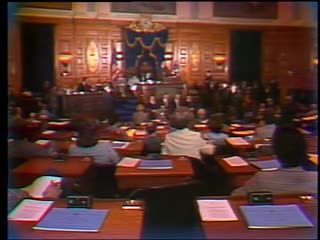
Description: Gov. Edward King's first budget address for FY80 before joint legislative session in House chamber (Constitutional Convention). Speaker Tom McGee forcefully bangs gavel. Senate President William Bulger announces entrance of the governor and Lt. Gov. Tom O'Neill. Rep. Robert Larkin, James Collins, Chester Atkins. Increase in local aid. “The people of Massachusetts do not want and do not deserve an ever expanding, ever more expensive state government. They do deserve and obviously want a government that provides the essential services they need at a price they can afford.” Goals: 1) reduce property taxes and stimulate economic development; 2) provide essential services to those most in need of care; 3) initiate improved management techniques in daily government operations. Man smoking pipe. King refers to high technology social contract (reducing individual taxes to level found in competing industrial states in exchange for job creation).
Collection: Ten O'Clock News
Date Created: 03/01/1979
Description: HIGH % OF BOSTON'S WORKING POOR LACK HEALTH INSURANCE. RAY FLYNN.
Collection: Ten O'Clock News
Date Created: 06/30/1987
Description: Report on an alarming increase in the infant mortality rate in Boston. Review of the statistics noting that the infant mortality rate among African Americans is 2.5 times the infant mortality rate among whites and that the increase was most pronounced in the Roxbury neighborhood. Interview with Dr. Bailus Walker, the Commissioner of Public Health, who says that the increase in the infant mortality rate is the result of a cutback in social programs from 1982 to 1984. Mayor Ray Flynn talks about the effects of cutbacks in social programs. The state has put $15 million toward reducing the infant mortality rate. Marian Wright Edelman, the Director of the Children's Defense Fund, speaks at a press conference, saying that the US has one of the highest infant mortality rates of any industrialized nation. The video cuts to black for 45 seconds during this story, from 00:01:34 to 00:02:15, presumably for graphics that weren't added to this copy. Following the edited story is additional b-roll footage of health care workers, parents and children at the Codman Square Health Center.
1:00:05: Visual: Footage of a doctor examining a non-white baby with a stethoscope. Hope Kelly reports that the infant mortality rate in Massachusetts is nine out of 1,000 infants; that 22 of every 1,000 African American babies die; that the infant mortality rate for African Americans is 2.5 times higher than the infant mortality rate for whites. V: Footage of three young African American children playing outside of a housing project. Kelly reports that the infant mortality rate is 15 out of 1,000 for babies born in Boston; that the mortality rate for non-white babies born in Boston is 23 out of 1,000. V: Shots of a white child standing near a park bench; of a doctor examining a pregnant African American woman. Kelly reports that infant mortality rates have increased from previous years. V: Shots of an African American infant girl being undressed before a medical examination. Kelly reports that the state-wide infant mortality rate was 8.9 deaths per 1,000 babies in 1984. V: Video cuts out. Black screen is visible. Kelly reports that that the state-wide infant mortality rate was 9.1 per 1,000 babies in 1985. Kelly notes that the African American infant mortality rate was 17 per 1,000 babies in 1984; that the African American mortality rate was 22.1 per 1,000 babies in 1985. Kelly adds that the increase was drastic in the city of Boston. Kelly notes that the African American infant mortality rate in Boston was 11.7 per 1,000 babies in 1984; that the African American infant mortality rate in Boston was 15.4 per 1,000 babies in 1985. Kelly notes that the increase in the infant mortality rate was pronounced in the Roxbury area; that the infant mortality rate in Roxbury rose from 16.5 per 1,000 in 1984 to 23.4 per 1,000 in 1985. Kelly adds that the infant mortality rate in North Dorchester doubled from 1984 to 1985. V: Video cuts back in. Footage of Dr. Bailus Walker (Commissioner of Public Health) saying that he is concerned but not surprised about the rise in the infant mortality rate. Walker says that the infant mortality rate is the result of cutbacks made in social programs from 1982 to 1984. Kelly says that Walker and Ray Flynn (Mayor of Boston) blame cutbacks by the federal government. V: Footage of Flynn saying that the rise in the infant mortality rate is attributable to dramatic cutbacks in nutrition programs, housing programs, and other social programs. Kelly says that the state put $15 million dollars toward an effort to reverse the increase in the infant mortality rate in 1985. V: Shots of the State House. Footage of Walker saying that it is too soon to see the results of the effort; that the data for 1986-1988 will show the results of the state effort. Shots of a Boston Globe front page article. The headline reads, "Hub infant deaths up 32%. Kelly says that Boston is home to some of the nation's most advanced medical centers. V: Shots of Boston City Hall; of signs for Boston Hospitals, including the New England Medical Center Hospital and Children's Hospital. Kelly reports that the Boston's Mission Hill neighborhood is very close to the Harvard Medical Complex and other hospitals. V: Shots of a child riding a go-cart outside of a housing project in Mission Hill; of a woman standing at the window of her aparment, holding an infant. Shots of African American children playing outside of the housing project. Kelly reports that the infant mortality rate in Mission Hill is 50 deaths per 1,000 births; that the infant mortality rate in Mission Hill is as high as the infant mortality rate in many third-world countries. Kelly reports that there are high infant mortality rates among African American communities across the nation. V: Footage of Marian Wright Edelman (Director, Children's Defense Fund) at a press conference. Wright Edelman says that an African American infant born in Washington D.C. is more likely to die than in infant born in Trinidad and Tobago; that the US and one other nation have the highest infant mortality rates among twenty industrialized nations surveyed. Footage of Walker saying that he will be concerned if this trend continues for three or more years; that a one-year "snapshot" does not yet indicate a trend.
Collection: Ten O'Clock News
Date Created: 02/09/1987
Description: Hope Kelly reports on an increase in the infant mortality rate since last year. Kelly reviews statistics on the infant mortality rate in Massachusetts and in Boston. There is a wide discrepancy between the infant mortality rates in the white and African American communities. Two out of three infant deaths in Boston are African American infants. Interview with Commissioner and Deputy Commissioner of Public Health, David Mulligan and Howard Spivak about the rising infant mortality rate. The state of Massachusetts has implemented prenatal care programs for all pregnant women. Interview with Commissioner of Boston Health and Hospitals, Judith Kurland, about the prenatal care programs. Kurland says that the programs do not reach the women who are most in need of them. Kurland says that an increase in poverty has resulted in an increase of the infant mortality rates. Kelly reviews statistics concerning teenage pregnancy in the state, noting that teenage pregnancy is becoming increasingly common. Kelly's report is accompanied by footage of infants in a hospital nursery and footage of a doctor examining a baby.
1:00:01: Visual: Shots of an infant in a neo-natal intensive care unit; of an infant in an incubator being wheeled through the corridors of a hospital. Hope Kelly reports that infant mortality refers to any infant who dies within the first year of life; that the infant mortality rate among the minority population in Massachusetts is high. Kelly reports that the infant mortality rate for white babies is 7.1 per 1,000 births; that the infant mortality rate for African American babies is 17.2 per 1,000 births. Kelly notes that the infant mortality rate for white babies in Boston is 8.1 per 1,000 births; that the infant mortality rate for African American babies in Boston is 24.4 per 1,000 births. Kelly reports that the infant mortality rate has increased since last year. V: On-screen text and visuals detail the statistics of the infant mortality rate in Massachusetts. Footage of David Mulligan (Commissioner of Public Health) saying that there the infant mortality rate signals a wide discrepancy between the white community and the African American community. Kelly reports that two out of every three infant deaths in Boston are African American infants; that African Americans make up less than one-quarter of the city's population. V: Footage of Howard Spivak (Deputy Commissioner of Public Health) saying that infant mortality rates are high across the nation; that Massachusetts has one of the lowest infant mortality rates in the nation. Shot of a woman dressing a baby in an examination room of a health clinic. Kelly reports that Massachusetts has already implemented pre-natal care programs for all pregnant women. V: Footage of Judith Kurland (Commissioner, Boston Health and Hospitals) saying that these programs are good; that the programs do not always reach the women who need the most help. Kurland says that there are women who do not know that help is available. Kelly reports that Kurland runs the health department of the city of Boston. Kelly reports that one out of four newborns at Boston City Hospital will spend time in the intensive care nursery. Kelly notes that the mothers of these children often receive inadequate pre-natal care. V: Shot of an infant in the intensive care nursery. Shot of a health care worker tending to an infant in a hospital nursery. The health care worker takes a measurement and refers to a gauge. Kelly reports that Kurland does not think that the pre-natal care programs in Massachusetts are adequate. V: Footage of Kurland saying that the programs need to reach women in housing projects and on street corners. Shot of health care workers tending to an infant in a hospital nursery. The workers look at an image on a computer monitor. The infant is hooked up to medical equipment. Kelly reports that Kurland is proposing a radical expansion of health care. Kelly notes that outreach is necessary in order to help at-risk women. V: Footage of Kurland saying that there has been an increase in poverty during the past eight years; that increases in poverty are linked to increases in infant mortality. Kelly reports that teenage pregnancy is on the rise in Massachusetts. Kelly reports that 88,047 babies were born to teenage mothers in Massachusetts in 1988; that 84,343 babies were born to teenage mothers in Massachusetts in 1987. Kelly notes that the teenage birthrate has increased 22% since 1980. V: Shot of a young woman and a baby at the window of an apartment building. On-screen text and visuals detail statistics about teen pregnancy in Massachusetts. Shot of Dr. Graunke (pediatrician), a woman, and a baby in an examination room at the Codman Square Health Center. The woman puts the child on the examination table.
Collection: Ten O'Clock News
Date Created: 12/12/1989