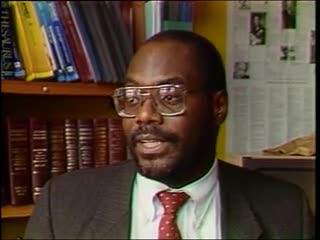
Description: Callie Crossley reports on the documentary film Street Cop, set in Roxbury. Interview with Roxbury community activists Georgette Watson and Ben Haith about the documentary's portrayal of crime and drug traffic in the community. Watson complains about the negative images of Roxbury in the media and about the negative attitude of many police officers toward African Americans. Crossley's report includes footage from Street Cop and footage of Crossley, Watson, and Haith walking in Dudley Square. Interview with Larry Brown of the Boston Minority Police Association, who says that the documentary gave a realistic and effective portrayal of law enforcement. This edition of the Ten O'Clock News also included the following item: David Boeri reports that William Celester has been accused of sexual assault by a female employee of the Police Department
1:00:00: Visual: Footage from Street Cop, a documentary film produced for Frontline. The footage shows a police plainclothes police officer entering a family's apartment. Women and children in the apartment are screaming and crying. Callie Crossley reports that Street Cop is a gritty documentary set in Roxbury; that the documentary profiles police officers from Area B headquarters in Roxbury; that the documentary examines crime and drug traffic. Crossley reports that some Roxbury activists say that the film shows the disrepectful attitude of the police toward citizens in the community. V: Footage of Crossley interviewing Georgette Watson (Roxbury community activist) and Ben Haith (Roxbury community activist). Watson says that police show less respect and restraint in Roxbury than they do in other communities. Watson wonders if the police are helping the community or destroying it. Crossley reports that Watson and Haith are concerned about the portrayal the Roxbury community in the documentary. V: Footage from Street Cop of a police officer breaking down an apartment door with a sledgehammer. Footage of Watson saying that drug problems exist all over the city, not just in Roxbury. Footage of Haith saying that the documentary showed the police attacking the neighborhood as if they were engaged in warfare. Footage from Street Cop of police officers searching for drugs in an apartment. Footage of Crossley, Watson, and Haith walking across the street in Dudley Square in Roxbury. Watson says that there are massive drug deals taking place across from the police station; that police are more concerned with forcefully entering homes to search for nickel bags of marijuana. Footage from Street Cop. Stanley Philbin (Boston Police Department) drives by a depressed housing project in Roxbury, saying that if he were young, black and living in that housing project, he would probably sell drugs; that "being black is no bargain." Crossley reports that Roxbury activists say that comments by police officers in the documentary reflect racist attitudes. V: Footage from Street Cop of a white police officer grabbing an African American girl as he tries to chase some African American kids away from a residential home. Footage of Watson saying that Roxbury needs police officers who understand the community; that police officers from South Boston do not understand the culture of African Americans. Watson says that Roxbury needs police officers who do not have a negative attitude toward African Americans. Footage of Larry Brown (Boston Minority Police Association) saying that the documentary was realistic and effective portrayal of law enforcement. Footage from Street Cop of a police officer reaching down the shirt of an old woman to pull out drugs. Footage of Brown saying that drugs and guns are a huge problem in communities; that police officers need to protect themselves from violence. Footage from Street Cop of police officers making an arrest. Footage of Brown saying that the community needs to support the police officers in the fight against the drug problem; that tough tactics are necessary to eradicate the drug problem. Footage from Street Cop of a uniformed African American police officer in a cruiser.
Collection: Ten O'Clock News
Date Created: 03/31/1987
Description: Story on the Drop-a-Dime Program started by Roxbury residents Georgette Watson and Rev. Bruce Wall. Pedestrians on the streets of Roxbury and Roxbury neighborhood in the evening. Watson points out a drug dealer and a building out of which the drug trade operates. Interview with Watson about the drug problem in the city and the effectiveness of the Drop-a-Dime Program. She talks about the role of neighborhood youth in the drug trade. Representatives from the Drop-a-Dime Program were not included in the mayor's newly formed council on drug abuse. Mayor Ray Flynn holds press conference announcing the formation of the council. Ben Thompson, Chairman of the council, says that the council intends to work with anti-crime and drug prevention groups across the city. William Weld, US Attorney for Massachusetts, and Derek Sanderson, former player for the Boston Bruins, stand with the other members of the council at the press conference. Interview with Bruce Wall about how community groups have not been included on the council. He adds that members of community groups understand how the drug trade functions in their neighborhoods. Flynn will go to the Boston City Council to obtain funding to combat drug abuse in the city.
1:00:05: Visual: Shots through the windshield of a traveling car of Boston streets; of Washington Street; of youth gathered in front of a building. Audio of Georgette Watson (Roxbury community leader) talking about drug trafficking in her neighborhood. Watson points out a well-known drug dealer as he walks across the street. Watson talks about the role of neighborhood youth in the drug trade. Meg Vaillancourt reports that Watson is familiar with the drug trade in her neighborhood; that Watson and Reverend Bruce Wall (Roxbury community leader) started the Drop-a-Dime program. Vaillancourt reports that the Drop-a-Dime program encourages residents to phone in tips and information about the drug trade to police; that South Boston and Roxbury police have found the tips to be mostly accurate. V: Shots of Watson and Wall; of a tape recorder. Footage of a hand pressing the play button on the tape recorder. Audiocassette is heard playing in the background of the report. Shots from a traveling car of Washington Street in the evening. Vaillancourt reports that Watson wants to expand Drop-a-Dime program into a city-wide service; that representatives from the program were not included in the mayor's council on drug abuse. V: Footage of Watson saying that Drop-a-Dime deserves more support from the mayor and the city. Vaillancourt reports that the Ray Flynn (Mayor of the City of Boston) held a press conference today to announce his new drug abuse council; that Flynn did not answer questions regarding the absence of Drop-a-Dime representatives from the council. V: Shots of Flynn and his council at a press conference. Footage of Ben Thompson (Chairman of the Council), saying that the council intends to be "inclusive"; that the council intends to work with other anti-crime and drug prevention groups across the city. Footage of Wall saying that community groups need to be included on the mayor's council; that community groups understand how the drug trade functions on the streets of the city. Shots of members of the drug abuse council, including William Weld (US Attorney for Massachusetts) and Derek Sanderson (former player for the Boston Bruins). Footage of Flynn explaining that Sanderson will be paid by the city of Boston; that the rest of the committee is made up of volunteers. Shots of the council preparing to leave the press conference. Vaillancourt notes that the council is made up of local and state officials. Vaillancourt notes that the council will prepare a report on how the city can combat drug abuse; that Flynn will take the report to the Boston City Council in order to obtain funding; that it will be difficult for Flynn to obtain extra funds because of the economic crisis faced by the city.
Collection: Ten O'Clock News
Date Created: 12/07/1984
Description: David Boeri reports on drug traffic in the Franklin Development Project. William Sommers, the Boston Inspectional Services Commissioner tours a condemned building on Homestead Street. Interviews with Sommers and Pat Farreta about the problems in the building. Ferrata talks about drug dealers who sell drugs from their apartments. Boeri talks to a tenant, who refuses to comment on the drug traffic in the building. Boeri reports on a plan for increased police presence in the community to combat drug and footage of police making a drug arrest. Interview with Roxbury community leader Don Muhammad about how to solve the drug problem in the community. Following the edited story is b-roll of the Roxbury neighborhood around the Franklin Development Project. Also, additional footage from the tour of condemned buildings with Commissioner Sommers and Pat Ferrata. This edition of the Ten O'Clock News also included the following item: Ray Flynn proposes to increase the number of Boston residents working in Boston jobs
1:00:08: Visual: Footage William Sommers (Inspectional Services Commissioner, Boston) touring a condemned building on 157 Homestead Street in Roxbury. Shots of a rotted stairway; of a the structural beams showing through a wall. Footage of Sommers pointing to a rotted ceiling in an apartment. Shots of Sommers standing in the stairwell of the building. David Boeri reports that Sommers condemned the building at 157 Homestead Street on the previous day; that the tenants will be relocated while the building is repaired. V: Footage of Sommers saying that he has written up thousands of housing violations for the Franklin Development Project. Footage of African American tenants moving furniture from the decrepit building. Boeri reports that Sommers blames the US Department of Housing and Urban Development (HUD) for neglecting this building and others. V: Shot of a cockroach crawling along a dirty wall. Shots of African American tenants in the lobby of the building. The lobby walls are covered with graffiti. Footage of Sommers saying that there needs to be continuous support for urban housing; that he does not want to repair this building only to see it fall apart again. Boeri stands in front of the building on Homestead Street. Boeri reports that the city will have to fight the drug pushers in the building. V: Footage of Pat Farreta (Housing Inspector) saying that drug buyers will smash down the front doors of buildings in order to reach the apartment of a drug dealer. Shot of a door covered in graffiti. Shots of an African American man removing cabinet doors from the building on Homestead Street. Boeri reports that tenants of these buildings are terrorized by drug dealers. V: Footage of Ferreta saying that tenants report that drugs are being dealt through a hole in the door of one of the apartments. Shot of Boeri, Sommers and Ferreta standing together. Ferreta says that drugs will be dealt in the building that evening if he does have the building secured. Boeri reports that Mrs. Walker (tenant) will be moved to a hotel or shelter while her apartment is fixed. V: Footage of Mrs. Walker looking away from the camera. She says that she does not want to talk about it. Boeri stands in front of the building on Homestead Street. Boeri reports that tenants are afraid of reprisals if they talk about the drug problem; that tenants have told him off-camera that drug dealing occurs day and night in the building. V: Footage of a handcuffed woman getting into a police cruiser. A white police officer closes the cruiser door. Shots of police officers standing on the sidewalks in Roxbury. Boeri reports that the court-appointed trustee for the Franklin Development Project used $300,000 of federal money to hire Boston Police officers to remove drug dealers. Boeri notes that Boston Police officers will be continually present on the streets of Roxbury for 30 days. V: Shot from a moving vehicle of police officers standing on a sidewalk. Boeri reports that community activists disagree about whether the police presence is a good thing. V: Shot of Boeri walking on a street with Don Muhammad (Roxbury community leader}. Footage of Muhammad saying that the community needs leadership more than it needs police; that absentee landlords and irresponsible tenants are part of the problem. Muhammad says that residents would drive out the drug pushers if they owned the buildings. Muhammad urges the courts to punish drug dealers to the full extent of the law. Muhammad compares a drug pusher to "someone who is driving an automobile at 150 mph in a 30 mph zone when children are crossing the street."
Collection: Ten O'Clock News
Date Created: 07/24/1986
Description: Deaths, violence, and crime related to drug transactions increasingly common in inner city neighborhoods. Scene of Roxbury double murder, suspects in custody, blood on car seat and street.
Collection: Ten O'Clock News
Date Created: 05/09/1988
Description: Marcus Jones reports on efforts by the Roxbury community to fight drugs. Jones' reports includes footage of a community meeting with William Celester (Deputy Superintendent, Boston Police Department) and Roxbury residents. Celester and Georgette Watson (Roxbury residents) talk about the need for residents to fight the drug trade. Watson and Lola Jenkins (Roxbury resident) talk about the need for more funding to help communities fight drugs. Jones notes that Watson runs the Drop-A-Dime Program in Boston. Jones' reports also includes footage of Watson walking through Dudley Square in Roxbury with Callie Crossley (WGBH reporter). Following the edited story is b-roll of the community meeting and of Dudley Square. Church's Chicken sign, liquor store front, church steeple, food stamp center, Ugi's Subs sign.
1:00:04: Visual: Footage of William Celester (Deputy Superintendent, Boston Police Department) talking to a group of Roxbury residents. The residents are mostly African American. Shots of meeting attendees. Marcus Jones reports that Celester talked to residents about street patrols at an afternoon meeting at Boston Police Department Area B Headquarters. Jones reports that drugs have become a major problem in the Roxbury community. V: Footage of Georgette Watson (Roxbury resident) saying that residents have become soldiers in the war on drugs. Watson says that the community needs more resources to fight drugs. Jones reports that Watson runs the Drop-A-Dime program; that Drop-A-Dime is a drug crime hotline; that Drop-A-Dime receives some federal funding. V: Shots of Callie Crossley (WGBH reporter) walking with an African American woman and an African American man near Dudley Square in Roxbury; of plain-clothes police officers making a drug arrest. Footage of Watson saying that police officers and inner-city residents are fighting drugs; that federal lawmakers should give more funds to these efforts. Footage of Lola Jenkins (Roxbury resident) saying that money should be given to grassroots anti-drug efforts. Footage of Celester saying that people need to come down from their soapboxes; that people need to take action against drugs. Shots of Celester addressing the meeting. Jones reports that Celester believes that attention must be focused on local anti-drug efforts. V: Footage of Celester saying that drugs are not a "police problem"; that drugs are a "human service problem." Celester says that more money is needed to build jails and hospitals and to fund drug education. Shot of an African American police officer sitting in a police cruiser. The cruiser's lights are flashing.
Collection: Ten O'Clock News
Date Created: 08/21/1989
Description: Marcus Jones reports on the competion of renovations at the Renaissance Building in the Grove Hall district of Roxbury. The project was funded with money from the city's only minority-owned bank and was overseen by minority architects and contractors. Jones adds that the building is a cornerstone of the Grove Hall revitalization effort. People hold a celebration for the completion of the restorations. A crowd stands outside of the building. Virginia Morrison (Neighborhood Development Corporation of Grove Hall) and Don Muhammad (Muhammad's Mosque) address the crowd. Muhammad says that gang activity will decline as more renovation takes place in the neighborhood. Interview with Trevor Blake (TTB Construction Inc.) and Ernest Scott, a businessman, about the renovations. Blake talks about the challenges faced by minority businesses and contractors. Scott says that renovations and increased foot traffic will force the drug trade out of the area. Jones reports that the city of Boston has committed an additional $50,000 to the Grove Hall revitalization effort.
1:00:01: Visual: Footage of a gathering to celebrate the restoration of the Renaissance Building in the Grove Hall district of Roxbury. Virginia Morrison (Neighborhood Development Corporation of Grove Hall) addresses the gathering. Morrison says that the building makes a statement on behalf of Muhammad's Mosque, of the Grove Hall Board of Trade, of the Prince Hall Masonic Lodge, of the residents of the area. Morrison says that the building represents the way that the residents of the area intend to live. Shot of a man tearing off paper above the door to reveal the street number. Marcus Jones reports the newly renovated Renaissance Building is located at 483 - 487 Blue Hill Avenue. Jones says that the building was "an eyesore" for more than a decade; that the building is now the cornerstone of the Grove Hall revitalization effort. V: Footage of Morrison addressing the gathered crowd. Supporters stand behind her, including Don Muhammad (Muhammad's Mosque). Morrison says that the building cost $1,276,000 to renovate; that the building was renovated by qualified African American workers from the community. Shot from an upper window of the Renaissance building, of the intersection of Blue Hill Avenue and Cheney Street. Shots of people looking at the interior of the newly-renovated building. Shot of the newly renovated kitchen. Jones reports that the project was funded with money from the city's only minority-owned bank; that the project was overseen by minority architects and contractors. Jones reports that the building includes twelve apartments on the upper floors of the building; that there is retail space on the bottom level. V: Shot of a man exiting the Ernest Scott Insurance Agency. Footage of Trevor Blake (TTB Construction Inc.) standing in one of the apartments. Blake talks about the challenges faced by African American businesses and contractors. Footage of Ernest Scott (businessman) saying that the whole neighborhood is improving. Jones reports that Scott's Insurance Agency has operated on Blue Hill Avenue for over thirty years. Jones notes that Scott's business is one of the new tenants in the Renaissance Building; that Scott believes that businesses and residents need to fight the gangs and drug dealers in the neighborhood. V: Shot of the exterior of the Ernest Scott Insurance Agency. Shot of a man fixing lettering to the interior of a window of the Insurance Agency; of an employee and customer at the Insurance Agency. Footage of Scott saying that foot traffic and business activity puts a damper on the drug trade. Scott says that participants in the drug trade will be forced out of the area. Shots of traffic on the street in the Grove Hall area; of the crowd gathered in front of the Renaissance Area. Jones reports that community organizers hope to refurbish the entire Grove Hall district within five years; that Ray Flynn (Mayor of Boston) has committed an addtional $50,000 to the effort. V: Footage of Muhammad addressing the crowd outside of the Renaissance Building. Muhammad says that the Grove Hall community deserves the same respect and resources as any other neighborhood. Muhammad says that gang activity will dwindle as more renovation takes place in the neighborhood. The crowd claps for Muhammad. Morrison approaches the microphone.
Collection: Ten O'Clock News
Date Created: 03/12/1990
Description: Marcus Jones reports that many residents were present at a public hearing on whether to allow nude dancing at the Highland Tap in Roxbury. The Highland Tap has featured nude dancing for almost ten years. The police and critics believe that the bar is attracting drug traffic and other vices to the area. City Councilor Bruce Bolling and Deputy Superintendent of the Boston Police Department William Celester speak out against nude dancing at the bar. Celester talks about criminal activity and underage dancers at the bar. Local business owners say that the Highland Tap is a good neighbor. Interview with a local business owner who says that the bar creates no problems. Interview with Highland Tap owner Agamemnon Alexopoulos, who denies any problems with drugs or violence at the bar. Interviews with Roxbury residents Norma Alvarado and Dana Holley about their opinions on nude dancing at the bar. Jones reports that the city will soon decide whether to grant a license for adult entertainment at the bar. This edition of the Ten O'Clock News also included the following item: Jesse Jackson's supporters criticize the Dukakis presidential campaign.
1:00:09: Visual: Footage of Bruce Bolling (Boston City Council) speaking at a hearing on nude dancing at the Highland Tap in Roxbury. Bolling asks why Roxbury is the only neighborhood outside of the Combat Zone to have a nude dancing venue. The crowd applauds Bolling. Shots of the crowd. Members of the crowd hold up signs protesting the nude dancing venue in Roxbury. Marcus Jones reports that most of the audience members at the hearing were there to protest nude dancing at the Highland Tap in Roxbury. V: Shots of city officials at the hearing; of a man speaking at the hearing. Shots of a sign for "live adult entertainment" outside of the Highland Tap; of an African American woman entering a side door of the Highland Tap; of the exterior of the bar. Jones reports that the Highland Tap has featured nude dancing for almost ten years. Jones notes that police and critics say that the bar is attracting drug traffic and other vices. Jones adds that the bar is located near the Orchard Park Housing Development. V: Footage of William Celester (Deputy Superintendent, Boston Police Department) speaking at the hearing. Celester says that the community already has enough problems without the Highland Tap. Jones reports that local businesses say that the Highland Tap has been a good neighbor. V: Footage of Lloyd (owner of Washington Fruit) seated in front of his business across from the Highland Tap. Lloyd says that his business has been here for eighteen years; that he has never seen any trouble at the Highland Tap. Footage of Celester speaking at the hearing. Celester says that police have pursued several investigations of the sale of cocaine at the Highland Tap. Celester says that police have arrested a girl under sixteen for nude dancing at the Highland Tap; that the owner was aware of the girl's age. The crowd applauds Celester. Footage of Agamemnon Alexopoulos (owner, Highland Tap) being interviewed on the street. Alexopoulos says that the Highland Tap has had no problems with drugs or violence. Alexopoulos talks about other bars in the areas that do have problems with drugs or violence. Footage of Norma Alvarado (local woman) saying that nude dancing does not create a drug problem. Footage of Dana Holley (local man) saying that the Highland Tap does not belong in a newly developed Roxbury. Marcus Jones stands outside of the bar. Jones reports that unlicensed nude dancing has been going on at the Highland Tap since the 1970s; that legal maneuvers by the bar's ownership has prevented a public hearing until now. Jones notes that the city can refuse to grant a license for adult entertainment to the bar; that the courts will ultimately decide on the fate of nude dancing at the club.
Collection: Ten O'Clock News
Date Created: 08/25/1988
Description: Dudley neighborhood group reclaims Howard Street from drug dealers and dumping by sealing it off with locked fence and removing abandoned cars. Jackhammer, concrete, cement in wheelbarrow.
Collection: Ten O'Clock News
Date Created: 08/04/1988
Description: Marcus Jones interviews Brian Wright O'Connor, the Managing Editor of The Bay State Banner, about the negative media portrayal of the Roxbury, Dorchester and Mattapan area. Jones notes that O'Connor believes that the media focus only on images of violence, drugs, and murder. O'Connor talks about the effects of the negative media coverage. Footage from an interview with Boston Police Deputy Superintendent William Celester about negative media coverage of the community. Jones notes that gubernatorial candidate John Silber was recently criticized for making negative comments about the Roxbury community. Silber has accused columnist Mike Barnacle of giving a biased representation of life in many neighborhoods. Jones' report is accompanied by footage from a news story with Barnacle, by footage from Justice on Trial (WCVB-TV) and by footage from Street Cop (WGBH/Frontline documentary). Jones notes that politicians and community leaders have spoken out against media bias in the wake of the Carol Stuart murder case. Michael Dukakis talks about media bias at a press conference. Following the edited story is additional footage of Jones's interview with O'Connor. This edition of the Ten O'Clock News also included the following item: John Silber speaks to the media and Roxbury residents
1:00:25: Visual: Footage of news reports from local TV stations. John Henning (WBZ news anchor) reports on the murder of a woman in the city. Natalie Jacobson (WCVB news anchor) reports on a police search for suspects in two Roxbury shootings. Shot of police searching two suspects who are lying face down on a sidewalk. R.D. Sahl (WHDH news anchor) reports on growing outrage in Roxbury. Shot of a woman being taken from a home on a stretcher. Shots of police cruisers on the streets of Roxbury at night. Shot of an injured person in an ambulance; of police at a crime scene cordoned off by yellow tape. Shot of an African American man leaving a police station. Marcus Jones reports that media coverage of the Roxbury, Dorchester, and Mattapan neighborhoods focus on images of violence, drugs, and murder. Jones reports that Brian Wright O'Connor (Managing Editor, The Bay State Banner) believes that the media does not provide an accurate portrayal of life in Roxbury. Jones notes that O'Connor lives in a quiet section of the Roxbury neighborhood. V: Shot of Jones and O'Connor walking through a quiet park. Footage of O'Connor saying that criminal activity should be covered by the media; that the media uses questionable tactics in covering crime. O'Connor says that the media often stretches its definition of the term "news." O'Connor questions if there is balanced news coverage of the greater Roxbury area. O'Connor says that the media come to Roxbury to cover crime; that the media comes to Roxbury to cover reactions of local residents to comments by white politicians. Footage of William Celester (Deputy Superintendent, Boston Police Department) saying that media coverage creates the wrong perceptions about the community. Celester says that negative perceptions did not begin with the comments of John Silber (Democratic candidate for governor of Massachusetts). Celester says that the negative perceptions need to be changed. Footage from WCVB of Justice on Trial. The footage shows Joe Lally (Boston Police Department) walking toward a city courthouse. The narrator says that Lally is "the only symbol of civilization left on many city streets." Marcus Jones reports that Silber has accused the media of twisting his words; that Silber says that the media has skewed perceptions of reality in Area B neighborhoods. Jones notes that Silber accused Mike Barnacle (columnist) of giving a skewed portrayal of life in many neighborhoods. V: Shot of Mike Barnacle interviewing a white man outside of a building. Footage of Barnacle walking along a sidewalk. Barnacle compares the neighborhood to a "shooting gallery." Jones reports that he interviewed Barnacle by telephone. Jones reports that Barnacle says that he feels no obligation to balance negative coverage of a neighborhood with positive coverage. Jones notes that Barnacle could not recall the number of columns he has written this summer with positive coverage of the neighborhoods in Area B. V: Footage from a WGBH/Frontline documentary called Street Cop. A plain-clothes police officer rides through a housing development. The officer says that the neighborhood is a tough place. The officer says that he would probably end up selling drugs if he were a poor, African American teenager in this neighborhood. Footage from Street Cop of white, plain-clothes police officers breaking down the door of an apartment with sledgehammers. A police officer reaches down the shirt of an old woman to look for drugs. Jones notes that WGBH/Frontline produced a documentary called Street Cop three years ago; that the documentary was accused of using negative stereotypes of crime in Roxbury. Jones reports that politicians and community leaders have spoken out against media bias in the wake of the Carol Stuart murder. V: Shots of newspaper articles with headlines about the suspect in the Stuart case. Footage of Michael Dukakis (Governor of Massachusetts) speaking at a press conference on April 11, 1990. Dukakis says that there are thousands of good kids in the community; that the media gives all of the news coverage to the 500 bad kids. Bernard Cardinal Law (Archidiocese of Boston) is seated behind Dukakis. Footage of O'Connor being interviewed by Jones. Jones asks if the media focus on crime leads to a reduction in crime. O'Connor says that the community has been stereotyped by the media; that negative stereotypes reduce the political will to address the underlying socio-economic problems. O'Connor says that these negative stereotypes imply that the citizens of the community are morally defective or undeserving of aid. O'Connor says that the biased media coverage is "pernicious." O'Connor says that the negative media coverage allows people with resources to turn away from the community. O'Connor notes that two large companies scrapped their plans to build facilities in Roxbury in the wake of the Stuart murder. O'Connor says that the two companies could have provided jobs for at-risk teenagers in the community.
Collection: Ten O'Clock News
Date Created: 09/12/1990
Description: Leslie Harris, an attorney with Roxbury Defenders Committee, describes his work seeking justice for those accused, sometimes unfairly, by police in the street drug war. Lawyers in conference room.
Collection: Ten O'Clock News
Date Created: 09/04/1990