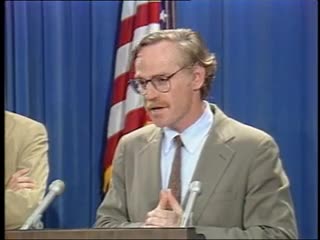
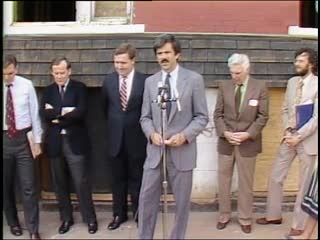
Description: Bernadette Devlin McAliskey (Irish Republican activist) holds a press conference in Boston as part of a 13-city tour of the United States. Devlin speaks about her recent candidacy for the European parliament and says that her speaking tour is intended to help defray debts incurred during her campaign. Devlin's campaign was organized around a human rights platform. Devlin notes that international organizations have condemned the human rights abuses in Northern Ireland but that the United Nations and western countries will not speak out against Great Britain. Devlin expresses cynicism towards politicians and doubts about an American political response to the situation in Northern Ireland. She equates the oppression in Northern Ireland to the inequalities that exist in the United States and notes that Irish Americans engage in oppression of African Americans in Boston. Devlin compares the dearth of Protestant support for her cause in Northern Ireland to the lack of white working class support for busing in Boston; recounts the history of the Irish conflict from the Irish elections in 1918; and discusses changes that must be made by Great Britain in Northern Ireland. Devlin discusses her activities in the years since she left parliament; the use of violence by Catholics in Northern Ireland; the death of Lord Louis Mountbatten (British official). She accuses the international press of hypocrisy; answers questions about her speaking schedule and her life in Ireland.
0:58:09: Visual: Bernadette Devlin McAliskey (Irish Republican activist) prepares for a press conference as part of a 13-city tour of the United States. She sits at a small table in front of a microphone and takes questions from reporters. The press conference takes place in an informally furnished room; the walls are covered with handmade political posters. A reporter asks Devlin if she is doing the speaking tour to pay off debt accumulated during her recent campaign for a seat in the European parliament. Devlin says that her candidacy focused on human rights issues; that her candidacy was announced only three weeks before the election; that she ran on behalf of the H-Block political prisoners. Devlin says that her political party still has a debt of $10,000 after the elections; that she has come to the US to raise money through speaking engagements and from contributions. Devlin says that she has raised about $3,000 so far. A reporter asks Devlin's opinion on US involvement in Northern Ireland. Devlin says that Amnesty International, the International Red Cross and the European Court of Human Rights have all condemned the human rights abuses in Northern Ireland; that Jimmy Carter (US President) condemns human rights abuses all over the world, but ignores the deprivation of human rights in Northern Ireland. Devlin questions Carter's sincerity on human rights issues. Devlin says that the United Nations and western countries will not speak out against Great Britain; that she is trying to raise awareness of the situation among the white population of the US. The reporter asks Devlin if she expects a response from Irish Americans and Irish American politicians. Devlin says that she has a cynical view of politicians; that Edward Kennedy (US Senator) and Carter might speak out against the situation in Northern Ireland if they thought it would win them some votes; that she is not sure if Irish American politicians will take any action. Devlin says that the Irish American community has been made to feel guilty about giving money to Ireland; that they are made to feel like they are supporting violence. Devlin says that US politicians do not want Irish Americans to take interest in the situation in Northern Ireland. Devlin says that there are enough Irish Americans in the US to pressure the US government to take some firm action about Northern Ireland; that Irish Americans might become aware of the inequalities in US society if they started to think about the oppression in Northern Ireland. Devlin says that it saddens her to see Irish Americans involved in the oppression of African Americans in Boston. Devlin says that Irish Americans would get themselves on the "right side" of the civil rights struggle in the US if they understood the situation in Northern Ireland. Devlin says that Catholics in Northern Ireland were inspired by the civil rights movement in the US; that they identify with the struggles of African Americans. Devlin says that Irish Americans appear to be actively involved in the oppression of African Americans. Devlin says that she could probably raise money more easily if she avoided discussing the role of Irish Americans in the oppression of African Americans; that she is not willing to keep silent for money. Devlin says that she hopes Irish Americans will become more aware of their contradictory behavior; that many fled oppression in Ireland only to become oppressors in the US. 1:07:11: V: Devlin says that there is little Protestant support for her cause in Northern Ireland. She compares the amount of Protestant support for her cause in Northern Ireland to the amount of white working class support for busing in Boston. Devlin says that Great Britain needs to withdraw the undemocratic veto given to Protestants in Northern Ireland in 1921; that Great Britain needs to support change in Northern Ireland. Devlin reviews the history of the Irish conflict from the Irish elections in 1918 to the partition of the country by Great Britain. Devlin accuses Great Britain of partitioning the country in order to create a Protestant majority where there was none before. A reporter asks Devlin what she did during the years before the most recent election. The reporter comments that Devlin had not been visible on the political scene. Devlin responds that she has never stopped working for her cause; that the media ignored her activities because she was no longer a member of the British Parliament. Devlin says that the world took no notice of the violence used by Great Britain to oppress Catholics in Northern Ireland before 1969; that the oppressed Catholics are adopting the methods of violence used by Great Britain. Devlin questions why the Catholics are condemned for using violence, when they are only reacting to the violence used to oppress them. Devlin says that the international media have portrayed Lord Louis Mountbatten (British official) as a brave soldier and an aristocrat; that the oppressed peoples of the British Empire see Lord Mountbatten as a symbol of oppression. Devlin adds that public figures who represent the oppression of the British Empire will inevitably become targets of the oppressed. Devlin questions why the life of Mountbatten is worth more than the lives of all the Irish people who have died at the hands of the British; that the Irish victims fought for their country as Mountbatten did; that they were portrayed as terrorists by the international press. Devlin accuses the international press of hypocrisy. She says that the Irish people will not be "chastened" by the press coverage of Mountbatten's death. Devlin adds that if Great Britain was not occupying Northern Ireland, Mountbatten would be alive today. A reporter asks Devlin about Princess Margaret of England's comment that the Irish are "pigs." Devlin responds with a translation of an old Irish saying that "a pig thinks the whole world is pigs." Devlin answers questions about her speaking schedule and her life in Ireland. Devlin says that she has three children; that she does not have a regular job; that she works in the resistance movement. Devlin adds that she works with Catholics whose welfare benefits have been taken away by the British government. Devlin says that the money she raises will pay off her party's campaign debt. She adds that if the debt is paid, the rest of the money will go to a fund to benefit Irish prisoners.
Collection: Ten O'Clock News
Date Created: 10/19/1979
Description: Bill Baird press conference on concerns over abortion clinic bombings and fighting back against them. He describes the types of demonstrations by antiabortion groups and the effects they have on the women who use those clinics. He proposes a "demilitarized zone" between the protesters and the women using the clinics, so that they can continue to receive treatment without being physically abused. He describes interstate efforts of pro-choice groups to analyze the attacks. He expresses anger with the FBI's lack of attention, refusal to classify the attacks as terrorism, and the institutionalized sexism of law enforcement agencies. He says that many abortion clinics are now armed and have increased defenses.
Collection: Ten O'Clock News
Date Created: 01/11/1985
Description: Bernard Law's first press conference as Archbishop of Boston. Talks about role, ideology, impressions of Boston. Says women and men are equal but only men can be ordained (“paradox”). Bishop Thomas Daily.
Collection: Ten O'Clock News
Date Created: 01/27/1984
Description: Marcus Jones reports that the Black Political Task Force has announced its candidate endorsements for the upcoming elections. Footage from a press conference at which the Task Force announces its slate of candidates. Salvatore DiMasi (candidate for State Representative) addresses the audience. The Task Force has generated controversy by endorsing some white candidates over African American candidates. Footage of Georgette Watson and Robert Rufo talking about Black Political Task Force endorsement. Jones interviews Peter Hardie (President, Black Political Task Force) about the endorsements. Clips of Jack E. Robinson (President, Boston chapter of the NAACP), Baroness Williams-Martin (political activist), and Regina Placid (candidate for State Representative) commenting on the endorsements. Clips of Mel King (political activist) and Michael Dukakis (Governor of Massachusetts) campaigning.
1:00:21: Visual: Footage of Peter Hardie (President, Black Political Task Force) addressing a crowd at a press conference in front of the Robert Gould Shaw Memorial on Boston Common. Hardie talks about the mission of the Black Political Task Force. Marcus Jones reports that the Black Political Task Force was started in 1979; that the Task Force is comprised of 60 minority activists who collect dues, hold forums, and endorse candidates. V: Shots of a male Task Force member wearing a Bob Rufo campaign pin; of a female Task Force member; of Mel King (political acitivist) campaigning in Roxbury; of Michael Dukakis (Governor of Massachusetts). Jones reports that the Task Force endorsed Mel King in the 1983 mayoral race; that they endorsed Michael Dukakis in the 1982 governor's race. V: Shots of African American campaign workers holding campaign signs for Georgette Watson (candidate for Suffolk County Sheriff); of Bob Rufo (candidate for Suffolk County Sheriff) shaking hands with Hardie. Jones reports that the Task Force has endorsed Bob Rufo over Georgette Watson in the race for Suffolk County Sheriff. V: Footage of Jack E. Robinson (President, Boston chapter of the NAACP) saying that the Task Force does not always have to endorse African American candidates; that Watson deserves the endorsement of the Task Force because she is a good leader. Footage of Baroness Williams-Martin (political activist) saying that the Task Force's endorsement of Rufo was unfair; that the endorsement was "a political slap in the face to Watson." Jones says that Watson was shaken by the Task Force's endorsement of Rufo. V: Footage of Watson with supporters at a press conference. Watson has tears in her eyes. Watson says that the Task Force's decision has been an "emotional experience"; that she is going to wage a winning campaign. Footage of Hardie at the Task Force press conference. Hardie says that Rufo is a better candidate for the position than Watson. Footage of Rufo saying that the race is important to him; that the voters need to decide which candidate is most qualified for the position. Rufo says that he hopes that the endorsement does not become an issue between him and Watson. Jones says that the Task Force announced its full slate of candidates at the press conference today. Jones reports that the Task Force has endorsed Rufo for Suffolk County Sheriff, Gerry D'Amico for lieutenant governor, Jo Ann Shotwell for attorney general, Byron Rushing for state representative for the ninth Suffolk District. Jones notes that the Task Force endorsed Salvatore DiMasi over Regina Placid for state representative of the third Suffolk District. V: Shots of Rufo at the Task Force press conference; of Gerry D'Amico (candidate for lieutenant governor) at the press conference; of Jo Ann Shotwell (candidate for state attorney general) at the press conference; of Byron Rushing (candidate for state representative) at the press conference. Footage of Salvatore DiMasi (candidate for state representative) at the Task Force press conference. DiMasi says that this endorsement shows that people from different communities and ethnic backgrounds are working together. DiMasi says that he is proud to receive the Task Force's endorsement. Footage of Regina Placid (candidate for State Representative) saying that the Task Force's endorsement does not represent the true voice of the African American community. Footage of Hardie at the press conference. Hardie says that the Task Force is accustomed to the controversy which often accompanies their endorsements. Jones stands on the Boston Common. Jones reports that no one can predict if the Task Force's endorsements will make a difference in the upcoming elections. Jones notes that critics of the Task Force say that their endorsements may backfire. Jones says that some critics predict that the African American community may back the African American candidates not backed by the Task Force.
Collection: Ten O'Clock News
Date Created: 08/25/1986
Description: Governor Edward King speaks on lifting blue laws to permit Sunday business. King signs bill that allows businesses to open Sundays, although the law prohibits forcing anyone to work Sundays. King states that this bill will increase job opportunities.
Collection: Ten O'Clock News
Date Created: 12/22/1982
Description: Frank Keefe announces low July revenues, causing state to borrow $200 million to pay bills and FY89 estimates to be revised. At separate PC, Dukakis presents more optimistic budget outlook.
Collection: Ten O'Clock News
Date Created: 08/02/1988
Description: Thomas Saltonstall (Regional Director, EEOC) speaks at a press conference to mark the opening of the Boston office of the Equal Employment Opportunity Commission (EEOC). Saltonstall calls for an end to employment discrimination against minorities; he remarks that minorities in Boston are concentrated in low-paying jobs. Saltonstall refers to charts illustrating the under representation of minorities in office/clerical and sales positions. Saltonstall advocates affirmative action programs and discusses the EEOC's intention to pursue litigation against companies that continue to discriminate in their employment practices. Saltonstall says that minority underemployment is a problem in the Boston area. He defends and explains the intended function of affirmative action programs.Saltonstall discusses the under representation of minorities in the public sector and some pending investigations against employers in the Boston area. Saltonstall describes the realtionship between the EEOC and the Civil Rights Commission; he talks about EEOC enforcement of Title VII of the Civil Rights Act. A reporter asks if employers are receiving mixed messages from a conservative federal government and a more liberal EEOC. Saltonstall says that businesses should comply voluntarily with EEOC guidelines and explains the importance of goals and timetables in a voluntary compliance program. Saltonstall says that discrimination exists in the New England region even though there are fewer minorities in northern New England. Saltonstall says that he does not know of a city with worse statistics regarding job discrimination. Tape 2 of 2.
1:00:01: Visual: Thomas Saltonstall (Regional Director, EEOC) stands at a podium speaking to the media at a press conference on the opening of a Boston office of the Equal Employment Opportunity Commission (EEOC). Saltonstall notes that minorities in Boston are better educated than in other areas of the country; that minorities in Boston are more likely to be concentrated in lower-paying jobs. Saltonstall refers to charts indicating industries which underutilize minorities in office/clerical and sales positions. Saltonstall calls for an end to job discrimination and job segregation. Saltonstall says that some Boston employers may not want to hire minority workers to represent their companies in sales positions; that racial discrimination is unacceptable. Saltonstall says that the problems of job discrimination and the underemployment of minorities must be solved; that action must be taken in the face of these complex problems. Saltonstall notes that advances in the elimination of job discrimination in Boston have been made only through litigation; that the EEOC will pursue litigation to this end; that employer efforts including voluntary affirmative action programs and voluntary compliance with the law will bring about change more quickly. Saltonstall talks about the necessity and importance of affirmative action programs. Saltonstall refers to EEOC guidelines for employer affirmative action programs. Saltonstall notes that affirmative action is a "remedy" for discrimination; that affirmative action programs are not discriminatory. Saltonstall adds that the EEOC wants to work with employers to promote diversity and to end job discrimination. Saltonstall says that Clarence Thomas (Chairman, EEOC) has initiated a voluntary assistance program to help employers understand federal anti-discrimination statutes. Shots of audience members. Saltonstall announces that an EEOC symposium will be broadcast to Chambers of Commerce across the nation. Saltonstall says that he hopes that voluntary compliance will be the norm in Boston; that the EEOC will pursue litigation if necessary. 1:09:21: V: Saltonstall answers questions from the audience. Saltonstall talks about the problem of underemployment of minorities in the greater Boston area. Saltonstall says that the problem is caused by inadequate attention to the problem and by discriminatory practices; that the problem is widespread in Boston. Saltonstall says that the underrepresentation of minorities in the public sector is a problem; that the mayor and the governor are committed to redressing the problem. Saltonstall says that the EEOC is pursuing investigations of employers in the Boston area; that he will not discuss the employer(s) against whom the EEOC will file suit. Saltonstall talks about the relationship between the EEOC and the Civil Rights Commission. Saltonstall talks about the EEOC's enforcement of Title VII of the Civil Rights Act. Saltonstall reads a section of Title VII to the audience. 1:13:32: V: A reporter asks if employers are getting mixed messages from the EEOC and from a more conservative federal government. Saltonstall says that employers should be paying attention to the EEOC instead of other government agencies. Saltonstall says that many cases are settled before litigation is filed. Saltonstall says that voluntary compliance by private employers is important; that the EEOC does not have the resources to pursue every case. Saltonstall notes the presence in the audience of directors from several civil rights enforcement agencies from across New England. Saltonstall says that there are fewer minorities in northern New England; that discrimination exists in the region. Saltonstall does not say that Boston is the "worst city in the nation" in terms of job discrimination. Saltonstall says that he does not know of a US city with a worse problem. Saltonstall says that the 1983 mayoral elections created a dialogue about race in the city; that it is important to take action to solve the problem of job discrimination; that voluntary compliance programs are an effective in resolving the problem. Saltonstall explains the importance of goals and timetables in a voluntary compliance program. Saltonstall explains that statistics for the metropolitan area can be skewed because of the low number of minorites living in the suburbs; that he does not know if Boston is the "worst city in the nation" in terms of this problem.
Collection: Ten O'Clock News
Date Created: 01/19/1984
Description: BOSTON HOUSING PARTNERSHIP PRESS CONFERENCE WITH RAY FLYNN. James Brett, William Edgerly.
Collection: Ten O'Clock News
Date Created: 05/10/1985
Description: Press conference at City Hall on day 3 of Phase I desegregation of Boston Schools. Frank Tivnan (Director of Communications for Mayor Kevin White) commends the performance of the police department and reports no serious injuries to residents or schoolchildren. John Coakley (Boston School Department) gives school attendance figures. Coakley reports that the atmosphere in the schools is reasonably calm. Joseph Jordan (Superintendent, Boston Police Department) reports on a liquor ban imposed in South Boston. Jordan notes that police made 20 arrests today. Leroy Chase (Deputy Superintendent, Boston Police Department) reports that Freedom House is helping to patrol streets in Roxbury/North Dorchester. Kevin White (Mayor, city of Boston) talks about antibusing sentiment in South Boston; answers questions about efforts by South Boston neighborhood leaders to calm the tension in the neighborhood; about the possible underworld and criminal background of some agitators in South Boston; about the school boycott by South Boston residents. William Leary (Superintendent, Boston School Department) and Robert Kiley (Deputy Mayor, City of Boston) are also present at the press conference. Anne O'Brien (Principal, John P. Holland School) gives a positive report on the opening of the Holland School.
0:03:46: Visual: Opening title reads Compass Special: Boston School Report. Paul deGive reports on the day's events from press conference at Boston City Hall: a ban on a protest march by South Boston residents; 20 arrests. Frank Tivnan (Director of Communications for Mayor Kevin White) thanks the media for the opportunity to report the day's events to the public. Tivnan reports no serious injuries to Boston residents or to children on school buses. Tivnan commends the police department for managing crowds in South Boston. Tivnan reports an increase in school attendance. 0:06:33: V: John Coakley (Boston School Department) reports that 57,000 students (69%) were in attendance: 66% at the high school level, 68% at the middle school level and 73% at the elementary school level. V: Video changes from color to black and white. Coakley notes a marked increase in attendance from the previous Friday. He adds that attendance is still very low in South Boston. Coakley reports a reasonably calm atmosphere at schools; that the superintendent visited schools in Hyde Park and Roslindale; that some scheduling difficulties remain to be worked out at the secondary school level (English High School, Roslindale High School, Jamaica Plain High School); that Robert Peterkin (Headmaster, English High School) is optimistic about the situation at his school. 0:12:31: V: Tivnan introduces Joseph Jordan (Superintendent, Boston Police Department). Jordan reports that crowds in South Boston gathered sporadically throughout the day and were broken up by police; that 20 arrests were made; that the ban on liquor during the day will continue; that the police will continue to deploy a maximum number of officers in South Boston. 0:14:30: V: Tivnan introduces Leroy Chase (Deputy Superintendent, Boston Police Department). Chase reports that Freedom House and members of the community are helping police monitor the streets of Roxbury and North Dorchester. 0:15:27: V: Kevin White (Mayor, City of Boston) joins the panel. He commends the performance of the police department, school officials, and Robert Kiley (Deputy Mayor, City of Boston). White talks about his goals of getting children back in school and withdrawing police from South Boston. He says he is prepared to increase police presence if necessary, but hopes to see a continued decrease in violence. 0:17:49: V: Tivnan invites reporters to ask questions. White answers questions about the afternoon's hearings in Judge Garrity's courtroom; about a possible decrease in the police presence in South Boston. V: Color video returns. White responds that police presence will decrease when the city can guarantee the safety of students. He again commends the performance of the police. Reporter asks the mayor how groups of people in South Boston managed to assemble if police were present in the neighborhood. White comments that children and young people were out on the streets despite a commitment by antibusing parents to keep children at home. 0:20:39: V: A reporter asks Mayor White if the city is getting cooperation from some moderates in South Boston. White responds that the moderate leaders must assert themselves over the groups causing disruption. A reporter asks Mayor White what it will take to end the white boycott of schools. White responds that it will take some time until emotions are cooled down. A reporter asks Mayor White when truancy laws will be enforced. White responds that the decision will be made by the School Department. A reporter asks Mayor White if Senator William Bulger, Councilor Louise Day Hicks, and other South Boston leaders will exert a calming influence on the neighborhood. White says that he has met with them and they are eager to resolve the situation. 0:25:41: V: A reporter asks Mayor White if he asked South Boston leaders to join him in an appeal to the people of South Boston. White says no. DeGive asks White how long the city can sustain the police presence in South Boston, and where the money comes from to pay overtime. Reporters ask White how bad the situation in South Boston will be allowed to get before outside help is sought; if he can confirm reports that agitators in South Boston are connected to the underworld. A reporter asks if a group of agitators in South Boston has been infiltrated by police. White says that all agitators are dealt with in the same manner. Jordan adds that the police will gather intelligence on anyone involved in the unrest. A reporter asks Jordan if he will identify any particular group associated with the unrest. Jordan confirms that police have identified agitators who have been involved in past criminal activity in South Boston. 0:29:31: V: A reporter asks Mayor White about comments by South Boston leaders which could be seen as supportive to the white boycott. White says he cannot control the opinions and comments of other leaders. He mentions that white students have been going to B.C. High School and other schools located in difficult neighborhoods for many years. Superintendent William Leary (Boston School Department) mentions Boston Technical High School in Roxbury. A reporter asks White about whether he will admit to isolating some groups in South Boston and failing to seek their input. White denies this charge. A reporter asks White if the liquor ban in South Boston will be enforced for the next day. White says that the decision is made by the police department. 0:32:53: V: A reporter asks Leary if he has information on increased discipline problems in the schools. Leary replies that he has visited several schools across the city and that the number of problems is no greater than normal. A reporter asks Jordan for a breakdown of arrests. White excuses himself and leaves the room. Jordan reads a list of arrest locations and charges. Tivnan asks Deputy Mayor Kiley if he has anything to add. Kiley says no. A reporter asks Tivnan how the city will pay for police overtime. Tivnan says that it will come from Police Department budget. A reporter asks Tivnan about the reaction of liquor store owners to the liquor ban. Tivnan responds that most stores complied with the ban. 0:36:52: V: A reporter asks Jordan if the liquor ban is effective. Jordan says yes. Leary breaks in to introduce Anne O'Brien (Principal, John P. Holland School). O'Brien reports a successful school opening; that teachers are prepared; that progress is good. Tivnan closes the press conference. Panelists and reporters rise and exit.
Collection: Evening Compass, The
Date Created: 09/16/1974
Description: Evening Compass special. Press conference at Boston City Hall during the second week of Phase I desegregation of Boston schools. Frank Tivnan (Director of Communications for Mayor Kevin White) introduces the speakers at the press conference. John Coakley (Boston School Department) gives school attendance figures and analyzes trends in attendance. Robert Kiley (Deputy Mayor, City of Boston) reports that sixteen people were arrested in South Boston and Roslindale today. Kiley voices his concern about the number of young people involved in violent incidents. Joseph Jordan (Superintendent, Boston School Department) and Charles Barry (Deputy Superintendent, Boston Police Department) report that a bus was stoned while passing the Old Colony Housing Project in South Boston. Jordan and Barry report that 200 people were gathered outside of the housing project in the afternoon. Jordan is optimistic that the tension in South Boston will abate. The officials take questions from reporters about school attendance, police tactics in South Boston and the safety of bus routes.
3:02:56: Visual: Ed Baumeister reports live from Boston City Hall, at a briefing by Mayor Kevin White's office and the Boston School Department, after a day of violence and arrests stemming from court-ordered busing in Boston. Reporters include Walt Sanders and John Henning. 3:03:25: V: Frank Tivnan (Director of Communications for Mayor Kevin White) thanks the media for the opportunity to keep the public informed, then outlines the agenda and introduces the speakers: John Coakley (Boston School Department); Robert Kiley (Deputy Mayor, City of Boston); Joseph Jordan (Superintendent, Boston Police Department); Charles Barry (Deputy Superintendent, Boston Police Department). 3:04:24: V: Coakley reports that 54,000 students (67.4% of projected enrollment) attended classes in grades 1 - 12. Shots of reporters looking at handout sheets and taking notes. Coakley notes that attendance decreased in South Boston High School, Roxbury High School, Gavin and McCormack middle schools and South Boston elementary schools but increased at other schools. Coakley gives further analysis of attendance numbers and notes some logistical issues to be resolved in the schools. 3:06:51: V: Kiley gives an overview of the day's events: 16 arrests in South Boston and Roslindale, and 2 injuries requiring hospital treatment. Shots of reporters taking notes. Kiley notes an upswing in calls from parents reporting bruises and minor injuries to their children in the schools. He says that the city is working hard to control and deter incidents of violence and is concerned at the number of young adolescents (aged 12-13) involved in violent incidents. 3:09:45: V: Superintendent Jordan reports on arrests in South Boston; he notes a slight reduction in tension among citizens. He voices the police commitment to the safety of students, calls the violence "deplorable" and is optimistic that the situation will abate. 3:12:00: V: Deputy Superintendent Barry reports that one student was injured by a projectile thrown at a bus in an incident in front of the Old Colony Project in South Boston; that the fine weather attracted many people to the streets, including 200 people outside of the project. Shots of reporters in audience. Jordan takes the microphone and reports that 2 youths were arrested in Roslindale. 3:13:56: V: The panelists take question from reporters. Kiley responds to questions about a possible NAACP motion for US Marshals to come to Boston. Barry responds to questions about the presence of police or US Marshals on buses. Coakley responds to questions about the accuracy of the school attendance figures. Kiley and Tivnan respond to questions about a communication lag between the site of the incidents in South Boston and the communications center at City Hall. Jordan responds to questions about the reaction of South Boston residents to a police rule banning assembly of large groups of people; about the incident outside the Old Colony Project; about security along bus routes; about new police tactics in the coming weeks; about maintaining personnel on the streets and the possibility of changing the bus routes. 3:22:35: V: The panelists take more questions from reporters. Coakley responds to questions about changes in school enrollment percentages from the day before. Kiley responds to questions about whether African American students are really safe in South Boston; about communication between the city government and community leaders in the Old Colony Project; about whether authorities learned about the incident at the Old Colony Project from MDC police. Barry responds to questions about a possible increased police presence at the Old Colony Project. Jordan responds to questions about whether the increased police presence in South Boston will keep South Boston parents from sending their children to school. Coakley responds to questions about the accuracy of attendance figures at South Boston High School; about whether it is possible to educate students in the environment at South Boston High School. 3:31:30: V: Tivnan closes by asking, "any other questions, gentlemen?" Reporters rise to leave. Kiley comments to Tivnan that there is a woman in the audience. Recording ends.
Collection: Evening Compass, The
Date Created: 09/13/1974