Description: Christy George reports on the funeral of Charles Hardison, who was a good student and star tennis player at Milton High School. Hardison was shot in his home. The funeral is held at Ebenezer Baptist Church and many people attend. George reports that many people consider the suburbs of Boston to be safe from the problems of urban violence. Interviews with mourners Wilson Henderson, Theresa Jenkins, and Roosevelt Stokes outside of the church. Jenkins says that Hardison's death has brought people of both races together. Henderson talks about the problem of violence. George talks about Hardison's accomplishments at Milton High School. George's report includes footage from WCVB of Hardison with his tennis team. George notes that Hardison's death challenges stereotypes about urban violence and race relations.
1:00:04: Visual: Footage of mourners at Ebenezer Baptist Church for the funeral of Charles Hardison (Milton resident). African American and white teenagers console one another. Christy George reports that African American and white mourners consoled one another at Hardison's funeral. V: African American and white teenage boys lean against a car. Two white girls hug an African American boy. George reports that Hardison belonged to both the African American and white communities. V: Shots of mourners entering the church. Audio of Reverend Kirk Jones (Ebenezer Baptist Church) saying that no one will ever completely understand why Hardison died. Shots of two African American women comforting one another. George reports that Hardison was shot to death in his home on Wednesday. George reports that the media has reported that police visited the home to speak to his mother's boyfriend; that the media has reported that Hardison may have argued with a member of a Boston gang. V: Shots of white and African American mourners on the steps of the church; of African American and white mourners standing on the street outside of the church. Shots of flower arrangements being removed from the church. Shots of an African American man comforting an African American boy. Shots of African American and white teenagers leaving the church, holding tennis rackets. Audio of Jones talking about Hardison's good qualities. Footage of Wilson Henderson (mourner) that Hardison's death was completely unexpected; that violence threatens people in their homes. Footage from WCVB of officials carrying a stretcher from Hardison's home. George reports that Hardison lived in suburban Milton; that many see Milton as a safe haven from urban violence. V: Shot of a street sign for Adanac Road; of the exterior of Hardison's home on Adanac Road. George reports that Hardison was sixteen when he died; that Hardison was the co-founder of a chapter of Students of African Descent at Milton High School; that Hardison was captain of his tennis team. George reports that Hardison visited the Soviet Union last summer; that Hardison won all of his tennis matches against Soviet players. V: Footage of Hardison playing a tennis match. Footage from Cityline/WCVB of Hardison boarding a bus. Hardison is seated on the bus. Hardison says that he encourages other players to try their best. Footage of the casket being carried from Ebenezer Baptist Church. Audio of Jones leading the mourners in prayer during the funeral service. Footage of Theresa Jenkins (mourner) saying that Hardison's life was cut short; that Hardison's death brought people of both races together. Footage of Reverend Roosevelt Stokes (Ebenezer Baptist Church) saying that Hardison touched many people by the time he reached the age of sixteen. Stokes says that Hardison will be missed. Shot of a hearse pulling away from the church. George stands on a street in Milton. The funeral procession passes behind her. George reports that Hardison's death challenges stereotypes about urban violence and safe neighborhoods. Goerge notes that Hardison's death also challenges stereotypes about teenagers and race relations.
Collection: Ten O'Clock News
Date Created: 04/16/1990

Description: Family and friends attend funeral for Kingsley Allen, 16 year old student stabbed in Boston High School.
Collection: Ten O'Clock News
Date Created: 12/17/1990
Description: Meg Vaillancourt talks to students at the Martin Luther King Middle School in Dorchester about their opinions of Nelson Mandela (black South African leader). The students tell what they know of Mandela's life and struggle. Two students compare Mandela to American civil rights leaders Martin Luther King, Jr. and to Malcolm X. Some students talk about whether violence should be used to further one's goals. The students agree on the importance of fighting for equality. They are united in their admiration for Mandela. Vaillancourt's report is accompanied by footage of Nelson Mandela and Winnie Mandela (wife of Nelson Mandela) greeting crowds in South Africa.
1:00:04: Visual: Footage of Meg Vaillancourt (WGBH reporter) talking to students in the library of the Martin Luther King School in Dorchester. Vaillancourt asks how many students have heard of Nelson Mandela (black South African leader). All of the students raise their hands. Vaillancourt reports that Mandela had already been jailed for fifteen years when these students were born. V: Black and white shot of Mandela as a young man. Vaillancourt notes that the middle-school students knew a lot about Mandela. V: Footage of an African American male student saying that Mandela fought against apartheid in South Africa. Footage of another African American male student saying that Mandela is the leader of "the black congress" in South Africa; that he was accused of participating in the bombing of a government building in South Africa. Footage of Nelson Mandela and Winnie Mandela (wife of Nelson Mandela) exiting an airplane onto a runway in Johannesburg. Nelson Mandela and Winnie Mandela wave at supporters. Vaillancourt reports that Mandela has been in the news since his release from prison. Vaillancourt notes that the students had heard of Mandela from their parents and friends; that the students recognized Mandela in thirty-year-old photos. V: Shot of Vaillancourt in the library with the students. Black and white shot of Mandela as a young man. Footage of an African American male student saying that Mandela reminds him of Martin Luther King (American civil rights leader). Footage of another African American male student saying that Mandela reminds him of Malcolm X (American civil rights leader). Footage of another African American male student says that black people need to fight for equality; that black people should use violence if non-violence does not work. Footage of an African American female student saying that violence should be avoided if possible. Footage of an Asian American female student saying that segregation in the US is like apartheid in South Africa. The student says that the people united to end segregation in the US. Footage of an African American male student saying that there are other ways to achieve goals besides violence. Footage of an African American male student saying that he would like to teach the South African goverment to trust black South Africans. Shots of the middle-school students sitting with Vaillancourt in the library. Vaillancourt reports that she spoke to students ranging in age from eleven to fifteen. Vaillancourt notes that the students believe that Americans can learn from Mandela's struggle. V: Footage of an Asian American female student saying that people need to fight for their rights sometimes; that there is a price to be paid. Footage of an African American male student saying that forgiveness is important; of another African American male student saying that Mandela showed patience and endurance during his struggle. Shot of Nelson Mandela raising his fist and smiling for the media.
Collection: Ten O'Clock News
Date Created: 02/13/1990
Description: Meg Vaillancourt talks to Nthabiseng Mabuza, who was exiled from South Africa, about the upcoming visit by Nelson Mandela to Boston. Mabuza will sing a welcome for Mandela when he visits Madison Park High School tomorrow. She practices her welcome song. Interview with Mabuza, who was only twelve years old when she was paralyzed from injuries sustained during an attack on her home by South African security forces. Interview with her month Anna Mabuza and Jane Schaller from the New England Medical Center, Floating Hospital. The Fund for a Free South Africa has helped Mabuza and her family settle in Boston. Nthabiseng Mabuza also talks about the inhumane policies and practices of the South African government. She says that she is not bitter about what happened to her. Mabuza talks about the importance of achieving democracy in South Africa.
1:00:06: Visual: Footage of Nthabiseng Mabuza (South African exile in the US) singing a song about South Africa. Meg Vaillancourt reports that Mabuza was born in South Africa; that her father was a member of the African National Congress (ANC). V: Footage of Mabuza being interviewed by Vaillancourt. Mabuza talks about being shot by South African Security Forces when they raided her home. Vaillancourt reports that Mabuza was twelve years old when South African Security Forces raided her home; that her aunt was killed in the raid; that an uncle was wounded; that her mother barely escaped. V: Shot of a color photo of Mabuza as a young girl. Footage of Anna Mabuza (mother of Nthabiseng Mabuza) being interviewed by Vaillancourt. Anna Mabuza says that Nthabiseng Mabuza is lucky to be alive. Footage of Dr. Jane Schaller (New England Medical Center, Floating Hospital) describing Nthabiseng Mabuza's injuries. Schaller says that Nthabiseng Mabuza was shot in the abdomen and in the back. Schaller says that Mabuza is paralyzed from the chest down. Shot of Nthabiseng Mabuza maneuvering herself into her wheelchair. Vaillancourt reports that the Fund for a Free South Africa (charity) has helped Nthabiseng Mabuza come to Boston; that Nthabiseng Mabuza is receiving free medical care at the Floating Hospital. Vaillancourt reports that Nthabiseng Mabuza is teaching local students about life under apartheid. V: Footage of Nthabiseng Mabuza being interviewed by Vaillancourt. Nthabiseng Mabuza talks about the cruel treatment of an eight-year old boy at the hands of the South African government. Nthabiseng Mabuza says that children and adults are imprisoned and killed by the South African government. Footage from January of 1990 of Nthabiseng Mabuza working with her physical therapist. Vaillancourt reports that Nthabiseng Mabuza has physical therapy twice a week; that doctors are doing what they can for her. Vaillancourt reports that Nthabiseng Mabuza keeps her spirits up; that she has responded to her trials with courage and dignity. V: Footage of Nthabiseng Mabuza in a wheelchair. She wheels herself through the house and into a room. Audio of "I'm Forever Your Girl" by Paula Abdul plays in the background. Shot of Nthabiseng Mabuza in her bedroom. Footage of Nthabiseng Mabuza being interviewed by Vaillancourt. Vaillancourt asks Nthabiseng Mabuza if she is bitter. Nthabiseng Mabuza says that she gets angry sometimes; that she is not bitter. Nthabiseng Mabuza says that South African citizens must work toward achieving a democratic society. Vaillancourt reports that Nthabiseng Mabuza will meet Nelson Mandela (ANC leader) tomorrow; that Nthabiseng Mabuza will talk to Madison Park High School students about the struggle against apartheid; that Nthabiseng Mabuza will sing a welcome for Mandela. V: Shot of Nthabiseng Mabuza on her bed. She takes off her shoes and begins to study a notebook. Audio of Nthabiseng Mabuza singing a song. Audio of Nthabiseng Mabuza saying that she was not yet born when Mandela went to prison; that today's youth will be tomorrow's leaders. Footage of Nthabiseng Mabuza singing her welcome for Mandela.
Collection: Ten O'Clock News
Date Created: 06/22/1990
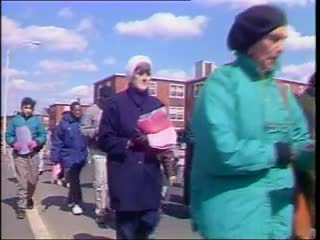
Description: Roxbury residents and clergy march past sites of shootings, singing hymns and carrying cross to commemorate victims of violence.
Collection: Ten O'Clock News
Date Created: 04/13/1990
Description: Marcus Jones interviews Eugene Rivers of the African Peoples Pentecostal Church about his community work in the greater Roxbury neighborhood. Jones notes that Rivers is an outspoken critic of the religious establishment. He adds that Rivers spends a lot of time counseling troubled youth and acting as a legal advocate for them. Rivers talks about his work with neighborhood youth. Rivers says that many troubled teenagers come from disadvantaged socioeconomic backgrounds. Rivers talks about the need for churches to do more to reach out to young people. Rivers says that churches must provide alternatives for young people. Rivers talks about violence in the community and about his commitment to young people in the neighborhood. Jones notes that violence is a problem in the neighborhood. He adds that Rivers is committed to fighting the problem. Jones' report is accompanied by footage of Rivers talking to young people on the street and footage of Rivers' church van, damaged from gunfire.
1:00:06: Visual: Footage of Eugene Rivers (Pastor, African Peoples Pentecostal Church) talking to two young African American men in front of a courthouse. Marcus Jones reports that Rivers is not a social worker; that Rivers spends a lot of time counseling troubled youth. Jones reports that Rivers is the pastor of the African Peoples Pentecostal Church; that Rivers' church holds its meetings at the Freedom House in Roxbury. V: Footage of Rivers being interviewed by Jones. Jones asks how much of Rivers' time is taken up by troubled youth. Rivers says that his wife thinks that he spends too much time. Jones asks Rivers how often he is in the courthouse. Rivers says that he is in the courthouse three or four days per week. Rivers says that a large number of teenagers end up getting into trouble for legitimate reasons; that many these teenagers get into trouble stemming from their socio-economic backgrounds. Rivers says that he tries to make himself available to help these people. Shot of Rivers walking on a sidewalk with a young African American man. Jones reports that Rivers is an outspoken critic of the religious establishment. Jones reports that Rivers believes that religious leaders have failed the young people of Roxbury, Dorchester, and Mattapan. Jones notes that Rivers believes that religious organizations need to provide alternatives to drugs, gangs, and violence. V: Shot of a group of African American teenage boys standing in front of a house. Another group of African American teenage boys rides by on bicycles. Footage of Rivers being interviewed by Jones. Rivers says that churches are the premier institutions in the African American community. Rivers says that churches, including his own, are not doing enough to reach out to young people. Rivers says that the absence of the churches on the street is more conspicuous than the presence of drugs. Shot of Rivers walking on the street with another African American man. Rivers stops an African American teenage boy. Rivers starts talking to the boy. Footage of Rivers being interviewed by Jones. Rivers says that many young men are involved in illegal activities because no other form of activity was available to them. Rivers says that many young drug dealers never had adult role models; that many young drug dealers never had access to any kind of significant alternative. Shot of Rivers walking down the courthouse steps with another man. Jones reports that Rivers speaks from experience when he talks about role models. Jones reports that Rivers was a gang member and drug dealer in Philadelphia before he enrolled at Harvard University. Jones notes that Rivers is trying to make a difference on the streets of a neighborhood where gang violence is commonplace. V: Shot of bullet holes in the windshield of Rivers's van. Footage of Rivers counting the bullet holes on his van. Rivers points out the damage done to his van. Close-up shot of a bullet hole on the side of the van. Jones reports that gang members fired dozens of bullets into the home of Rivers's next-door nieghbor last month. Jones reports that many of the bullets hit Rivers's church van; that two bullets pierced the wall of his home. V: Shot of Rivers and Jones outside of Rivers's home. Shot of a bullet hole in the window of a home. Shots of the broken windows of the church van; of broken glass inside of the van. Shot of a bullet hole in the wall of Rivers's home. Footage of Rivers being interviewed by Jones outside of his home. Jones comments that Rivers's neighbors have moved out of their home. Rivers says that he feels a commitment toward the community; that he wants to make something happen here. Shot of Rivers and Jones framed by the broken window of the van. Jones reports that Rivers, his family and his congregation want to make the African American community aware of its responsibility to change things. Jones reports that Rivers wants the community to work at making improvements instead of blaming outsiders. V: Footage of Rivers being interviewed by Jones. Rivers says that kids will participate in legitimate acitivities if those activities are provided. Jones asks who will provide the activities. Rivers says that African American churches need to come up with alternatives for youth; that the churches should close shop if they fail to provide alternatives. Rivers says that African American churches should become employers, educators, advocates; that the churches should be in the courts and in the jails. Rivers says that the churches have failed to understand the meaning of the gospel if they fail to take up this challenge.
Collection: Ten O'Clock News
Date Created: 08/15/1990
Description: Carolyn Sawyer reports on Reverend John Borders of the Morningstar Baptist Church, and his efforts to reach out to his community. Borders has conducted at least 15 funerals for teenagers who have died as a result of street violence. Interview with Borders, who talks about the problem of violence in the community. He expresses sadness at the number of young people caught up in the violence. Borders says that adults need to spend more time with young people; he adds that teenagers need to know that someone cares about them. Borders talks about his hopes for positive changes in the community. Sawyer's report includes footage of Borders at his church and footage of Borders at his children's school. Sawyer's report also includes footage from the funeral of Charles Hardison and footage of victims of street violence. Following the edited story is b-roll of the Blue Hill Avenue environs near the Morningstar Baptist Church.
1:00:01: Visual: Footage from the funeral of Charles Hardison (Milton teenager) at Ebenezer Baptist Church in Milton. Pall bearers bring the coffin out of the church. Mourners stand outside the church. Shots of African American and white teenagers standing outside of the church; of teenagers consoling each other with hugs. Shot of two white girls hugging an African American boy. Audio of Reverend John Borders (Morningstar Baptist Church) talks about the heartbreak caused by the violent deaths of teenagers. Borders says that he wants peoples' hearts to break when they hear about these tragedies. Footage of Borders and a young African American man praying in a church. Carolyn Sawyer reports that Borders prays for peace in a community afflicted by crime. Sawyer reports that Borders has conducted at least 15 funerals for teenagers who have died. V: Shot of Border's clasped hands as he prays. Footage of Borders being interviewed. Borders recalls some of the funerals of local teenagers. Shot of Borders walking to his car; of Blue Hill Avenue near the Morningstar Baptist Church. Sawyer reports that Borders grew up not far from the church; that Borders had a career in music before entering the ministry. V: Shots of residential homes in Mattapan. Footage of Borders being interviewed. Borders says that there has been a growth of evil in the neighborhood and a decline in values. Borders says that there is a lack of respect for human life. Footage of Borders at a local school. He speaks to a teacher. Borders speaks to a child standing with other children. Sawyer reports that Borders is 32 years old; that Borders has three children of his own. V: Footage of Borders saying that adults need to turn off the radio and the television; that adults need to spend time with young people. Borders says that parents needs to question where kids are getting money if the kids do not have jobs. Borders says that parents need to ban drug money from their homes. Shots of an African American man pulling a shopping cart along a street; of two African American men standing on a sidewalk. Shot of Borders speaking on the telephone. Sawyer reports that Borders preaches for people to return to the community. V: Footage of Borders being interviewed. Borders says that young people need people who care. Borders says that gang members care about other gang members; that some teenagers do not think that anyone else cares. Shot of Borders hand as he speaks on the telephone. Footage of Borders speaking on the phone. Sawyer reports that Borders puts his faith in change; that Borders wants the church to play a role in future changes. V: Shot of Borders in the church. Borders in on his knees as he prays. Footage of Borders being interviewed. Borders says that people will tire of the murder and violence; that people will turn to God. Borders says that the church will play a prominent role in the community. Shots of a body on a stretcher as it is wheeled toward an ambulance; of paramedics tending to an African American woman. Shots of paramedics putting an African American man on a stretcher; of a police cruiser turning a corner.
Collection: Ten O'Clock News
Date Created: 12/17/1990
Description: Human rights activist Dr. Jonathan Fine tells about Iraqi president Saddam Hussein's use of chemical weapons, and brutality to children.
Collection: Ten O'Clock News
Date Created: 08/03/1990
Description: Residents of San Sebastien are innocent victims in El Salvador civil war. Weaver works on loom, stitcher on sewing machine, spinning wheel. Countryside.
Collection: Ten O'Clock News
Date Created: 04/04/1990
Description: Rebecca Rollins reports that the murder rate in the city is rising. She notes that an overwhelming number of teenagers are involved in these homicides. Rollins interviews teenagers Grantley Payne, Michael Duval, and Pinto Triplett about why teenagers carry guns. Payne says that guns provide protection and grant status to teenagers. Payne and another teenager play basketball on an outdoor court. Rollins interviews Franklin Tucker (counselor) about teenagers and guns. Tucker talks about how teenagers obtain firearms. Tucker talks about the lack of programs aimed at preventing violence. He adds that many teenagers involved in violence come from disadvantaged backgrounds. Rollins' report is accompanied by footage of an African American teenager being treated by paramedics. This tape includes additional footage of Payne and another teenager playing basketball on an outdoor court.
1:00:01: Visual: Footage of a body on a stretcher being wheeled by medics to an ambulance; of an African American police officer speaking to an African American male suspect. Shots of Grantley Payne (age 18) and another teenager playing basketball on an outdoor court. Rebecca Rollins reports that the death toll in the city is rising at record pace; that the number of homicides may total 150 by the end of the year. Rollins notes that an overwhelming number of teenagers are involved in the homicides as victims or suspects. V: Shot of medics lifting the body of an African American teenager onto a stretcher. Shots of guns and weapons laid out on a table. Footage of Payne being interviewed. Payne says that guns provide protection and grant status to teenagers. Footage of Franklin Tucker (Barron) being interviewed by Rollins. Tucker says that teenagers are importing their own guns; that teenagers are ordering them by mail from states with lenient gun laws. Barron says that guns are being brought in by bus and car. Tucker says that teenagers are carrying new guns and serious firearms. Rollins reports that Tucker is an expert on the subject of kids, guns, and schools; that Tucker directs counseling services for kids caught with weapons on or near school property. V: Footage of Tucker being interviewed by Rollins. Tucker says that many teenagers carry guns for protection. Footage of Michael Duval (age 16) being interviewed by Rollins. Duval says that fighting and violence have progressed from hands to knives to guns. Duval says that a lot of movies have violence. Duval mentions the 1988 film Colors. Rollins asks why kids carry guns. Pinto Triplett (age 18) says that it is difficult to be a teenager in the projects; that teenagers who carry guns live in rough neighborhoods. Triplett says that many of these teenagers do not come from good backgrounds; that many teenagers cannot get jobs. Triplett says that some of these teenagers are the victims of racial discrimination. Footage of Tucker being interviewed by Rollins. Tucker says that there are no programs focusing on prevention; that society is trying to put these kids in jail. Tucker says that prisons are already overcrowded. Rollins stands in front of a basketball court. A group of teenagers play basketball on the court. Rollins says that the Boston Police Department and City Hall will officials will meet to discuss the problem of guns and violence.
Collection: Ten O'Clock News
Date Created: 12/19/1990