Description: Bill Baird press conference on concerns over abortion clinic bombings and fighting back against them. He describes the types of demonstrations by antiabortion groups and the effects they have on the women who use those clinics. He proposes a "demilitarized zone" between the protesters and the women using the clinics, so that they can continue to receive treatment without being physically abused. He describes interstate efforts of pro-choice groups to analyze the attacks. He expresses anger with the FBI's lack of attention, refusal to classify the attacks as terrorism, and the institutionalized sexism of law enforcement agencies. He says that many abortion clinics are now armed and have increased defenses.
Collection: Ten O'Clock News
Date Created: 01/11/1985
Description: Black students rally on City Hall Plaza because of shooting of black football player Darryl Williams during high school game. Interview with several students who plead for racial unity so everyone can go to school together in peace. Black adult representatives demand that Mayor Kevin White guarantee the safety of students with police details.
Collection: Ten O'Clock News
Date Created: 10/03/1979
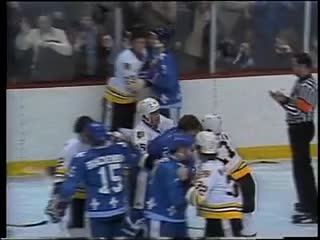
Description: WBZ Channel 4 story on Boston Bruins suspensions for fighting that spilled over into fans in the stands. Mike Milbury, Peter McNab, Terry O'Reilly.
Collection: Ten O'Clock News
Description: (2) clips of Boston Bruins fights, second clip against Montreal Canadians is especially bloody. c. 1979-1980.
Collection: Ten O'Clock News
Date Created: 1979...1980
Description: Boston Mayor Kevin White taped message addressing his concern over the wave of violence resulting from the implementation of the federally mandated busing laws. White states that he has asked Judge Garrity for Federal Marshals to help maintain order and to prevent the further spread of violence. 1974.
Collection: Evening Compass, The
Date Created: 10/08/1974
Description: Evening Compass special. Press conference at Boston City Hall during the second week of Phase I desegregation of Boston schools. Frank Tivnan (Director of Communications for Mayor Kevin White) introduces the speakers at the press conference. John Coakley (Boston School Department) gives school attendance figures and analyzes trends in attendance. Robert Kiley (Deputy Mayor, City of Boston) reports that sixteen people were arrested in South Boston and Roslindale today. Kiley voices his concern about the number of young people involved in violent incidents. Joseph Jordan (Superintendent, Boston School Department) and Charles Barry (Deputy Superintendent, Boston Police Department) report that a bus was stoned while passing the Old Colony Housing Project in South Boston. Jordan and Barry report that 200 people were gathered outside of the housing project in the afternoon. Jordan is optimistic that the tension in South Boston will abate. The officials take questions from reporters about school attendance, police tactics in South Boston and the safety of bus routes.
3:02:56: Visual: Ed Baumeister reports live from Boston City Hall, at a briefing by Mayor Kevin White's office and the Boston School Department, after a day of violence and arrests stemming from court-ordered busing in Boston. Reporters include Walt Sanders and John Henning. 3:03:25: V: Frank Tivnan (Director of Communications for Mayor Kevin White) thanks the media for the opportunity to keep the public informed, then outlines the agenda and introduces the speakers: John Coakley (Boston School Department); Robert Kiley (Deputy Mayor, City of Boston); Joseph Jordan (Superintendent, Boston Police Department); Charles Barry (Deputy Superintendent, Boston Police Department). 3:04:24: V: Coakley reports that 54,000 students (67.4% of projected enrollment) attended classes in grades 1 - 12. Shots of reporters looking at handout sheets and taking notes. Coakley notes that attendance decreased in South Boston High School, Roxbury High School, Gavin and McCormack middle schools and South Boston elementary schools but increased at other schools. Coakley gives further analysis of attendance numbers and notes some logistical issues to be resolved in the schools. 3:06:51: V: Kiley gives an overview of the day's events: 16 arrests in South Boston and Roslindale, and 2 injuries requiring hospital treatment. Shots of reporters taking notes. Kiley notes an upswing in calls from parents reporting bruises and minor injuries to their children in the schools. He says that the city is working hard to control and deter incidents of violence and is concerned at the number of young adolescents (aged 12-13) involved in violent incidents. 3:09:45: V: Superintendent Jordan reports on arrests in South Boston; he notes a slight reduction in tension among citizens. He voices the police commitment to the safety of students, calls the violence "deplorable" and is optimistic that the situation will abate. 3:12:00: V: Deputy Superintendent Barry reports that one student was injured by a projectile thrown at a bus in an incident in front of the Old Colony Project in South Boston; that the fine weather attracted many people to the streets, including 200 people outside of the project. Shots of reporters in audience. Jordan takes the microphone and reports that 2 youths were arrested in Roslindale. 3:13:56: V: The panelists take question from reporters. Kiley responds to questions about a possible NAACP motion for US Marshals to come to Boston. Barry responds to questions about the presence of police or US Marshals on buses. Coakley responds to questions about the accuracy of the school attendance figures. Kiley and Tivnan respond to questions about a communication lag between the site of the incidents in South Boston and the communications center at City Hall. Jordan responds to questions about the reaction of South Boston residents to a police rule banning assembly of large groups of people; about the incident outside the Old Colony Project; about security along bus routes; about new police tactics in the coming weeks; about maintaining personnel on the streets and the possibility of changing the bus routes. 3:22:35: V: The panelists take more questions from reporters. Coakley responds to questions about changes in school enrollment percentages from the day before. Kiley responds to questions about whether African American students are really safe in South Boston; about communication between the city government and community leaders in the Old Colony Project; about whether authorities learned about the incident at the Old Colony Project from MDC police. Barry responds to questions about a possible increased police presence at the Old Colony Project. Jordan responds to questions about whether the increased police presence in South Boston will keep South Boston parents from sending their children to school. Coakley responds to questions about the accuracy of attendance figures at South Boston High School; about whether it is possible to educate students in the environment at South Boston High School. 3:31:30: V: Tivnan closes by asking, "any other questions, gentlemen?" Reporters rise to leave. Kiley comments to Tivnan that there is a woman in the audience. Recording ends.
Collection: Evening Compass, The
Date Created: 09/13/1974
Description: Press conference at the Boston Schools Information Center on day two of Phase II desegregation of Boston schools. Footage is silent until 00:01:37. Robert DiGrazia (Police Commissioner, City of Boston) takes questions about the arrests of 74 members of the Committee Against Racism, and how the police and judiciary process mass arrests in South Boston. DiGrazia also answers questions about police restraint and police response to violence in the streets. Ed Baumeister (WGBH reporter) notes that there are many arrests for minor infractions and few arrests for major incidents. Greg Pilkington (WGBH reporter) questions the police policy of restraint. DiGrazia says that there is a difference between low visibility and restraint; that police are making arrests. J. Stanley Pottinger (Assistant US Attorney General) discusses the presence of federal marshals in Boston and the ongoing federal investigations into violations of the federal court order. Pottinger says that antibusing activity at night can be considered a violation of the court order. DiGrazia says that police are making great efforts to crack down on violence and vandalism during the evening hours. Peter Meade (Mayor's Office) reports on public safety teams in Charlestown. Marion Fahey (Superintendent, Boston Public Schools) reports on school attendance and atmosphere. She gives information on registration for students without school assignments. Reporters ask Pottinger questions about the federal investigations of antibusing activity. Reporters ask Fahey questions about school attendance and low attendance among white students. Fahey says that attendance will improve as parents and students realize that the schools are running smoothly. This tape has visible time code burned in at the bottom of the screen.
0:01:27: Visual: Press conference at the Boston Schools Information Center. Panelists assemble at a table with microphones. Reporters include Ed Baumeister (WGBH), John Henning, Greg Pilkington (WGBH), and Walt Sanders. Ron Brinn (Information Coordinator for Mayor Kevin White) begins to speak. Audio cuts in and out. 0:03:04: V: A reporter asks about the arrests of 74 members of the Committee Against Racism in South Boston, and a related confrontation with a hostile crowd at the South Boston courthouse. Robert DiGrazia (Police Commissioner, City of Boston) says he has spoken to the parties involved and that the problems at the South Boston courthouse were due to a lack of communication; that Chief Justice Flaschner will work with police and local courts to expedite the booking of arrestees; that he had previously met with Flaschner and others to discuss the expeditious booking of mass arrests; that there was confusion in South Boston on the day in question. A reporter asks if there was a firm agreement with all involved in the meeting to hold court in a venue other than the courthouse if necessary. DiGrazia says there was discussion and plans to implement action if necessary. 0:06:34: V: Baumeister points out that many arrests are made for minor infractions and few arrests are made for more serious acts of violence. DiGrazia responds that there have been quite a few arrests for acts of violence; that members of the Committee Against Racism needed to be moved in order to avoid a major confrontation along a bus route; that the police are trying to neutralize a dangerous situation; that police are showing great restraint. Pilkington points out that restraint by police was not effective during the previous year. DiGrazia interrupts him by saying that there is a difference between low visibility and restraint; that police are actively making arrests this year, but are showing restraint. Reporter asks if there is discussion of calling in the National Guard to aid police at night. DiGrazia says that police are working long hours but performing well; that there are no plans at present to call in the National Guard. 0:09:38: V: A reporter asks about the possibility of federal charges being brought against some arrestees. J. Stanley Pottinger (Assistant U.S. Attorney General) responds that charges are being investigated; that federal and state charges may be lodged; that he is personally involved with five investigations. A reporter asks how federal marshals can aid police in the evening if their mandate is to enforce the federal court order. Pottinger says that certain actions outside of school hours could be handled by the federal marshals as violations of the federal court order; that federal marshals are there to assist police; that federal marshals are working long hours. Pottinger confirms that the Justice Department is investigating an incident at the JFK Home and a Molotov cocktail incident; that they are investigating reports of direct intimidation of individuals trying to comply with the court order; that they are investigating some arrests for the assault of police officers. 0:12:38: V: Pilkington asks if the violence committed by youth gangs in Charlestown constitutes a violation of federal law. Pottinger says that the violence may be a violation, especially if the violence involves an assault on a police officer or a fire official. Reporter asks what will be done about nighttime violence and vandalism. DiGrazia says that he will increase police numbers in Charlestown and South Boston; that police will be assisted by federal marshals; that federal marshals will investigate assaults on police officers. A reporter asks Peter Meade (Mayor's Office) to clarify a statement indicating that he has complaints against the media. Meade says that it was a humorous statement directed at a reporter whom he knows well; that he would like to clarify a his answer to a question from yesterday about police presence in Charlestown. 0:15:31: V: A reporter asks Meade what public safety teams are doing to prevent violence and vandalism in Charlestown. Meade says that several people are on the streets trying to calm the situation; that Roberta Delaney (Manager, Charlestown Little City Hall) will hold a meeting that afternoon with a public safety team; that antibusing leaders in Charlestown have made it clear that they do not support violence. A reporter asks DiGrazia to compare today's violence in Charlestown to that of the previous day. DiGrazia says that police did a good job in defusing a difficult situation today. A reporter asks if federal marshals will be on duty for the evening. Pottinger says that the federal marshals will not be on patrol; that they will be available upon request from police. 0:18:09: V: Brinn introduces Marion Fahey (Superintendent, Boston Public Schools). Fahey thanks the public safety officials. Fahey says that attendance is up for both African Americans and whites; that there has been one suspension and no arrests; that the climate in the schools is good; that extracurricular activities are proceeding. Commissioner DiGrazia excuses himself and leaves. A reporter asks Fahey about low white attendance in West Roxbury. Fahey responds that they are watching the situation and will contact students who are absent. Reporter comments that attendance in elementary schools is primarily African American. Fahey says that some white parents may be waiting to assess the climate at the schools before sending their children; that she is confident that white attendance will go up. 0:21:37: V: A reporter asks Pottinger if there are some individuals under investigation who have not been arrested. Pottinger says yes, but that he will not give details. A reporter asks Fahey about students who have not yet been assigned to school. Fahey gives information on two sites where student registration will be held on the following day. Fahey asks the media to disseminate the information. Fahey says that 800 students were processed in last week's preregistration; that 400 students were processed today; that she has no way of knowing how many students still need school assignments. Fahey tells a reporter that she has no information on the suspension of an African American male student today. A reporter asks Fahey about plans to assess student achievement in the desegregated schools. Fahey says that she is working with consultants on assessing math and reading; that attendance is another indication of school performance. 0:25:21: V: Brinn interrupts to clarify Pottinger's title as he prepares to make a statement. Pottinger explains that he will be absent for a few days for personal reasons; that Robert Murphy (Civil Rights Division, US Justice Department) will be in charge in his absence. Brinn checks with Meade to see if he has a statement, then invites more questions. A reporter asks Pottinger for more detail on investigations of people who have not been arrested. Pottinger says that the investigations are centered on intimidations and threats to those trying to comply with the court order; that the FBI is investigating allegations; that it is possible to move quickly toward indictment if the evidence is sufficient; that he cannot predict when or if an indictment will occur. A reporter asks Pottinger about the five investigations he is involved with personally, and whether they concern people who have not been arrested. Pottinger says that he is familiar with five investigations concerning threats and intimidation as well as arrests made by the state; that there may be other investigations; that there are sitting grand juries available to hear these cases; that he does not think it will be necessary to empanel a grand jury. 0:28:49: V: A reporter asks Fahey where the 25,000 absentee students are. Fahey responds that she does not know. A reporter asks for a summary of the attendance figures. Robert Donahue (Boston School Department) says that the attendance has increased; that some parents have kept children out of school; that attendance will increase as it becomes clear to parents that schools are functioning normally. Fahey gives a rundown of attendance figures for the first and second days of school: that attendance was 60.3% and 64.1% at the high schools; that attendance was 60.1% and 65.8% at the middle schools; that attendance was 58.1% and 64.9% at the elementary schools. 0:30:44: V: Brinn thanks the panelists and closes the press conference. Baumeister gives a summary of the conference. Reporters mill around the room.
Collection: Evening Compass, The
Date Created: 09/09/1975
Description: Marcus Jones reports that the Dorchester Youth Collaborative (DYC) provides a safe haven from street violence for young people in the area. Jones reports that some young people at the DYC have formed their own music groups and write their own songs. Jones interviews Robert Bostic (15-year old Roxbury resident) and his friends. Bostic says that he is using rap music to send a positive message. Jones also interviews Al McClain (DYC counselor), who talks about the impact of the DYC on the lives of the neighborhood teenagers. Jones reports that the DYC-member group One Nation has released an album. Jones interviews DeMaul Golson (DYC member) and other members of the group One Nation. Jones also interviews Todd Maxell (16-year old Roxbury resident), who says that teenagers will listen to anti-violence messages from their peers. The report includes footage of Natalie Jacobson (WCVB-TV) and R.D. Sahl (WNEV-TV) reporting on crime in Roxbury. The report also features footage of teenagers at the DYC, footage of the members of One Nation performing on stage and footage from a video produced by teenagers at the Roxbury Boys and Girls Club. This tape includes additional footage of DYC members and a music video called "Stand Back From Crack" filmed inside Back Bay Station.
1:00:29: Visual: Footage of the members of the group One Nation dancing and performing on stage. Footage from WNEV of R.D. Sahl (WNEV reporter) reporting on gang violence in Roxbury. Footage from WCVB of Natalie Jacobson (WCVB reporter) reporting on shootings in Roxbury. Shots of paramedics wheeling an injured African American woman out of a building; of police vehicles and an ambulance on a street in Roxbury; of paramedics tending to an injured African American patient inside of an ambulance. Marcus Jones reports that a group of Roxbury youngsters are not surrenduring to the violence in Roxbury. V: Footage of Robert Bostic (15-year old Roxbury resident) sitting with a group of his friends. Bostic says that he wants to set a good example for young people; that young people should avoid violence. Bostic says that he and his friends are using rap to send a positive message. Jones reports that Bostic and his friends are members of the Dorchester Youth Collaborative (DYC). V: Shots of Bostic and other members of the Youth Collaborative; of a sign for the Youth Collaborative. Shots of African American youth entering the Youth Collaborative building. Footage of Al McClain (Counselor, Dorchester Youth Collaborative) saying that the Youth Collaborative has had a great impact; that some of the members of the Youth Collaborative used to be in gangs. Shots of members of the youth collaborative dancing to rap music; of Jones sitting with the members of the youth collaborative. Jones reports that some of the members of the Dorchester Youth Collaborative have formed groups to make music. Jones notes that some of the youth write their own music; that the DYC member group One Nation has released an album about AIDS. V: Shot of the cover of an album by the group One Nation. Footage of One Nation members performing a rap song about street violence. Footage of Jones interviewing DeMaul Golson (DYC member) and two other African American male DYC members. Jones asks the boys if they are scared by the street violence. The boys say yes. Golson says that his cousin was shot in the back; that his cousin is dead. Footage of One Nation members performing on stage. Jones reports that the DYC members are determined to rise above the violence. Jones notes that members of the Roxbury Boys and Girls Club are also doing their best to fight the violence. V: Footage of a video produced by members of the Roxbury Boys and Girls Club. Footage of Bostic saying that most kids are not going to listen to their parents' advice; that kids are influenced by the people on the streets who are making money from drugs. Footage of Todd Maxwell (16-year old Roxbury resident) saying that kids might listen to their peers if their peers tell them not to do drugs. Shots of an African American man being led into a police station by police officers; of police standing near a cordoned-off crime scene.
Collection: Ten O'Clock News
Date Created: 02/01/1989
Description: Violence against Cambodians in Revere.
Collection: Ten O'Clock News
Date Created: 01/09/1987
Description: "Children of War" tour brings teens from countries of violence and political strife to speak to Brighton High students about fighting for freedom.
Collection: Ten O'Clock News
Date Created: 03/19/1990