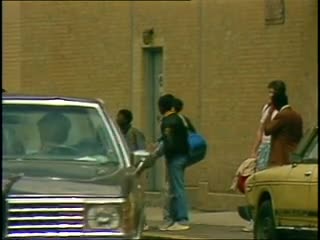
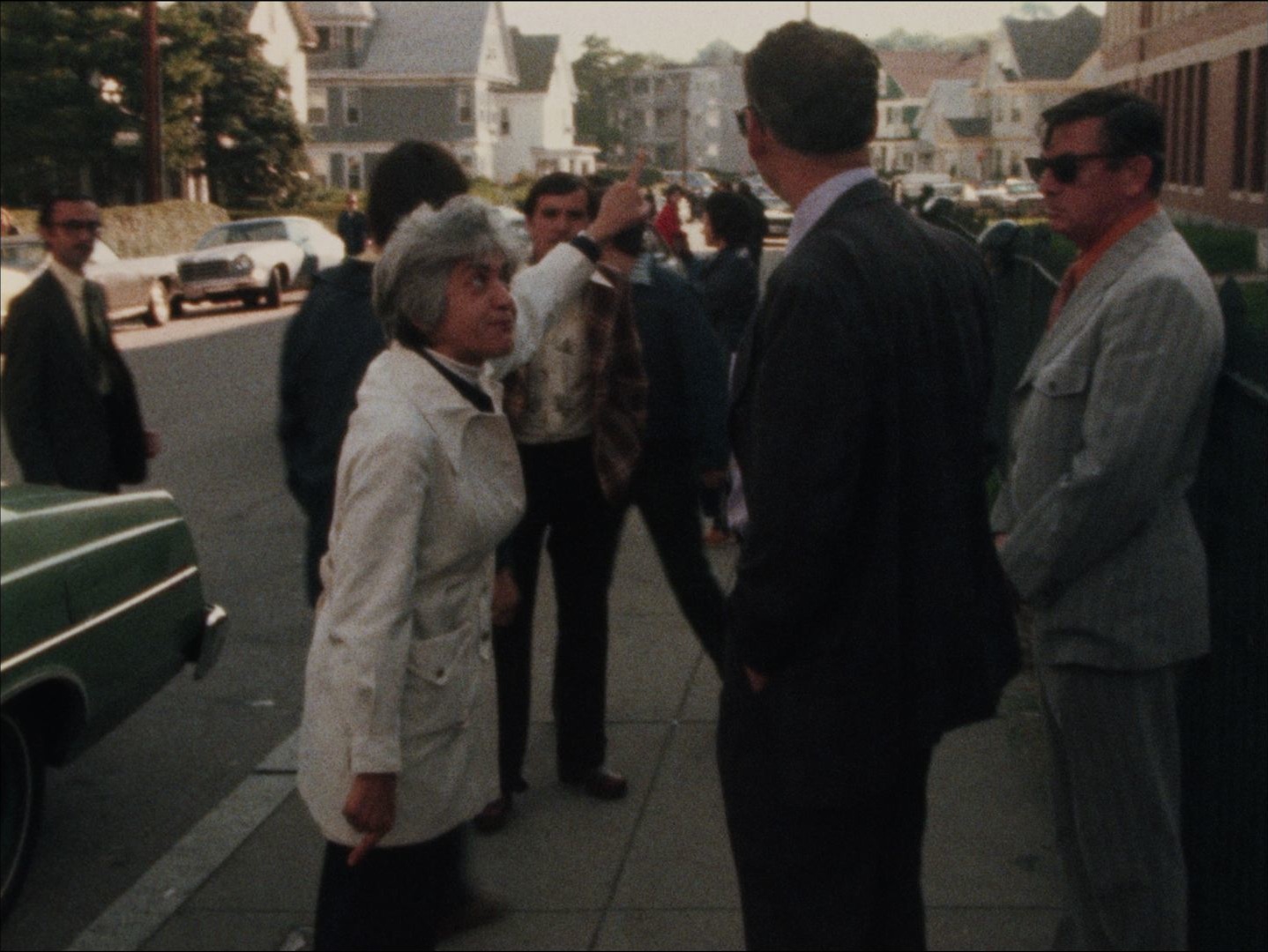
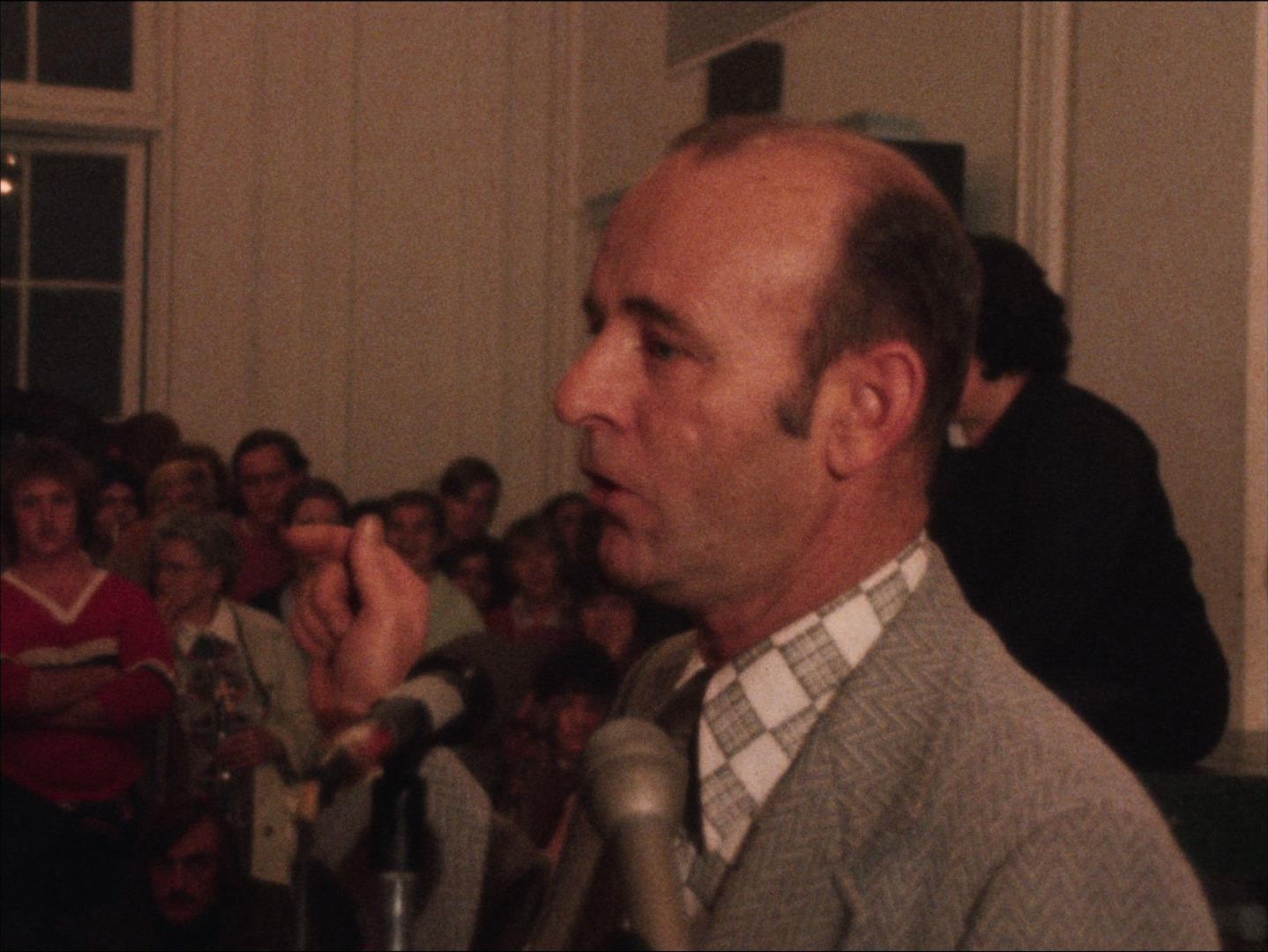
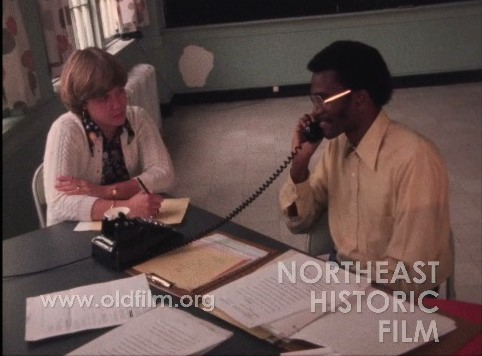
Description: Exterior South Boston High, first day of school on staggered opening schedule. Police on steps. Tilt up facade. White students walk up to school. Jerome Wynegar out front. Boston Police bus pulls up. Wynegar comments on insufficient buses to bring black students from distant neighborhoods because of contract dispute and the disruption of the staggered opening schedule. Press photographers. Person on the street interview with white mother, Evelyn Gorhan, who waited with daughter for bus that never came. Black mother, Edna Calhoun from Roxbury says she will not send her son to school until buses are available. Calhoun and another black woman, Frankie MacDonald, report rocks and expletives hurled at them. Shots of the children. “Nigers suck” graffiti on brick housing project.
Collection: Ten O'Clock News
Date Created: 09/07/1977
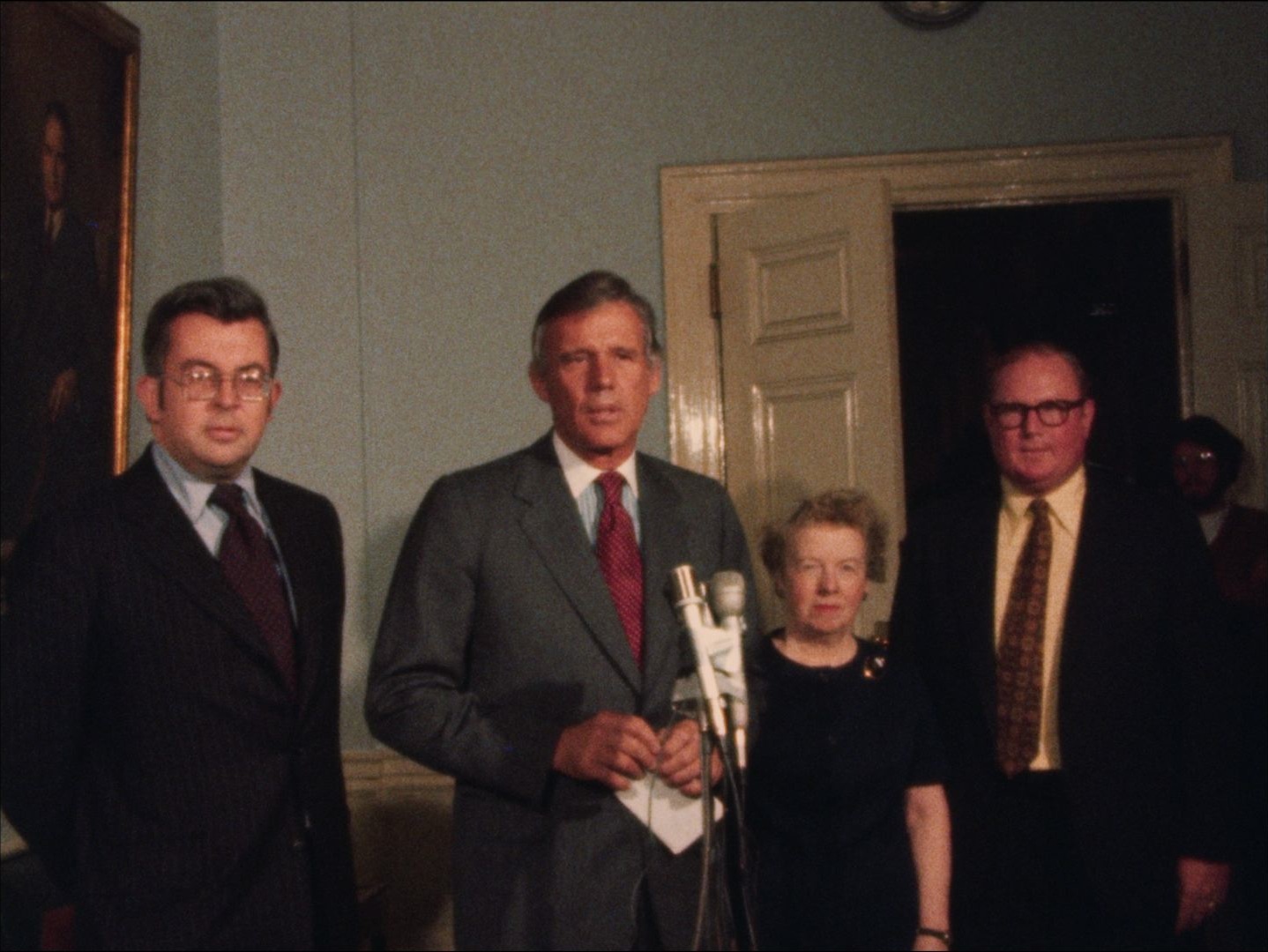
Description: Kevin White press conference. Interview with James W. Hennigan, former Chairman of the Boston School Committee, who speaks against busing for school integration. Kevin White speaks about the failure of the Racial Imbalance Law and the Boston Public School System. Hennigan sitting at his desk in the chambers of the Boston School Committee, and cutaways from the interview. Mix of silent and sound.
Collection: WCVB Collection
Date Created: 04/10/1973
Description: Boston mayoral debate from the 1975 campaign. 1975 mayoral campaign debate in WGBH studio, moderated by Pam Bullard, Ed Baumeister, and Gary Griffith, between Mayor Kevin White, Robert Gibbons, Senator Joseph Timilty, and Norman Oliver. Main topic is busing for school integration. Timilty believes that busing is a waste of resources; Gibbons believes that busing was forced by government and should be stopped. Discussion of budget: White is attacked for his handling of state funds. Timilty claims Boston is on verge of bankruptcy. White claims that he has tried to take politics out of City Hall. There is much bickering between Baumeister and Gibbons. Oliver says that Boston Police Department is not operating in the interest of the black community in the city. Timilty gives closing address, talks about type of city citizens want. Oliver closing address: vows to stand up against racism. Gibbons closing address: create neighborhoods for productive working class. White closing address: proud of his record in eight years as mayor. Talks about trying to balance the city fiscally. Ed Baumeister signs off.
Collection: Evening Compass, The
Date Created: 09/02/1975
Description: A compilation of three Evening Compass shows from 1974-75. Evening Compass newscast from September 12, 1974. Paul deGive reports on the first day of school at the Rochambeau Elementary School. He reports that some parents, including Barbara King (local resident), are keeping their children out of school for fear of violence. Judy Stoia reports on the peaceful opening of the Martin Luther King School. Greg Pilkington and Diane Dumanoski report on their experiences riding buses with students to and from South Boston High School and Hyde Park High School. The bus Pilkington rode on was stoned in South Boston. Pilkington and Dumanoski report on the reactions of students. Joe Klein reports on the first day of school for a Hyde Park student, bused to the Lewenberg School in Mattapan. Klein reports that the student says that he will return to school tomorrow. Evening Compass newscast from December 12, 1974. Stoia reports on a violent mob gathered outside South Boston High School after the stabbing of a white student by an African American student. Stoia reports on clashes between the crowd and police. Pilkington reports from the Bayside Mall, where African American students arrived on buses after being trapped for several hours in South Boston High School. The students and their parents are angry and frightened. Peggy Murrell reports on the reactions of Thomas Atkins (President, NAACP) and Mel King (State Representative) to the violence at South Boston High School. Murrell reports that Atkins and King say that schools should be shut down if the safety of African American students cannot be guaranteed. Pam Bullard reports that the plaintiffs in the Boston school desegregation case (Morgan v. Hennigan) will demand that the federal court increase safety measures for African American students in South Boston. She also reports on a pending deadline for the Boston School Committee to file a school desegregation plan for 1975. Bullard notes that the School Committee risks being held in contempt of court if it does not file a plan. Evening Compass special from March 14, 1975. Pam Bullard reviews the major events concerning the desegregation of Boston schools in 1974. Her report includes footage and still photos of key figures and events in the busing crisis. Judy Stoia reports on an alternative school in Hyde Park, created by white parents to avoid busing, and on an alternative school for African American students. White parents at the alternative school in Hyde Park say that African American students are welcome to attend their school. Baumeister reports on Raymond Flynn, the only mayoral candidate to campaign on an antibusing platform. Baumeister also analyzes busing coverage by The Boston Globe and The Boston Herald American. Bullard reports on the school desegregation plan for the 1975-76 school year. Her report includes comments by Peter Ingeneri (Area Superintendent, Dearborn District) and Isaac Graves (Manager, Roxbury Little City Hall. She reports on segregation among Boston school faculty and administrators, and on plans to integrate school faculty in 1975. End credits reflect personnel working on all Evening Compass shows for the weeks of December 12, 1974 and March 14, 1975. Produced and directed by Charles C. Stuart.
0:00:15: Ed Baumeister introduces Paul deGive's report on the first day of school at the Rochambeau Elementary School in Dorchester. DeGive reports that the opening was peaceful; that a rumored white boycott failed to materialize; that buses were empty; that the absentee rate was 50% for both white and African American students. Degive comments that many parents were present at the opening. DeGive reports on an interview with Barbara King (local resident) who was present to observe the opening but did not send her daughter to the school for fear of violence. The nearby Murphy school also opened without incident. The attendance rate at the Murphy was estimated at two-thirds. 0:02:50: Baumeister introduces Judy Stoia's report on the Martin Luther King School. Stoia reports on the peaceful opening of the Martin Luther King School, which had been an African American school the previous year: the attendance rate was 50%; 130 white students attended, out of a possible 634; many parents kept their children at home because the King school was expected to be a trouble spot. 0:04:25: Baumeister talks to reporters Greg Pilkington and Diane Dumanoski. Pilkington spent the day with African American students who were bused into South Boston. Pilkington describes the students' reactions to their arrival at South Boston High School and their departure on buses which were stoned by an angry crowd. Diane Dumanoski describes a peaceful bus ride to Hyde Park High School with just one white student on the bus. Pilkington remarks on the low attendance at South Boston High School and describes the teachers as tense and ambivalent about busing. Dumanoski describes hostility from some white students at Hyde Park High School. 0:11:46: Baumeister reports on statistics: 47,000 students out of possible 70,000 attended Boston schools; police made 6 arrests; buses made 450 runs. Joe Klein reports on the first day of school for Jimmy Glavin, a Hyde Park student bused to the Lewenberg school in Mattapan. Visual: Report is a montage of still photographs. Shots of a photo of Claire O'Malley (bus monitor); of Glavin waiting for the bus; of Glavin on the bus. Klein reports that Glavin was the only student at the first stop; that the bus made several stops; that some parents refused to put their children on the bus. Klein reports that children of non-local parents in Coast Guard housing attended school. V: Shots of photographs of students and parents at various bus stops. Shots of photographs of students boarding the bus. Klein reports that the Lewenberg school was quiet; that the nearby Thompson School was quiet; that there were few white students in attendance at the Thompson School. Klein reports that the white students left the Lewenberg School on buses in the afternoon. Klein notes that Glavin says that he will return to school the next day. V: Shots of photographs of students in classrooms. Shots of photographs of students exiting the school and boarding buses; of Glavin exiting the bus. Baumeister ends the show. 0:16:17: Baumeister introduces the show. (Opening credits are cut.) Judy Stoia reports on violence at South Boston High School, where an African American student stabbed a white student. Stoia reports that an angry crowd of 1500 people had assembled outside of the high school by 1:00pm. Stoia reports that Louise Day Hicks (Boston City Council) tried to calm the crowd. V: Shots of photographs of huge crowds assembled on G Street, in front of the school; of helmeted police officers keeping the crowd at bay. Shot of a photograph of Hicks. Footage of Hicks assuring the crowd that the assault will be investigated. William Bulger (State Senator) stands beside Hicks. Hicks pleads with the crowd to let African American students return home safely. The crowd boos Hicks. Stoia reports that the crowd was hostile to police; that police units from the Tactical Patrol Force (TPF), the MDC Police Department and the Massachusetts State Police Department were outnumbered by the crowd; that the crowd threw bricks and bottles at police. Stoia reports that the crowd angrily stoned school buses headed toward the school. V: Shots of photographs of the huge crowd; of a TPF unit; of an MDC police officer on a motorcycle; of mounted police on the street. Shots of photographs of a police car with a broken window; of arrests being made. Shots of photographs of the crowd; of stoned school buses. Stoia reports that the buses were decoys and that African American students had escaped through a side door and were bused to safety. V: Shots of photographs of a side entrance of South Boston High School. 0:21:06: Pilkington reports on atmosphere at the Bayside Mall, where buses arrived with African American students who had been trapped in South Boston High School. Pilkington reports that students and parents were frightened and angry. V: Footage of buses and police officers in the mall parking lot. Angry groups of African American students speak directly to the camera about their experiences in South Boston. One student comments on the angry and violent parents in the South Boston crowd. An angry African American woman says that white children go to school peacefully at the McCormack school in her neighborhood, but that African American students cannot go safely to South Boston. She says that Kevin White (Mayor, City of Boston) is not doing his job. A man shouts into a bullhorn that there is no school on Thursday or Friday. Pilkington reports that the anger of the African American community seems to be directed at the city, the police, and the Boston School Committee for not controlling the situation in South Boston. 0:22:55: Peggy Murrell reports on the reaction of Thomas Atkins (President, NAACP) and Mel King (State Representative) to the violence at South Boston High School. She says that both leaders are determined to continue with school desegregation; that both are concerned for the safety of African American students in the schools. She quotes Atkins as saying that schools should be shut down and students should be reassigned if the safety of African American students cannot be guaranteed. Murrell reports that King agrees with Atkins about shutting down the schools if safety cannot be assured; that King says African American students will continue to attend school despite the violence. V: Shots of photographs of Atkins and of King. Murrell quotes King's condemnation of the violence at South Boston High School. Murell reports that Atkins charged the South Boston Home and School Association with holding a racist rally inside the high school and with encouraging a school boycott by white students. Murell says that Virginia Sheehy (South Boston Home and School Association) denies the charges. Murell reports that Sheehy says that white students should be able to hold meetings in school just like African American students do. State Senator William Owens (Chairman of the Emergency Committee Against Racism in Education) agrees that schools should be shut down if a peaceful solution cannot be found, and says that a march against racism planned for Saturday will proceed. 0:26:52: Pam Bullard reports on a special hearing before Judge Garrity planned for the next day: the African American plaintiffs in the desegregation case (Morgan v. Hennigan) have called the hearing to demand the following: the presence of state police and the national guard in South Boston; a ban on parents in schools; a ban on gatherings of more than five people in South Boston; a ban on the use of all racial epithets. Bullard reports that Eric Van Loon (attorney for the plaintiffs) says that South Boston will not escape desegregation. Bullard notes that the Boston School Committee is under court order to file a second phase desegregation plan on the following Monday; that the new plan will desegregate schools city-wide and will allow parents to choose between flexible and traditional educational programs. V: Footage of John Coakley (Boston School Department) talking about the differences between the traditional and flexible program choices under the new plan. Coakley says that the new plan allows parents to choose programs, but not specific schools. Bullard reports that the Boston School Committee has repeatedly refused to endorse any form of desegregation; that the committee risks being held in contempt of court if they do not approve a plan to submit to the court. Bullard reports on speculation that William Leary (Superintendent, Boston Public Schools) will submit the plan without the approval of the School Committee, to avoid being held in contempt of court. 0:31:56: Baumeister comments on the silence of both Mayor Kevin White and Governor Frank Sargent regarding the violence in South Boston. V: Footage of White on September 12, 1974, condemning violence and promising that it would not be tolerated. Credits roll. 0:34:14: Evening Compass special: The Compass Weekly: A Delicate Balance. Pam Bullard's report sums up the events concerning the desegregation of schools in Boston during the 1974 school year. V: Report includes footage of antibusing demonstrations at City Hall Plaza in August and September of 1974; of William Reid (Headmaster, South Boston High School) reporting low attendance figures on September 13, 1974; of white students and black students discussing forced busing outside of Hyde Park High School; of a car on the street with two KKK signs displayed; of Kevin White addressing the busing issue on October 8, 1974; of Gerald Ford stating his opposition to forced busing on October 9, 1974; of national guardsmen on October 16, 1974; of students discussing their feelings about busing; of William Leary (Superintendent, Boston School Department) announcing the reopening of South Boston High School on January 7, 1974. Report also includes footage of children in classrooms, antibusing protests, school buses escorted by police, police in South Boston, and still photos of important figures in the busing controversy. 0:45:27: Stoia reports on alternative schools set up in Hyde Park by parents opposed to forced busing. Stoia reports that some teachers are accredited and are paid from the students' fees; that the curriculum is similar to public school curriculum and classes are smaller. V: Footage of a teacher and students in an alternative classroom. Footage of Henry Lodge (Hyde Park parent) being interviewed by Stoia. Lodge talks about the good education provided by the alternative schools; about parents' need to escape from forced busing and inferior public schools. Stoia reports that 125 white students attend alternative schools in Hyde Park and South Boston; that organizers plan to open Hyde Park Academy, which will have its own building to accommodate 500 students; that these schools are open to African Americans, but are mostly white. Stoia reports on an alternative school for African American students. V: Footage of African American teacher and students in an alternative classroom. Stoia reports that African American parents do not want to send their children into a hostile environment. Stoia remarks that parents are looking for "quality education," which is a term often heard in the desegregation debate. V: Footage of Thomas Atkins (President of the NAACP) calling on leaders to stop politicizing the school desegregation process. 0:49:22: Baumeister comments that many Boston residents are opposed to busing but that Raymond Flynn is the only mayoral candidate opposed to busing. Baumeister reports that Flynn campaigns on the busing issue and is the only antibusing politician to run for mayor. V: Shots of still photographs of candidates White, Thomas Eisenstadt, and Flynn. Shots of photographs of busing opponents Louise Day Hicks, William Bulger (State Senator), Avi Nelson (radio talk show host). Baumeister reports on media coverage of busing by The Boston Globe and The Boston Herald American. Baumeister reports that both papers urged compliance with the court order and played down any violence resulting from desegregation; that the Globe is especially distrusted by the antibusing movement; that antibusing leaders have set up their own information centers; that television stations have largely escaped the anti-media feeling of the anti-busers; that a large media presence will exacerbate the tense situation. V: Shots of front-page busing coverage in The Boston Globe and The Boston Herald American. Footage of William Reid (Headmaster, South Boston High School) on September 15, 1974. Reid tells the media to stop filming and photographing his students. 0:54:15: Bullard reports on the peaceful integration of some schools and on the next phase of school desegregation in Boston, which will include schools in Charlestown, East Boston, and Roxbury. V: Footage of Peter Ingeneri (Area Superintendent, Dearborn District) on November 21, 1974. Ingeneri talks about larger social problems which will make school desegregation difficult in Roxbury. Footage of Isaac Graves (Manager, Roxbury Little City Hall) on January 9, 1975. Graves talks about African American commitment to better schools and integration. Footage of Chris Mitchell (student) on January 9, 1975. Mitchell talks about how important it is to graduate from high school. Report also includes footage of students boarding buses; of students in integrated classrooms; of African American schoolchildren; of buses transporting schoolchildren. Bullard reports on a Supreme Court ruling which dealt a blow to the antibusing movement's plan to include the suburbs in desegregation. Bullard reads statistics regarding the segregation of Boston school teachers and administrators. She reports on the plan to integrate teachers and administrators and to hire more African Americans in the school system. Bullard reports on the budget for police and security required to desegregate Boston's schools; on expectations for more resistance to busing in the next school year; on efforts to reverse or stop the court order. V: Credits roll over footage of African American students boarding buses.
Collection: Evening Compass, The
Date Created: 09/12/1974
Description: African American and white students exit from separate buses and join other students entering West Roxbury High School. US Marshals stand in front of the school. Robert Donahue (District Superintendent, Boston Public Schools) greets students as they enter the school. More buses drop off students at the school. Robert DiGrazia confers with officials and enters the school. A white teacher affectionately greets some African American students as they arrive at school. Administrators use two-way radio to communicate with approaching buses. Donald Burgess (headmaster, West Roxbury High School) talks to students about bus schedules as they approach the school from the parking lot.
0:10:07: Visual: Robert Donahue (District Superintendent, Boston Public Schools) greets African American students as they exit a yellow school bus. A police officer stands near the bus as the students exit. White students exit a second bus pulled up behind the first bus. White and African American students from the separate buses walk toward the entrance of West Roxbury High School. Groups of white students gather in the courtyard. Three more buses pull up to the school. White students exit the first bus. African American students exit the second and third buses. Students walk toward the entrance of the school. A group of white male students is gathered to the side of the walkway. Donahue breaks up the group and they walk easily toward the school. Three US Marshals stand on the sidewalk in front of the school. Donahue greets the US Marshals. White students continue to stream into the school, walking past the US Marshals. Donahue talks and gestures good-naturedly with a white male student on crutches. Another school bus pulls up. African American students exit the bus and walk toward the school. Groups of African American and white students enter the school. 0:08:03: V: Robert DiGrazia (Police Commissioner, City of Boston) speaks with officials gathered to the side of the walkway leading to the school. DiGrazia enters the school. White students are gathered outside of the school on the walkway. Donald Burgess (headmaster, West Roxbury High School) moves among the students with a walkie-talkie. Burgess encourages the students to enter the school. Students finish their cigarettes and make their way into the school. Members of the media film the inside of the school through a classroom window. 0:09:40: V: Another bus pulls up to the school. African American students exit the bus and walk toward the school. A teacher and a police officer supervise the students as they exit the bus. School officials and the police officer confer outside of the school. Donahue speaks into a walkie-talkie. A white teacher greets African American students affectionately as they exit the bus. He pats them on the shoulders and shakes their hands. A group of white female students walk up the steps from the school parking lot. They are followed by a group of white male students. Burgess speaks to the students as they walk up the steps. Donahue and Burgess confer about logistics. A large group of white and African American students make their way across the parking lot toward the school. Burgess speaks to some of the students about bus schedules as they approach the school. 0:16:50: V: US Marshals continue to stand in front of the school.
Collection: Ten O'Clock News
Date Created: 09/13/1976
Description: Crowd of anti-war veterans and other anti-war protesters on Lexington Green. Police arrest them and escort them into school buses. American flag waving in wind at night. Police officer makes an announcement to the crowd. Man addresses an full auditorium. Men in suits walk with protesters. John Kerry in fatigues talks with men in suits and marches with protesters. They walk into Robert F. Kennedy Hall.
Collection: WHDH
Date Created: 05/29/1971
Description: David Boeri reports that the US Circuit Court of Appeals has ruled that the Boston Public School System is desegregated. Boeri reports that the Marshall Elementary School is less racially integrated now than it was before court-ordered desegregation began in 1974. He notes that the school population was 50% white when the school opened in the 1970s; he adds that the school population is now 8% white. Boeri interviews Jack Wyatt (Teacher, Marshall Elementary School), Elaine Rundle (teacher, Marshall Elementary School) and Lou Tobaski (Principal, Marshall Elementary School) about school desegregation at the Marshall Elementary School. Boeri notes that there are no educational problems at the school. He adds that the school faculty has been successfully integrated. Boeri interviews Jane Bowden (parent). Bowden says that the school is excellent. Boeri notes that the school is not racially balanced but that it is in compliance with the court order. Boeri's report is accompanied by footage of students and teachers in classrooms at the Marshall Elementary School. This edition of the Ten O'Clock News also included the following item: Marcus Jones reports on integration at the Lee Elementary School Lee School is a successful integrated school
1:00:05: Visual: Footage of a white teacher singing a song with elementary school students in a classroom at the John Marshall Elementary School. Most of the students in the class are African American. Shot of a white male student in the classroom. David Boeri reports that the Marshall Elementary School opened 17 years ago as a neighborhood school; that 50% of the students were African American and 50% of the students were white when the school opened. Boeri notes that 8% of the school population is white in 1987. Boeri adds that the US Circuit Court of Appeals has ruled that the Marshall School is desegregated. V: Footage of Jack Wyatt (teacher, Marshall Elementary School) saying that the school is not racially balanced; that the school was racially balanced when it opened. Shot of a white male student standing at the front of the classroom. Footage of Elaine Rundle (teacher, Marshall Elementary School) saying that many of the bright African American students are bused to the suburbs through METCO (Metropolitan Council for Educational Opportunity). Shots of an African American teacher teaching to a classroom of African American students. Boeri reports that two buses transport children to and from the school; that one of the buses brings African American students to the school; that African Americans comprise 61% of the school's enrollment. V: Footage of Rundle saying that she does not know why African American students are bused to the school. Shot of African American students walking away from the school. Boeri says that there do not seem to be educational problems at the school. V: Footage of Boeri interviewing Jane Bowden (Marshall School parent). Bowden says that she did opposed busing at first; that she refused the opportunity to put her children in a different school. Bowden notes that the Marshall School is "excellent." Shot of Bowden's children getting into her car. Footage of Boeri interviewing Lou Tobaski (Principal, Marshall Elementary School). Tobaski says that the school has been able to convince the white parents to keep their children in the school; that the children are receiving a good education. Tobaski says that the school is mostly African American because the surrounding neighborhood has mostly African American residents. Boeri notes that African American and Hispanic residents have moved into the neighborhood surrounding the school. V: Footage of an African American teacher in a classroom with mostly African American students. Shots of individual students. Boeri notes that the school has received more money from the School Department because of desegregation; that the staff at the Marshall School is integrated. Boeri adds that the school is not racially balanced; that the school is in compliance with the court order. V: Footage of Tobaski saying that the Boston School Committee has done its best to integrate the public schools; that not much more can be done.
Collection: Ten O'Clock News
Date Created: 09/29/1987
Description: Leader: P1 Southie Info Center #10179 10/10/74; South Boston Information Center. Interviews with men and women about their reaction to a statement from President Gerald Ford that he is against busing for school integration. Women with Stop Forced Busing pins on get information and flyer. A woman attaches a pin to a boy's coat. Silent b-roll of decorations around the office and volunteers answering phones. More interviews. Mary McKay reporter standup.
Collection: WCVB Collection
Date Created: 10/10/1974
Description: No audio at the beginning. Horse-mounted police officers, police cars, police bus. Police officers are gathered along G Street outside of South Boston High School. Exteriors of the school building. School buses, accompanied by a police motorcycle escort, pull up outside of the school. African American and white students exit the school. White students walk away from the school. African American students board the buses. The buses depart. Pam Bullard interviews four South Boston High School teachers: Jerry Power, Bob Healey, Bob Donovan, and Paul Grueter. The four teachers says that conditions in the school are improving, despite negative reports in the media. Donovan says that Judge Arthury Garrity (federal judge) is among those receiving inaccurate reports about the school. They discuss some of the good things that they think are happening in South Boston High despite the racial tensions.
1:00:04: Boston Police Department vehicles are lined up along the side of the road in South Boston. A mounted police officer exercises his horse. A horse stands in a yard with grass. 1:02:21: Visual: Boston Police Department vehicles are parked in the schoolyard of South Boston High School. Police are gathered along G Street in front of the high school. Shot of the exterior of South Boston High School. A Massachusetts State Police vehicle is parked in the schoolyard. A Boston Police station wagon is parked on G Street. 1:04:55: V: Buses pull up in front of South Boston High School. The buses are accompanied by a police motorcycle escort. White students exit the high school, walking out of the schoolyard. African American students exit the high school and walk toward the buses. A young African American male student raises a clenched fist and looks at the camera. Some white students continue to exit the school, along with African American students. Two African American female students pose for the camera and say, "Hi, mom." A few of the African American students wave at the camera as they walk to the buses. Police officers stand casually on the sidewalk in front of the buses. A white student walks by the camera crew and says, "We don't watch Channel 2 news." 1:10:13: V: A group of four police officers are gathered on G Street. They laugh casually at a joke. A female African American student rushes toward her bus. Police officers mount their motorcycles. The buses pull away from the school and travel down G Street with the police escort. 1:11:57: V: Shot of the exterior of South Boston High School. Pam Bullard exits the high school, followed by four white teachers. She sets up an interview in front of the school with Jerry Power (teacher, South Boston High School), Bob Healey (teacher, South Boston High School), Bob Donovan (teacher, South Boston High School), and Paul Grueter (teacher, South Boston High School). Donovan makes it clear to Bullard that each teacher is speaking as an individual; that they are not speaking for the faculty of the school. Bullard asks each of them to say and speak their names for the camera. Bullard tells them that negative reports have been circulating about the situation inside South Boston High School. Donovan asks where the negative reports are from. Bullard says that they are from the media. Donovan says that the situation is slowly getting better after a hectic beginning of the school year. Grueter agrees that the situation is improving. Healey says that sweep teams have been established in the corridors in order to get students to class; that the school corridors had been a problem until now. Donovan says that the school faculty took some drastic measures to control the situation inside the school. Power says that the atmosphere in the school has swung between periods of tension and periods of calm; that there has been a decrease in the number of suspensions and separations of students from the school. Bullard says that many school officials and teachers outside of South Boston High School are calling the school "a lost cause." Donovan says that the faculty and staff at South Boston High School are committed to educating the students and keeping the school open. Healey says that many people are not aware of the good programs at South Boston High School. He mentions the automotive shop, business courses, and computer courses. Power says that he was quoted in a Boston Herald article that was critical of the school. He says that his quote was taken out of context. He had meant to say that not all of the students are taking full advantage of the programs offered to them; that there are both white and African American students at the school who are not interested in getting an education. Donovan says that the faculty is not ashamed of their school; that Judge Arthur Garrity (federal judge) is among those receiving inaccurate information about the situation at South Boston High School; that Garrity received a letter from the CCC which contained inaccurate information about the school.
Collection: Ten O'Clock News
Date Created: 11/01/1976
Description: "Leader: "P2 Elma Lewis #8111 5/5/74"; Elma Lewis talking about busing. Silent b-roll of the audience and Lewis on stage behind a podium. More footage of Lewis's speech about school segregation in Boston and busing."
Collection: WCVB Collection
Date Created: 05/05/1974