Description:
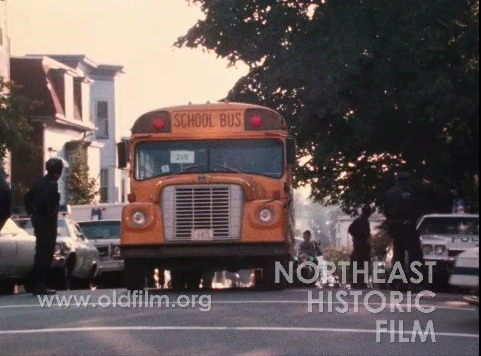
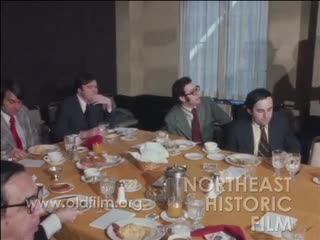
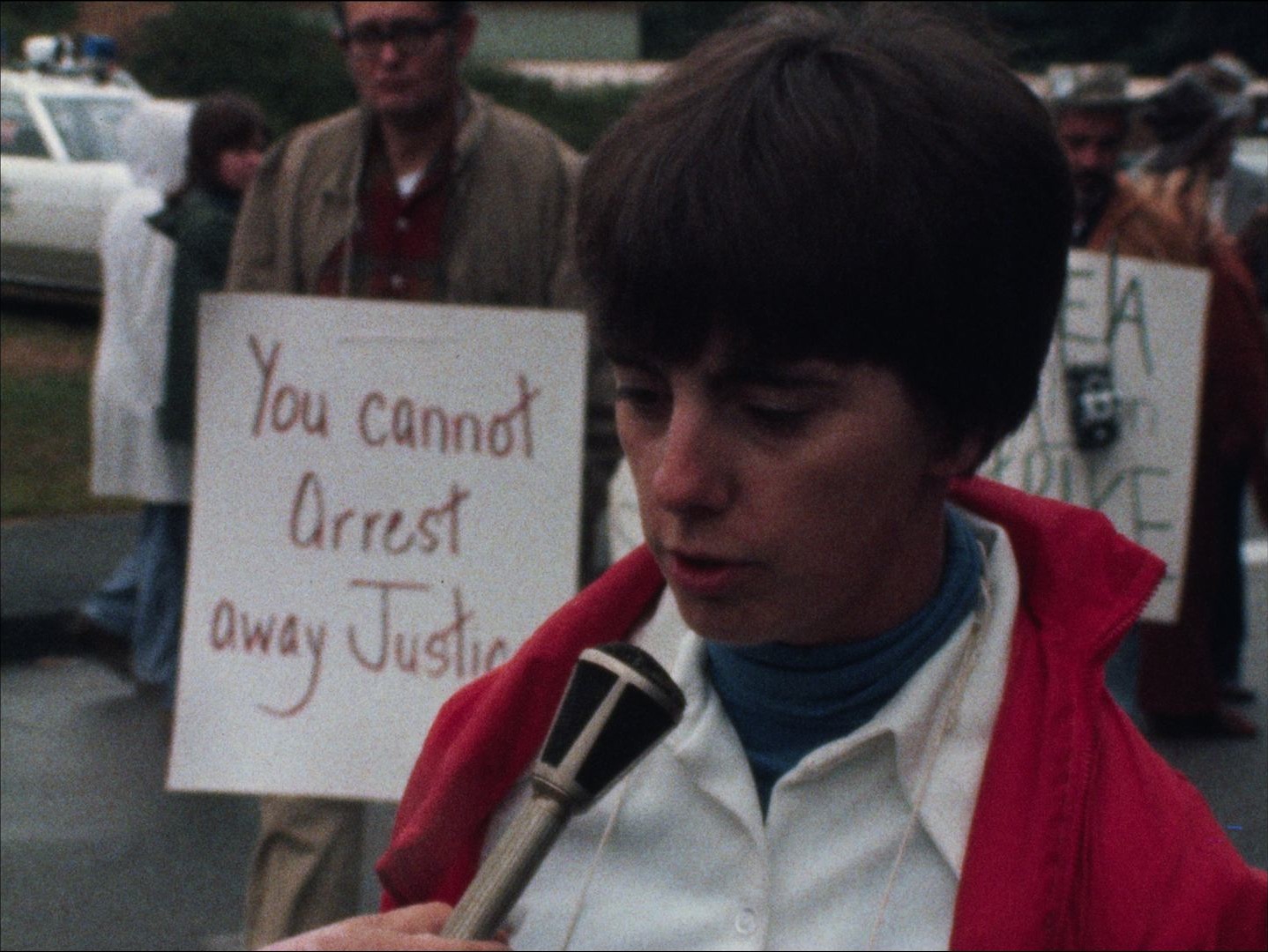
Evening Compass newscast during the first week of Phase II integration of Boston schools. Ed Baumeister reads school attendance statistics and reports on the stoning of a bus in Jamaica Plain. Pam Bullard reports on resistance to busing among Hyde Park parents. She interviews Hyde Park residents Paul Murphy, Ginny McCarthy, William Wager, Sylvia Connaughton, Pauline Haley, and Eddie Remondi. Remondi invokes the civil disobedience of Martin Luther King as a model for the antibusing movement. Gary Griffith reports on complaints of police brutality by Tactical Patrol Force officers in South Boston, Charlestown and Roxbury. Bill MacDonald, Joseph Rowan, William Johnston, Val Williams, and Kathy Fitzpatrick (all of the Boston Police Department) talk about the TPF and respond to the charges of brutality. Baumeister reports on how busing has affected East Boston. He interviews East Boston residents Rose DiScisio, Mina DeFilippo, Mrs. Jay DiGiangregorio and Evelyn Babin about busing. Judy Stoia interviews Dennis Kearney (State Representative), Gloria Conway (Editor, Charlestown Patriot) and Mon O'Shea (Associate Dean, Bunker Hill Community College) about youth violence in Charlestown. Conway, Kearney and O'Shea complain that the media has exaggerated the violence in Charlestown; that youth violence is a problem across the city. Greg Pilkington reports on his conversation with James Nabrit (attorney for the plaintiffs, Brown v. Board of Education) about busing as a means to achieve school desegregation. Pilkington reports that Nabrit says that busing is a necessary remedy for school desegregation.
19:30:00: Ed Baumeister introduces the Evening Compass broadcast. Opening credits roll. Baumeister reports that today's school attendance was 52,631 out of 76,127; that school attendance has risen each day since school opened; that a bus carrying white students was stoned in Jamaica Plain. Baumeister comments that coverage of the busing crisis has moved from daily statistics to larger issues of resistance and a white minority school population. Baumeister reports that Bob Schwartz (Educational Advisor to the Mayor) fears that a minority white school system in Boston will lead to a decline in the quality of education; that Kevin White (Mayor, City of Boston) favors a metropolitan desegregation plan. Baumeister reports that Thomas Atkins (President, NAACP) is not worried about a white minority population in the schools. 19:32:22: Pam Bullard reports on resistance to busing in Hyde Park. Bullard reports that over 600 African American students attend Hyde Park High School with 900 white students; that the school has been calm this year; that police are stationed outside of the school; that there was a heavy police presence in the school last year due to trouble between African American and white students; that residents of Hyde Park are still heavily opposed to busing. Visual: Footage of buses pulling up to Hyde Park High School; of white students walking toward the school; of African American and white students entering the school. Footage of Paul Murphy (Hyde Park parent) saying that he will never support busing; that the school appears calm but there is great tension within. Ginny McCarthy (Hyde Park parent) says that there is very strong antibusing sentiment in Hyde Park; that residents are not able to vent their feelings because of the strong police presence. William Wager (Hyde Park parent) says that he resents seeing police officers lining the streets. Sylvia Connaughton (Hyde Park parent) says that the antibusing movement has been silenced; that all forms of antibusing protest have been outlawed; that she will continue to fight the court order nonviolently. Pauline Haley (Hyde Park parent) says that the strong police presence does not allow for any form of protest. McCarthy says that antibusing residents will fight the court order through political means; that the antibusing movement must stay united and visible; that people should fight the court order, not leave the city. Connaughton agrees that the antibusing movement must stay active and visible; that the antibusing movement will not give up and accept busing. Eddie Remondi (Hyde Park parent) says that the antibusing movement must fight the court order through civil disobedience, citing the example of Martin Luther King; that the movement must fight in the courts and in the political arena. Wager says that the antibusing movement must create turmoil throughout the city through marches and lawful demonstrations; that the movement must avoid violence. 19:37:26: Baumeister introduces Gary Griffith's report on complaints lodged against the Tactical Patrol Force (TPF) by residents of Charlestown, South Boston and Roxbury. V: Footage Bill MacDonald (Boston Police Department) saying that the TPF is a well-disciplined and effective unit with expertise in crowd control. Griffith reports that the TPF are the elite corps of the Boston Police Department; that residents of South Boston and Charlestown have charged the TPF with police brutality. V: Footage of TPF officers gathered at the side of a street in Charlestown. A traveling shot follows one officer to his car. Footage of Joseph Rowan (Deputy Superintendent, Boston Police Department) saying that the TPF reacts to violence directed at them by residents; that there may be isolated cases of brutality; that residents are encouraged to file complaints; that all complaints are investigated. Griffith reports that many TPF officers were previously regular duty police officers; that the TPF includes an emergency services unit, a canine unit, and an anti-crime unit; that TPF officers do not get paid more than regular police officers; that TPF officers may make additional money working overtime. V: Footage of Rowan saying that the TPF officers are carefully selected; that they are trained to work as a group; that TPF officers are stable, hardworking and are not afraid to perform their duties. Griffith reports that TPF officers have been called "drug-crazed animals." V: Footage of William Johnston (Boston Police Department) saying that that TPF officers are not "mean." Val Williams (Boston Police Department) says that the TPF has to deal with difficult situations; that rumors of TPF behavior have been exaggerated. Griffith asks Kathy Fitzpatrick (Boston Police Department) if she is involved in crowd control. She responds that she performs the same job as the men; that residents of South Boston and Charlestown are venting their frustration on the TPF. Griffith reports that TPF officers do not work in the neighborhoods; that they are called into difficult situations in which they must act quickly and forcefully. Baumeister asks Griffith if the TPF cultivates their fierce reputation in the city. Griffith says that the TPF officers like to play up their roles as "the hard guys"; that the TPF officers do not appreciate the rumors that circulate about TPF brutality; that he did not ask the officers about the allegations against TPF in the Rabbit Inn case or other cases. 19:43:16: Baumeister reports that East Boston has been the neighborhood least affected by court-ordered busing; that under Phase II desegregation, the East Boston district remains 95% white, 3% African American and 2% other minority; that the geographical isolation of the neighborhood makes the busing of students difficult; that the district high school will be open to students city-wide next year; that other East Boston schools will be unaffected next year. V: Footage of the entrance of the Callahan Tunnel. Traveling shot from a car driving through the tunnel. Baumeister reports that African American students have been bused into East Boston under Phase II desegregation; that buses are quietly escorted to the schools; that most students bused out of East Boston have chosen to attend city-wide magnet schools. V: Footage of a bus passing through toll booth. Footage of a white male student saying that he chose to attend Boston English High School because of its academic reputation; that he does not mind being bused; that his friends in East Boston tell him not to attend school. A white female student at a bus stop says that people tell her not to go to school. Shots of students boarding a bus in East Boston. Baumeister reports that many residents of East Boston strongly oppose busing. V: Footage of Rose DiScisio (East Boston resident) saying that many in East Boston will not allow their children to be bused; that there will be trouble in East Boston next year if students are bused out. Baumeister reports that DiScisio helps run the East Boston Information Center; that the East Boston Information Center is connected to ROAR (Restore Our Alienated Rights), the city-wide antibusing organization. Baumeister reports on the formation of two organizations formed to counter the antibusing movement in East Boston: EBQE (East Bostonians for Quality Education) and East Boston People Against Racism. V: Footage of Mina DeFilippo (East Boston resident) saying that she sends her children to Martin Luther King School in Dorchester; that her children are happy there; that she is a member of East Boston People Against Racism. Mrs. Jay DiGiangregorio (East Boston resident) says that her child has been sent to the Samuel Adams School in East Boston; that the school is overcrowded and lacks adequate facilities; that a nearby school is not overcrowded; that she will take her child out of the school system before the situation gets worse next year. DeFilippo says that her neighbors have insulted her in the streets for allowing her children to be bused; that she will continue to put her children on the bus. Evelyn Babin (East Boston resident) says that the antibusing movement is not causing trouble; that the other side tries to make the antibusing movement look bad. Baumeister reports that the organizations on both sides of the busing issue have support among East Boston residents; that many residents will wait until next year before getting involved in the busing debate. 19:50:16: Judy Stoia reports that the past two days have been relatively peaceful in Charlestown; that community leaders think reports of violence may have been exaggerated by the media. V: Footage of police officers lined up at an ice cream truck outside of Charlestown High School. Footage of Stoia interviewing Dennis Kearney (State Representative), Gloria Conway (Editor, Charlestown Patriot) and Mon O'Shea (Associate Dean, Bunker Hill Community College) on the steps of the Bunker Hill Monument. O'Shea says that it is normal for adolescents to act up; that the youth violence in Charlestown may not be related to race issues. Conway says that it is easy for kids to get caught up in the action of the moment. O'Shea says that very young children were caught up in an angry crowd on Monday evening; that it is dangerous for children to get caught up in violence. Conway says that racism is present in Charlestown, but not overwhelming; that one racist person can paint most of the graffiti in a neighborhood; that most people are concerned with the safety of their children. Kearney says that the majority of residents are shocked when they hear someone yell racial epithets at a bus of African American schoolchildren. Conway says that she has been active in the antibusing movement; that the antibusing movement has repudiated violence and has conducted peaceful demonstrations. Stoia comments that most people outside of Charlestown see it as a violent community. O'Shea says that violence is a problem in most urban environments; that there is violence in Charlestown, but it is still a good community. 19:55:07: Baumeister reports that the court case which brought desegregation to Boston schools is related to the landmark Brown v. Board of Education case; that 17 lawyers worked to bring the Brown case to the US Supreme Court. Greg Pilkington reports that five of the lawyers from the Brown case have died; that four of those lawyers are now judges (Thurgood Marshall, Spotswood Robinson, Constance Baker Motley and Robert Carter). Pilkington reports on a conversation about busing with another one of the lawyers, James Nabrit, who is retired and living in Washington D.C. Pilkington reports that Nabrit said that quality education is not possible in a segregated school system; that Nabrit believes the antibusing movement is not sincere when they claim that the quality of education suffers under busing; that in a segregated system, African American schools will be of lesser quality than white schools; that both whites and African Americans suffer from the adverse effects of segregation; that busing is necessary remedy if it is the only way to desegregate schools. 19:57:36: Baumeister closes the show. He makes a joke about getting reading lessons before the next show to improve his delivery of the news. Credits roll.
19:30:00: Ed Baumeister introduces the Evening Compass broadcast. Opening credits roll. Baumeister reports that today's school attendance was 52,631 out of 76,127; that school attendance has risen each day since school opened; that a bus carrying white students was stoned in Jamaica Plain. Baumeister comments that coverage of the busing crisis has moved from daily statistics to larger issues of resistance and a white minority school population. Baumeister reports that Bob Schwartz (Educational Advisor to the Mayor) fears that a minority white school system in Boston will lead to a decline in the quality of education; that Kevin White (Mayor, City of Boston) favors a metropolitan desegregation plan. Baumeister reports that Thomas Atkins (President, NAACP) is not worried about a white minority population in the schools. 19:32:22: Pam Bullard reports on resistance to busing in Hyde Park. Bullard reports that over 600 African American students attend Hyde Park High School with 900 white students; that the school has been calm this year; that police are stationed outside of the school; that there was a heavy police presence in the school last year due to trouble between African American and white students; that residents of Hyde Park are still heavily opposed to busing. Visual: Footage of buses pulling up to Hyde Park High School; of white students walking toward the school; of African American and white students entering the school. Footage of Paul Murphy (Hyde Park parent) saying that he will never support busing; that the school appears calm but there is great tension within. Ginny McCarthy (Hyde Park parent) says that there is very strong antibusing sentiment in Hyde Park; that residents are not able to vent their feelings because of the strong police presence. William Wager (Hyde Park parent) says that he resents seeing police officers lining the streets. Sylvia Connaughton (Hyde Park parent) says that the antibusing movement has been silenced; that all forms of antibusing protest have been outlawed; that she will continue to fight the court order nonviolently. Pauline Haley (Hyde Park parent) says that the strong police presence does not allow for any form of protest. McCarthy says that antibusing residents will fight the court order through political means; that the antibusing movement must stay united and visible; that people should fight the court order, not leave the city. Connaughton agrees that the antibusing movement must stay active and visible; that the antibusing movement will not give up and accept busing. Eddie Remondi (Hyde Park parent) says that the antibusing movement must fight the court order through civil disobedience, citing the example of Martin Luther King; that the movement must fight in the courts and in the political arena. Wager says that the antibusing movement must create turmoil throughout the city through marches and lawful demonstrations; that the movement must avoid violence. 19:37:26: Baumeister introduces Gary Griffith's report on complaints lodged against the Tactical Patrol Force (TPF) by residents of Charlestown, South Boston and Roxbury. V: Footage Bill MacDonald (Boston Police Department) saying that the TPF is a well-disciplined and effective unit with expertise in crowd control. Griffith reports that the TPF are the elite corps of the Boston Police Department; that residents of South Boston and Charlestown have charged the TPF with police brutality. V: Footage of TPF officers gathered at the side of a street in Charlestown. A traveling shot follows one officer to his car. Footage of Joseph Rowan (Deputy Superintendent, Boston Police Department) saying that the TPF reacts to violence directed at them by residents; that there may be isolated cases of brutality; that residents are encouraged to file complaints; that all complaints are investigated. Griffith reports that many TPF officers were previously regular duty police officers; that the TPF includes an emergency services unit, a canine unit, and an anti-crime unit; that TPF officers do not get paid more than regular police officers; that TPF officers may make additional money working overtime. V: Footage of Rowan saying that the TPF officers are carefully selected; that they are trained to work as a group; that TPF officers are stable, hardworking and are not afraid to perform their duties. Griffith reports that TPF officers have been called "drug-crazed animals." V: Footage of William Johnston (Boston Police Department) saying that that TPF officers are not "mean." Val Williams (Boston Police Department) says that the TPF has to deal with difficult situations; that rumors of TPF behavior have been exaggerated. Griffith asks Kathy Fitzpatrick (Boston Police Department) if she is involved in crowd control. She responds that she performs the same job as the men; that residents of South Boston and Charlestown are venting their frustration on the TPF. Griffith reports that TPF officers do not work in the neighborhoods; that they are called into difficult situations in which they must act quickly and forcefully. Baumeister asks Griffith if the TPF cultivates their fierce reputation in the city. Griffith says that the TPF officers like to play up their roles as "the hard guys"; that the TPF officers do not appreciate the rumors that circulate about TPF brutality; that he did not ask the officers about the allegations against TPF in the Rabbit Inn case or other cases. 19:43:16: Baumeister reports that East Boston has been the neighborhood least affected by court-ordered busing; that under Phase II desegregation, the East Boston district remains 95% white, 3% African American and 2% other minority; that the geographical isolation of the neighborhood makes the busing of students difficult; that the district high school will be open to students city-wide next year; that other East Boston schools will be unaffected next year. V: Footage of the entrance of the Callahan Tunnel. Traveling shot from a car driving through the tunnel. Baumeister reports that African American students have been bused into East Boston under Phase II desegregation; that buses are quietly escorted to the schools; that most students bused out of East Boston have chosen to attend city-wide magnet schools. V: Footage of a bus passing through toll booth. Footage of a white male student saying that he chose to attend Boston English High School because of its academic reputation; that he does not mind being bused; that his friends in East Boston tell him not to attend school. A white female student at a bus stop says that people tell her not to go to school. Shots of students boarding a bus in East Boston. Baumeister reports that many residents of East Boston strongly oppose busing. V: Footage of Rose DiScisio (East Boston resident) saying that many in East Boston will not allow their children to be bused; that there will be trouble in East Boston next year if students are bused out. Baumeister reports that DiScisio helps run the East Boston Information Center; that the East Boston Information Center is connected to ROAR (Restore Our Alienated Rights), the city-wide antibusing organization. Baumeister reports on the formation of two organizations formed to counter the antibusing movement in East Boston: EBQE (East Bostonians for Quality Education) and East Boston People Against Racism. V: Footage of Mina DeFilippo (East Boston resident) saying that she sends her children to Martin Luther King School in Dorchester; that her children are happy there; that she is a member of East Boston People Against Racism. Mrs. Jay DiGiangregorio (East Boston resident) says that her child has been sent to the Samuel Adams School in East Boston; that the school is overcrowded and lacks adequate facilities; that a nearby school is not overcrowded; that she will take her child out of the school system before the situation gets worse next year. DeFilippo says that her neighbors have insulted her in the streets for allowing her children to be bused; that she will continue to put her children on the bus. Evelyn Babin (East Boston resident) says that the antibusing movement is not causing trouble; that the other side tries to make the antibusing movement look bad. Baumeister reports that the organizations on both sides of the busing issue have support among East Boston residents; that many residents will wait until next year before getting involved in the busing debate. 19:50:16: Judy Stoia reports that the past two days have been relatively peaceful in Charlestown; that community leaders think reports of violence may have been exaggerated by the media. V: Footage of police officers lined up at an ice cream truck outside of Charlestown High School. Footage of Stoia interviewing Dennis Kearney (State Representative), Gloria Conway (Editor, Charlestown Patriot) and Mon O'Shea (Associate Dean, Bunker Hill Community College) on the steps of the Bunker Hill Monument. O'Shea says that it is normal for adolescents to act up; that the youth violence in Charlestown may not be related to race issues. Conway says that it is easy for kids to get caught up in the action of the moment. O'Shea says that very young children were caught up in an angry crowd on Monday evening; that it is dangerous for children to get caught up in violence. Conway says that racism is present in Charlestown, but not overwhelming; that one racist person can paint most of the graffiti in a neighborhood; that most people are concerned with the safety of their children. Kearney says that the majority of residents are shocked when they hear someone yell racial epithets at a bus of African American schoolchildren. Conway says that she has been active in the antibusing movement; that the antibusing movement has repudiated violence and has conducted peaceful demonstrations. Stoia comments that most people outside of Charlestown see it as a violent community. O'Shea says that violence is a problem in most urban environments; that there is violence in Charlestown, but it is still a good community. 19:55:07: Baumeister reports that the court case which brought desegregation to Boston schools is related to the landmark Brown v. Board of Education case; that 17 lawyers worked to bring the Brown case to the US Supreme Court. Greg Pilkington reports that five of the lawyers from the Brown case have died; that four of those lawyers are now judges (Thurgood Marshall, Spotswood Robinson, Constance Baker Motley and Robert Carter). Pilkington reports on a conversation about busing with another one of the lawyers, James Nabrit, who is retired and living in Washington D.C. Pilkington reports that Nabrit said that quality education is not possible in a segregated school system; that Nabrit believes the antibusing movement is not sincere when they claim that the quality of education suffers under busing; that in a segregated system, African American schools will be of lesser quality than white schools; that both whites and African Americans suffer from the adverse effects of segregation; that busing is necessary remedy if it is the only way to desegregate schools. 19:57:36: Baumeister closes the show. He makes a joke about getting reading lessons before the next show to improve his delivery of the news. Credits roll.
Collection:
Evening Compass, The
Date Created:
09/11/1975