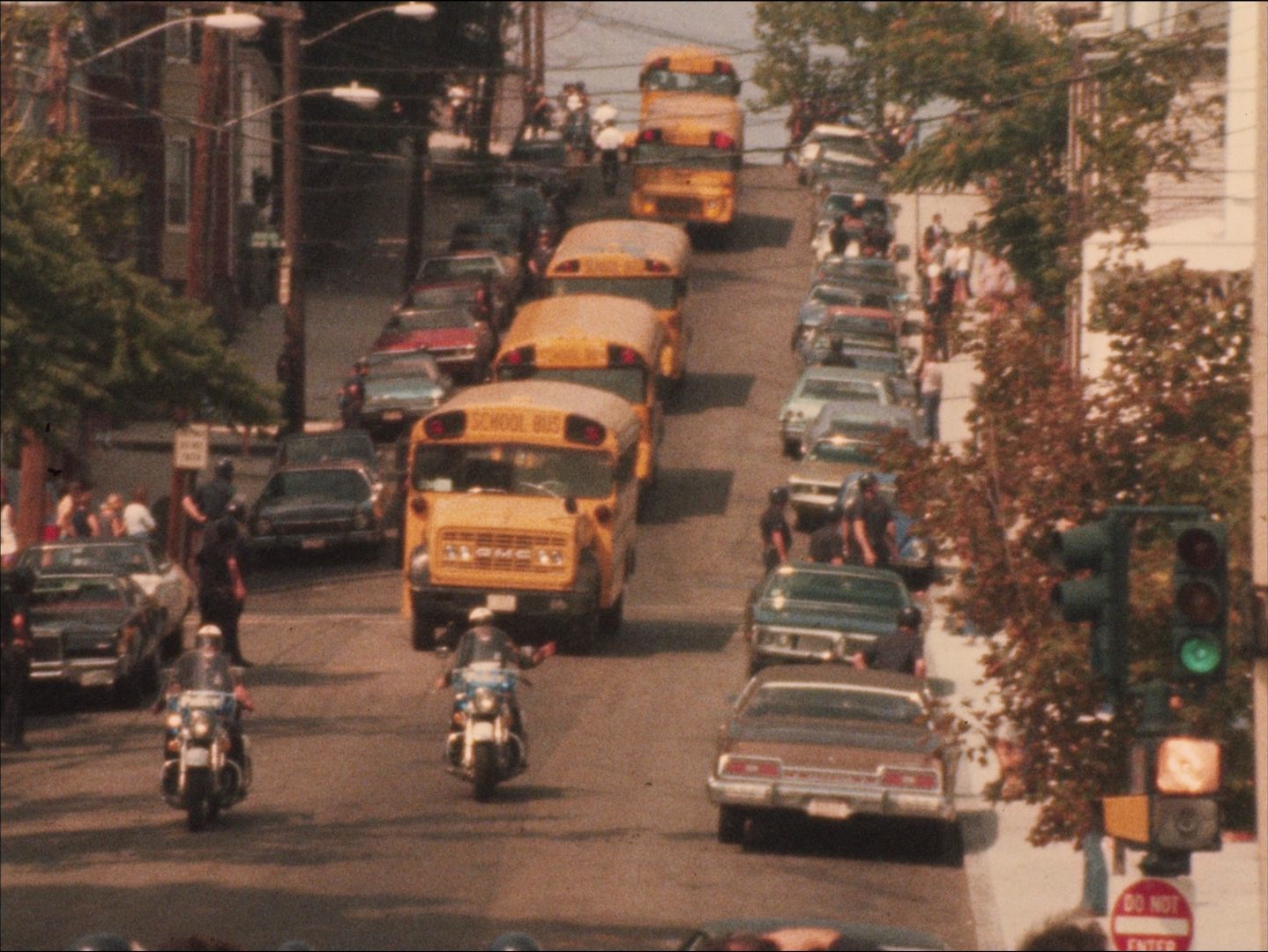
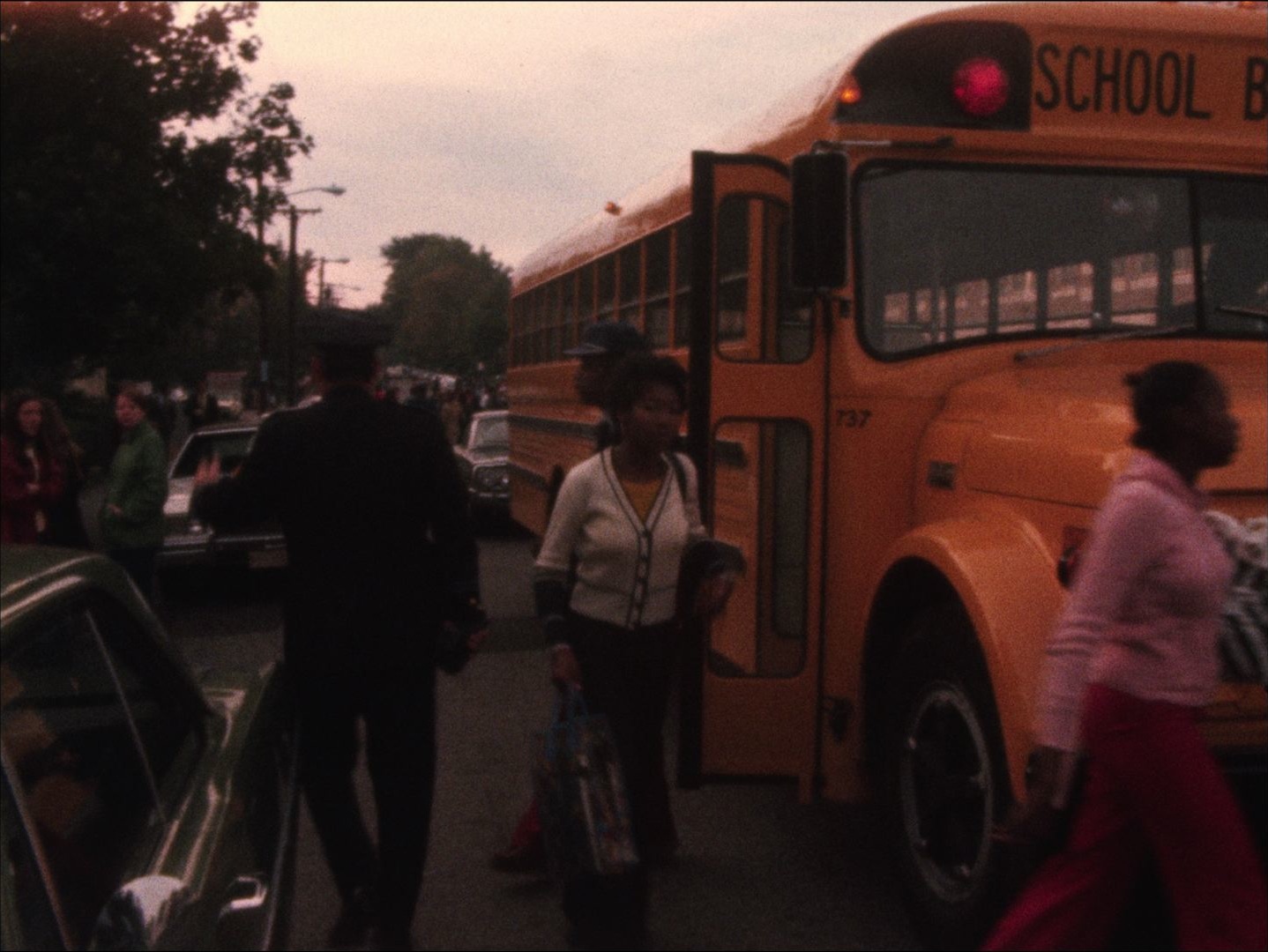
Description: No audio at the beginning. The first day of school at South Boston High School during Phase II desegregation of Boston schools. Helmeted members of the Tactical Patrol Force and US Marshals are present in the school yard and on the street. Exteriors of the South Boston High School building. Headmaster William Reid (Headmaster, South Boston High School), Charles Barry (Deputy Superintendent, Boston Police Department), Peter Meade (Mayor's Office) and others confer on the street outside of the school. White students approach on foot. Buses carrying African American students arrive with a police motorcycle escort. Two groups of press photographers are cordoned off behind ropes in front of the school. African American students exit buses. A police helicopter circles the area.
0:00:37: Visual: Two police officers stand on a street corner in South Boston. 0:01:17: V: Helmeted police officers from the Tactical Patrol Force line up in front of South Boston High School. Police radios are audible. Shots of South Boston High School. Media and onlookers are gathered on sidewalk. US Marshals and small groups of officials are in the schoolyard and on G Street in front of the high school. Police question a student as he enters schoolyard. 0:04:04: V: A group of police officers walk into the street and continue down the hill on East 6th Street. Three African American students exit a police car and walk into the schoolyard. William Reid (Headmaster, South Boston High School), Peter Meade (Mayor's Office), Charles Barry (Deputy Superintendent, Boston Police Department), and others converse in the street in front of the school. Two white students enter the schoolyard. Police are stationed at entrance of school; students enter. 0:06:06: V: Police line the streets. A group of three white students enters the schoolyard. 0:06:46: Helicopter noise is audible. V: Schoolbuses with police motorcycle escort are visible down East 6th Street, making their way toward the school. A station wagon arrives; three women and a police officer help a student out of the wagon. Four school buses with a police escort pull up in front of the school. Shots of the news media cordoned off behind a rope on either side of the entrance to the schoolyard. Several African American students enter schoolyard. A group of students exit a bus prematurely. The students are told to get back on the bus by an official. Shots of buses lined up; of helicopters overhead. Officials converse on street. African American students exit buses and enter schoolyard. Shot through a crowd of the front entrance of the school.
Collection: Evening Compass, The
Date Created: 09/08/1975
Description: Exterior of South Boston High School. Headmaster Jerome Wynegar in front of school. Students enter school. South Boston environs. Crowd of South Boston residents gathered on the street. Rolling shots taken from news van driving down the streets of South Boston. Anti- busing and racist graffiti: “Stop Forced Busing” “White Power” “Never Nigger”
Collection: Ten O'Clock News
Date Created: 09/08/1976
Description: Footage of the first day of school at Charlestown High School during year two of desegregation in Boston. Media crews gather at the foot of the Bunker Hill Monument. Helicopters circle overhead. Police in riot helmets and MDC officers on horseback are stationed in front of the school. A police officer with a rifle is posted on the roof of the school. No buses have yet arrived.
0:00:08: Visual: Media crews gather at the foot of the Bunker Hill Monument to cover the first day of school at Charlestown High School. The noise of helicopters is audible. Shots of media crews and equipment; of the Bunker Hill Monument; of the shabby exterior of Charlestown High School. A small group of people stand at the doors to Charlestown High School. Police officers wearing riot helmets are gathered on the streets outside of the school. MDC police officers on horseback are stationed on the streets. A helmeted police officer with a rifle is posted on the roof of the school. Small groups of onlookers are gathered around Monument Square. Shot of helicopter overhead. A few white people enter and leave the school. 0:16:24: V: A group of young men walk on the street. They make an obscene gesture to the camera; one appears to be drinking. Two US Marshals, one white and one African American, walk down the street toward the school. Shot of helicopter circling the area.
Collection: Evening Compass, The
Date Created: 09/08/1975
Description: Mayor Kevin White's message to citizens of Boston regarding the opening of school. He says that all residents share the responsibility for a safe opening of schools. He adds that no threat to school children or school buses will be tolerated, and that police, federal marshals, and the FBI will be on hand to enforce the court order. White reminds citizens that the education of schoolchildren must not be politicized. This tape has audible time code on track 2.
0:59:04: Visual: Chalk slate indicates production information: School Opening / Mayor White / 9 -3- 75 / Ferrante (producer) / DeBarger (director). 0:59:32: V: Kevin White reminds viewers that school starts on Monday; that the first week of school is a time of transition for teachers, students, and parents; that many are concerned about the safety of children in schools as well as safety on the streets; that many will have to adapt to the changes brought by new school assignments. White says that every citizen has a responsibility to make the school opening peaceful no matter how he or she feels about busing; that responsibility, judgement and restraint will be important. White says that every child has a right to attend school safely; that he will use every resource at his disposal to guarantee safe access to schools for all children. White says that a comprehensive safety plan has been developed to maintain peace on the streets and to avoid violence and disruption in schools. White pledges that he will not tolerate any breach of public safety; that unlawful activity posing a threat to schools, buses, or school children will be punished with the maximum sentence. 1:02:17: White says that many concerned citizens and parents have participated in the development of the public safety plan; that the plan for 1975 triples the efforts made in 1974; that 1,000 Boston police officers, 300 state troopers, 250 MDC police and 100 federal marshals will be on duty along bus routes and near schools; that 400 school crossing supervisors, 300 bus monitors and over 900 transitional aids will be employed by the city; that the FBI and special teams of prosecutors will be on hand to investigate unlawful activity. White says again that interference with school desegregation will not be tolerated; that violators of the court order risk arrest and prosecution under federal law; that the city is better prepared for the opening of school this year. White urges city residents to act with decency, compassion, and charity; to avoid violence; to set a good example for the city's children. White reminds viewers that children need to go to school; that schools need to be separate from politics and power struggles.
Collection: Evening Compass, The
Date Created: 09/03/1975
Description: Kim Reid , a student at Brighton High School, sits with a group of students in a classroom. The students talk about school activities and look at yearbooks while discussing a movie they saw on television. Another group of students in the classroom also look at yearbooks. This tape also includes footage of Reid exiting Brighton High School and boarding a school bus outside.
1:00:00: Visual: Kim Reid (Brighton High School student) sits with a three white and Hispanic students in a classroom at Brighton High School. They talk about ordering sweatshirts to sell at school. The students talk about scheduling meetings after school. Another student points out that Kim needs to know about meetings in advance because she needs to arrange transportation home. The students talk about choosing a theme for their class night. A female student seated across from Kim looks at a yearbook. A racially diverse group of boys is seated near Kim's group. A white teacher arranges files and papers at her desk. Kim's group continues to talk to one another. Kim's group looks at a yearbook. Close-up shot of Kim. The students talk about the upcoming prom. Shots of a girl turning pages of the yearbook. Kim opens the yearbook in front of her. Kim says that she knows fewer people now than she did in the ninth grade. The group identifies and talks about the people in the yearbook. The group of boys also look at yearbooks. 1:08:24: V: Kim walks over to the teacher's desk. She looks for a book on the teacher's desk. The crew sets up a shot of Kim walking across the room with a book. Kim sits down with her group. Kim and the other students talk about a TV movie. Shots of the two other girls in Kim's group. Shots of the group of boys talking to one another. 1:14:00: V: Shots of the exterior of Brighton High School; of school buses waiting on Warren Street in front of the school. An African American male student jokes around with the camera crew. Kim descends the stairs toward the buses with a group of African American and Asian American students. The students wave and talk to the camera crew as they board the buses. A police officer stands against the fence on the sidewalk. Kim walks toward her bus. The camera crew does a three takes of Kim and other students boarding the buses.
Collection: Ten O'Clock News
Date Created: 01/15/1985
Description: Buses pull up in front of English High School. Robert Peterkin (Headmaster, English High School) stands out front as buses arrive. Students exit buses and congregate by race in front of school. Judy Stoia interviews African American and white students outside of the school about how they like school. Students talk about the school and report no racial tensions so far. Stoia interviews a white female student who says that she would prefer to attend Brighton High School. Stoia interviews two African American female students who says that the school is disorganized this year. The two girls complain about problems with their class schedules and relations with teachers. Stoia interviews a group of African American female students who say that they like the school. One of the students says that African American and white students can get along fine if their parents leave them alone. Stoia interviews two white male students from Brighton who like the facilities at the school. They say the school was originally supposed to be just for boys, but it's better now that it's coed. Stoia starts interview another group of students, when a teacher comes over and tells them they're going to be late for class. Stoia interviews Chris Lane (Flexible Campus Coordinator, English High School) about the opening of the school and school programs offered in conjunction with area colleges including Brandeis University, Massachusetts College of Art and UMass Amherst. Lane says that attendance has increased since yesterday. Dropout during middle of video.
0:00:46: Visual: Buses pull up outside of English High School on Avenue Louis Pasteur. White students exit buses. Robert Peterkin (Headmaster, English High School) watches from sidewalk. Students gather on steps. 0:01:41: V: Judy Stoia sets up an interview with a white female student. Student says that she is from Allston-Brighton; that she does not like English High School; that she is bused here but would rather go to Brighton High School; that the school is nice but she lives very close to Brighton High School; that she doesn't plan to take advantage of any of the special programs at English High School. Stoia closes the interview. 0:02:55: V: A bus pulls up to the school. Peterkin, a few school officials, and a small group of police officers are on the sidewalk. White students exit the bus. A second bus pulls up and more white students are unloaded. Students congregate by race on the steps of the school. 0:05:31: V: Stoia sets up an interview with two African American female students. The first student is from Dorchester and the second is from Roxbury. Both say that they do not like school so far this year. The first student says that the system is not organized. The second student says that the school is crowded; that her class schedule is mixed up. The first student says that teachers will not give her a second chance after having difficulties the previous year. The second student says that she is not involved in the school's special programs, but has heard of a program in which the students will visit Brandeis University. The second student says that the administrators waited until the last minute to prepare for the school year; that she would like school if her schedule were straightened out. V: Video cuts out for 15 seconds. The second student says that there have been no problems with integration so far; that she has always gone to school with white students. Both students say that they requested to attend English High School. Stoia closes the interview. 0:07:49: V; Stoia interviews a group of African American female students. Two students are attending English High School for the fourth year and both like it. One student takes the MBTA bus to school. A third student says she likes the school; that the students seem to get along. The first student says that the African American and white students will get along if their parents leave them alone. The third student says that African American students at English High School are there for an education; that they are not looking for trouble with the white students. The first student agrees. The third student says that she requested to attend English High School. The first student says that she likes the teachers at English High School; that they are strict about attendance; that they care about the students. The third student says that she would like to be involved in the program which allows English High students to teach younger children. The first two students say that they will be cheerleaders. Stoia closes the interview. 0:10:54: V: Two more buses pull up to the school. African American students exit the bus. Shots of students congregated in front of school. Another bus pulls up. More African American students exit the bus. Stoia sets up an interview with two white male students. Both students are from Brighton and like English High School so far. The first student says that the school has good facilities. The second student says he likes some of his classes and the gymnasium. Both students say that they requested to attend English High School. The second student says that he is happy that it is now co-ed; that he requested English High School because he heard it was good. The first student says that he wanted to leave Brighton High School. Both students say that they ride the bus to school; that African American and white students are getting along so far. Stoia closes the interview. 0:14:09: V: Long shot of the entrance to English High School. Students are entering the school. 0:14:46: V: Stoia sets up an interview with a three African American female students. She promises not to make them late. They are joined by several other African American students. The first student says that there are not enough people at school. The students disperse and head toward the school. Chris Lane (Flexible Campus Coordinator) jokes around with an African American male student as he heads into school. 0:15:36: V: Stoia sets up an interview with Lane. He says that English High School opened peacefully the previous day; that attendance is up today; that he expects that it will be a good school year; that buses arriving from all sections of the city looked full; that buses seemed to be on time; that transportation problems will decline. Lane says that buses scheduled to transport students to the ORC (Occupational Resource Center) did not show up the previous day; that they are scheduled to arrive today. Lane says that the special programs planned for English High School are not yet in place; that they are waiting on approval and funding. Lane explains what a magnet school is; that the staff is ready to implement a theater arts programs in conjunction with Brandeis University; that programs in conjunction with Massachusetts College of Art and University of Massachusetts will follow.
Collection: Evening Compass, The
Date Created: 09/09/1975
Description: Tone at the beginning of the video. Footage of the first day of school at Charlestown High School during Phase II desegregation of Boston schools. Exterior shots of school building. Media crews are gathered at the foot of Bunker Hill Monument to cover the arrival of buses. Helicopter noise is audible. A school bus accompanied by a police officer on motorcycle pulls up in front of the school. Students, mostly African American, exit the bus. The bus pulls away and police line the street in front of the school. A second bus pulls up. The students exit the bus and head to the entrance of the school. Students and teachers inside the school look out the window at the activity on the street.
0:00:50: Visual: Media crews are gathered at the foot of the Bunker Hill Monument to cover opening day at Charlestown High School. The noise of helicopters overhead is audible. An MDC police officer on horseback is stationed in front of the school. School officials stand at the school entrance. 0:01:27: V: A yellow school bus escorted by a police motorcycle escort pulls up to the front of the school. African American students and some students of other races exit the bus and enter the school. Officials and police confer outside of the bus. Shots of exterior of Charlestown High School; of media crews; of helicopter overhead. The bus pulls away from school. Students and teachers in the school look out the window at activity outside. 0:05:53: V: Helmeted police line up in the street outside the school. They receive instructions from their superior officer. Noise from police radios is audible. A second bus with police escort pulls up outside school. African American students exit the bus and enter the school. Students crowd the entrance to the school. The bus pulls away. Police and officials remain outside of school.
Collection: Evening Compass, The
Date Created: 09/08/1975
Description: Pam Bullard reports on the Tobin Elementary School, which is located near the Mission Hill Housing Project.Bullard reports that 75 white children are bused into the Tobin school with no problems. Interviews with students and teachers talking about how much they like the school. Bullard reports that Charlie Gibbons, the principal, encourages teachers to develop innovative programs for students. During the report Principal Gibbons was in Puerto Rico learning about the schools there to better be able to serve the Latino students at his school. Bullard notes that the school has a good atmosphere and enjoys a good rapport with the community.
9:50:07: Visual: Shots of street sign for Tobin Ct.; of the Mission Hill Housing Project. Pam Bullard reports that the Mission Hill Housing Project is in one of Boston's toughest neighborhoods; that racial fighting occurred there two weeks before school opened; that the housing project is in the heart of a depressed neighborhood. Bullard reports that the Tobin Elementary School is located near the housing project. V: Footage of an African American male student (Derek) saying that he has attended the Tobin School for four years; that he knows all of the teachers and gets along with them; that the school is special because of the teachers, the kids, and the field trips. A white male student (Richard) says that Derek is his friend; that he likes the Tobin school; that he has fun taking the bus everyday; that he has met a lot of new people. Bullard reports that Charlie Gibbons (principal, Tobin School) and his assistant are in Puerto Rico; that they are learning about the Puerto Rican school system in order to understand the needs of Spanish-speaking students; that Gibbons and his assistant are paying for their own trips. V: Shots of Gibbons' office; of a button reading "I go to the best - Tobin School, Roxbury"; of a thank-you note written to Gibbons from the students. Bullard reports that the Tobin School has extensive reading and physical education programs set up with Boston University; that there is a program for dental care set up with the Harvard Dental school; that the Tobin School has one of the city's best bilingual programs; that the students receive a lot of individual attention. Bullard reports that Gibbons and the teachers at the Tobin set up most of these programs themselves. V: Footage of student reading Spanish; of a student writing on a chalkboard; of bilingual posters in a classroom. Footage of a teacher at a chalkboard; of students in classroom. A white female teacher says that the students respond well to the school's programs; that she tries to give the students individual attention; that she likes the students and the parents at the Tobin. Footage of children playing learning games. An African American female teacher says that she agrees with Gibbons that the Tobin is the best school in Boston; that the Tobin has a warm atmosphere, a good faculty and a lot of support from the community. An African American male student says that he likes the Tobin because he learns things. Bullard reports that the Tobin school is located in a predominantly African American neighborhood; that 75 white students have been bused in with no problems; that students and teachers like the school very much. V: Footage of children playing on a field outside of the school. The Church of Our Lady of Perpetual Help is visible.
Collection: Ten O'Clock News
Date Created: 03/26/1976
Description: Footage of the exterior of Wellesley High School and students coming out the doors and getting on the buses. Silent.
Collection: WCVB Collection
Date Created: 12/10/1974
Description: Some sound dropout at the beginning of the tape. Pam Bullard's 1978 review of school desegregation in Boston. The review focuses on the effects of desegregation on South Boston High School and the Joseph Lee School. Bullard reports that attendance is low at South Boston High School, but the school atmosphere and programs have improved. Bullard reports that the Joseph Lee School is a good example of a successfully integrated elementary school. The story includes footage of Kevin White (Mayor, City of Boston) and interviews with Ruth Batson (African American community activist), Jerome Wynegar (headmaster, South Boston High School), David Finnegan (Boston School Committee), Robert Peterkin (headmaster, English High School). Bullard also interviews teachers and students at the Lee School and South Boston High School. The report ends with footage of students at the Lee School performing in a play of "The Wizard of Oz."
1:00:02: Visual: Shot of Boston skyline. Footage of Mayor Kevin White on September 9, 1974 calling on Boston residents to come together to make busing work. Footage of buses pulling up in front of South Boston High School on the first day of school in 1974. A crowd of antibusing protesters has gathered outside of the high school. The crowd jeers at the buses. Shots of the Boston Public Gardens. Footage of Ruth Batson (African American community activist) describing Boston as a "racist, violent city." She says that the violence stemming from school desegregation has spilled over into the streets and housing projects. Footage of police marching in formation on Bunker Hill Street in Charlestown. A large crowd is gathered outside of the Bunker Hill Housing Project. Pam Bullard reports that violence and racial hatred erupted in Boston when a federal court ordered the desegregation of schools in 1974. She notes that President Gerald Ford was forced to put the 82nd Airborne division on alert, in preparation for duty on the streets of Boston. Bullard reports that the toughest neighborhoods are quiet three years later; that African American and white children attend school together without incident. V: Shots of a lone police officer outside of South Boston High School; of African American and white children entering an elementary school. 1:01:39: Bullard reports that the effects of school desegregation will not be known for years; that some inconclusive studies have been made. V: Footage of African American and white students in an integrated elementary school classroom. Bullard notes that resistance to school desegregation in Boston has been overcome. V: Shots of a busy street in South Boston; of a young white boy outside of a church; of two elderly white residents sitting on a stoop in South Boston; of racist graffiti on a wall. Bullard reports that the fiercest opposition to court-ordered desegregation in the north took place in South Boston; that the opposition has calmed down since 1974. Bullard notes that school buses transporting students to and from South Boston High School are still accompanied by a police escort; that they are greeted by four police officers on duty at the high school. V: Shots of a police cruiser leading school buses up G Street to South Boston High School; of police officers outside South Boston High School; of African American students exiting the buses at South Boston High School. Bullard notes that metal detectors were installed at South Boston High School after the stabbing of a student three years ago. V: Footage of a student passing through a metal detector; of the halls of South Boston High School. Bullard reports that racial hatred and fear at South Boston High School have given way to a lingering uneasiness. V: Footage of a white teacher in a classroom in South Boston High School. He teaches to a classroom of eight African American and white students. Bullard notes that attendance is low at South Boston High School; that classes can be as small as four students. V: Shots of teachers teaching to very small classes at the high school. A teacher is heard saying that the official enrollment at South Boston High School is 600 students; that she estimates the enrollment to be 300 students. Shots of an African American teacher helping an African American female student at a desk; of students studying in classrooms; of teachers and students in sparsely populated classrooms. Bullard notes that the school was put under receivership by the federal court in 1975; that Jerome Wynegar (Headmaster, South Boston High School) was brought in by the court; that Wynegar and his staff have instituted many alternative programs at the school. V: Footage of Wynegar saying that there are fewer problems at South Boston High School because students are happy with the school programs. Shots of white and African American students studying in classrooms at the high school. Footage of a white female teacher saying that erratic attendance is the biggest problem at South Boston High School; that she finds herself repeating lessons for the benefit of students who were absent. Footage of Wynegar saying that South Boston High School ranks eleventh out of eighteen schools in attendance; that he though the school would rank last in attendance; that students appreciate the way they are treated at the school. Shots of students in classrooms; in the automotive shop. Footage of the white female teachers saying that alternative programs are attractive to students; that students also need to learn basic skills. 1:05:04: Bullard notes that there are divisions between those who support traditional classroom learning and those who support alternative programs. V: Shots of students in classrooms; of students in the lunchroom. Footage of an African American female student saying that South Boston High School is much better this year than in previous years; that students are getting along and are more focused on their classes. A white male student says that more students are attending school now. Another white male student says that students are getting along better. The white female teacher says that the atmosphere at the school has improved. Shots of the corridors in South Boston High School; of white and African American students playing basketball. Bullard says that there are no answers as to why the atmosphere at South Boston has improved; that innovative programs, low attendance and a wearing down of resistance to integration are all factors. V: Footage of white and African American students exiting South Boston High School; of school buses traveling down G Street away from the school. Footage of David Finnegan (Boston School Committee) saying that the community needs to realize that there are good solid programs in the Boston Public School System; that desegregation has added to the quality education provided by the schools; that the atmosphere in the schools is good, but can be improved. Bullard notes that even critics have conceded that the court-ordered magnet school programs have been good for the school system. V: Footage of African American and white students at a student art show; of the students' art projects. Bullard notes that there are opportunities in art and drama programs at the magnet schools; that there are opportunities for student internships; that there have been no racial problems at the magnet schools. Bullard reports that desegregation has been costly in financial and human terms; that the cost of the first year of desegregation was $20 million; that the second year of desegregation was $30 million; that police overtime ran up the cost of school desegregation. Bullard notes that costs have stabilized at $12 million over the past two years; that there is less of a need for police officers in the schools now. Bullard reports that Boston taxpayers have had to pay for expenses not covered by state and federal funds; that Boston taxpayers pay the highest property taxes in the nation. Bullard notes that the school budget remains at $175 million per year; that the city has lost 28,000 white students since 1972; that one expert says that 16,000 students were lost to desegregation. V: Shots of an empty classroom; of a teacher's attendance book; of a students in a sparsely populated classroom. Bullard adds that many students transferred to parochial schools, private academies and suburban schools; that many high school students dropped out. Bullard notes that the Lonegan family of South Boston refused to bus their children; that their daughter stayed out of school for a year. V: Footage of the Lonegan family. Mrs. Lonegan sits at a table in her home with her daughter Michelle and her son. Mrs. Lonegan says that she found a job making beds at a nursing home in order to pay her children's tuition at a private school. 1:09:07: Bullard reports that Christina Termini (student) lives in West Roxbury, but attends the Lee School in Dorchester. V: Footage of Termini leaving her home and walking to a bus stop. She boards the bus. Footage shot from the inside of the bus as it travels through the city. The white children on the bus sing songs. Audio of Termini's mother saying that the Lee School is ideal for Christina; that she has great confidence in the education her daughter receives at the Lee School. Shots of African American children walking to the Lee School from the Franklin Field Housing Project. Shots of a white student in French class at the Lee School; of integrated classrooms at the Lee School. Footage of a teacher saying that the children of the Lee School get along well; that racial differences are not important in the classroom. Bullard reports that attendance at the Lee School is low; that 600 students attend the school; that the school has 1,000 seats available; that white attendance could be higher. Bullard notes that the atmosphere at the school is excellent. V: Footage of the students performing "The Wizard of Oz" on stage. A young white female student says that she likes the facilities at the Lee School; that she has met a lot of friends. Footage of the white female teacher saying that she likes teaching at the Lee School. Footage of Robert Peterkin (headmaster, English High School) saying that many other urban school systems are experiencing the same problems as Boston; that desegregation has brought stability and strong programs to the system. Footage of Lee School students at their "Wizard of Oz" play. They sing "Ding, dong, the wicked witch is dead." Bullard reports that the Boston Public School System has made impressive progress since school desegregation began in 1974; that the system is no longer deliberately segregated and rife with political patronage. Bullard notes that parental involvement and stronger political leadership has improved the schools. V: Footage of Batson saying that the city has been forced to confront its racial problems through school desegregation. Shots of African American and white students entering an elementary school. Bullard reports that the federal court still runs the Boston Public School System. V: Footage of Batson saying that the process of desegregation has been valuable to some students. Shot of a Lee School student performing a song in the "Wizard of Oz" play. The audio of the student singing accompanies shots of a police officer in front of South Boston High School; of African American students entering South Boston High School; of Wynegar in front of South Boston High School; of a student passing through a metal detector; of African American and white students playing basketball; of an empty classroom; of the Lonegan family; of young African American and white students; of police cruisers leaving the school yard of South Boston High School. Children at the Lee School clap for the student performer on stage.
Collection: Ten O'Clock News
Date Created: 06/01/1978