Description:
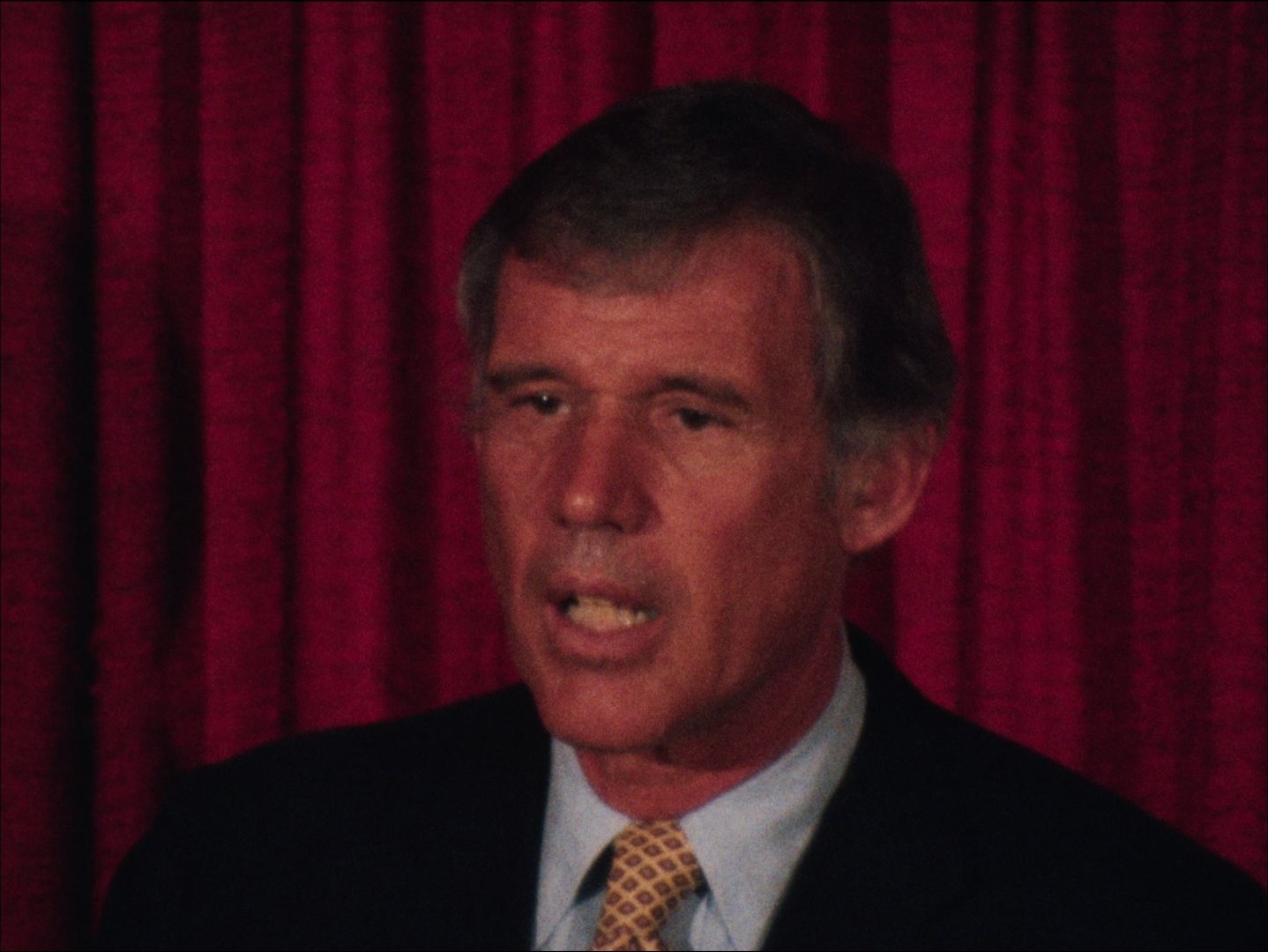
Christopher Lydon and Gail Harris host a Ten O'Clock News broadcast. Christy George reports on a campaign debate between Republican US Senate candidates Elliot Richardson and Ray Shamie. The report includes footage of their debate at Faneuil Hall. Charles Bennett reports on the race between Democratic US Senate candidates Jim Shannon and John Kerry. Bennett reports that Shannon held a press conference to announce the endorsement of his candidacy by several leaders of Vietnam Veterans' groups. The report includes footage from the press conference featuring Shannon and Vietnam veterans Charles Harris and Sam Mullen. Bennett reviews Kerry's history as a Vietnam veteran and talks about Kerry's relations with veterans' groups. Bennett's report also includes footage from a campaign advertisement for Kerry. Lydon and Harris read headlines about Greg Bemis (arsonist) and a hepatitis outbreak in Worcester. Lydon reports on addresses to the B'Nai Brith convention by Ronald Reagan (US president) and Walter Mondale (Democratic candidate for US president). The report includes footage of both candidates addressing the convention. Harris reports on a power-sharing agreement between Israeli leaders Shimon Peres and Yitzhak Shamir. Harris's report features footage of Peres and Shamir at a press conference. Loretta Roach talks about school desegregation ten years later Christopher Lydon interviews in-studio guests Kim Marshall (Director for Curriculum, Boston Public Schools) and Loretta Roach (parent activist) about the state of Boston Public Schools ten years after the beginning of school desegregation. Marshall talks about the educational agenda for the schools; he says that the schools are beginning to improve. Roach says that she is more concerned about quality education than she is about integrated schools. Roach and Marshall say that the schools must concentrate on serving the present student population, which is poor and minority. Harris reads a news brief about school bus safety standards in the aftermath of a school bus accident in Rehoboth, Mass. Donna Hodge reports on Congressional efforts to protect the striped bass population in the Northeast. Hodge notes that there are disagreements between those who support a moratorium on striped bass fishing and those who are opposed to any quotas on striped bass fishing. Hodge's report includes footage from interviews with Kenny Baker (fisherman), Philip Coates (Director, Massachusetts Marine Fisheries) and Owen DeLong (Emergency Striped Bass Council).
1:00:02: Christopher Lydon and Gail Harris introduce the newscast. The logos of The Ten O'Clock News underwriters Shawmut Bank, New England Telephone, and The Nimrod Press are displayed.
1:00:54: Christopher Lydon reports on the debate at Faneuil Hall between Republican candidates for the Senate seat of Paul Tsongas (US Senator). Christy George reports on the debate. George says that the candidates disagreed on most of the issues. Visual: Footage of Elliot Richardson (candidate for US Senate) and Ray Shamie (candidate for US Senate) debating tax increases and the ERA (Equal Rights Amendment).
1:04:15: Harris reports that Jim Shannon (candidate for US Senate) won the personal endorsement of a number of the leaders of Massachusetts' Vietnam Veterans groups; that opponent John Kerry (candidate for US Senate) is a Vietnam veteran. Charles Bennett reports that Shannon choreographed a "large-scale stunt;" that the media was invited to a press conference where the endorsement was announced. V: Footage from Vietnam- A Television History, of Kerry in Vietnam; of Vietnam protesters in Washington D.C.; of Kerry testifying about Vietnam before the US Congress; of a sign reading "Vietnam Vets against the war." Bennett reviews Kerry's history as a Vietnam veteran and as an activist protesting against the war. V: Footage of Charles Harris (Vietnam veteran) endorsing Shannon at the press conference with other leaders from Vietnam Veterans of Massachusetts Incorporated. Harris wears a pin reading "Vietnam Vets for Shannon." Harris talks about Shannon's sponsorship of a bill declaring a national POW-MIA recognition day. Footage of Shannon talking about the need to provide compensation to the victims of Agent Orange; about the need to improve treatment for veterans who suffer from post-traumatic stress disorder. Bennett reports that Shannon made no mention of Kerry; that Sam Mullen (Vietnam veteran) seemed to represent the sentiment of some anti-Kerry veterans. V: Footage of Mullen saying that Kerry had an outstanding record of service; that he finds Kerry's political commercials offensive; that Kerry's performance was not "above and beyond the call" of duty. Footage of Kerry saying that he has a lot of support from veterans; that different veterans have different beliefs. Bennett reports that the veterans' endorsement of Shannon was intended as a rejection of Kerry. V: Footage of Shannon saying that he did not serve in the military. Bennett stands in front of the South Boston Vietnam Memorial. Bennett reports that some veterans may not support Kerry because he was a fierce opponent of the Vietnam War, as well as a war hero. V: Footage of a Kerry political advertisement focusing on the Vietnam War. Bennett reports that some veterans think that Kerry is denouncing the soldiers as well as the war in this political advertisement. V: Footage of Kerry saying that the soldiers were the victims of the Vietnam War; that he has fought to gain recognition for the contribution of the Vietnam veterans. Bennett reports that many veterans are conflicted by Kerry's dual roles as a war hero and an upper-middle class, well-educated war protester. V: Shot of the South Boston Vietnam Memorial.
1:08:39: Lydon and Harris read the news headlines. Harris reports that Kerry won the endorsement of the Black Political Task Force in Roxbury. Lydon reports that Greg Bemis (arsonist) pleaded guilty to 68 counts of arson; that Bemis admitted to setting more than 100 fires in the Boston area as a member of an arson ring in 1982 and 1983; that the arson ring included former Boston area police officers and fire fighters who were protesting the cutbacks resulting from Proposition 2 1/2. Harris reports that the outbreak of hepatitis in Worcester is being complicated by a rare Delta Virus; that this form of hepatitis is very serious; that city officials are trying to institute a program to vaccinate drug abusers who use needles.
1:10:08: Harris gives the weather report. WGBH promotions for the The Ten O'Clock News and Live From Lincoln Center.
1:11:34: Lydon reads the national news headlines. Lydon reports that Walter Mondale (candidate for US President) accused Ronald Reagan (US President) of "moral McCarthyism" and religious zealotry; that Mondale asked for respect of his religion, family values, and patriotism. V: Footage of Mondale and Reagan addressing the B'nai Brith convention in Washington DC. Lydon reports that Reagan talked about the importance of the separation of church and state. Lydon reports that Gerald Ford (former US President) said that Mondale never complained when Jimmy Carter (former US President) mixed religion and politics. Lydon reports on a humorous exchange between Geraldine Ferraro (Mondale's running mate) and a high school student in Independence, Missouri.
1:12:51: Harris reads the international headlines. Harris reports that Shimon Peres (leader, Israeli Labour Party) and Yitzhak Shamir (leader, Israeli Likud Party) have agreed on the details of a power-sharing agreement. V: Footage of Peres and Shamir at a press conference. Harris reports that the Labour Party will handle defense issues and the Likud Party will handle economic issues; that the parties are optimistic that the agreement will work. Harris reports that the US vetoed a resolution by the United Nations Security Council; that the resolution would have demanded that Israel lift restrictions on the movement of people in Southern Lebanon. Harris reports that the US representative rejected the resolution because it did not address the activities of Syrian and Palestinian forces in other parts of Lebanon.
1:14:13: Report on the winning lottery numbers in Massachusetts, New Hampshire, and Rhode Island.
1:14:34: Christopher Lydon reports on the opening of Boston Public Schools. Lydon notes that it has been ten years since the beginning of busing and school desegregation. Lydon introduces in-studio guests Kim Marshall (Director for Curriculum, Boston Public Schools) and Loretta Roach (parent activist). Lydon notes that Marshall called the 1974 court order a "disaster" because it did not integrate the city with the suburbs. Marshall says that he thought few educational advancements could be made without integrating students of diverse social classes as well as students of different races. Marshall says that integration with the suburbs will never happen; that he is more realistic now. Marshall says that he is now concentrating on addressing the important issues on the educational agenda of the Boston Public Schools. Marshall talks about the need for good school principals, for high expectations for all students, for clear curriculum objectives, for test data about student performance, and for a safe climate in the schools. Marshall says that he was not focused enough on the realities of urban classrooms and schools in 1974. Lydon asks Roach what she has learned as a parent since the beginning of school desegregation in 1974. Roach says that the school system has improved; that there are some administrators in place who are concerned with accountability in education and high expectations for students. Roach says that the schools still have a poor record in dealing with racism. Roach says that the integration of social classes is not possible in Boston Public Schools; that the majority of students are African American, Hispanic, and poor. Lydon asks Roach if the court order has tried to address the needs of white students who have left the school system. Roach and Lydon agree that no one knows the whereabouts of the white students who are assigned to integrated public schools and do not show up. Marshall mentions the Jeremiah Burke School as an example of a school which has shown great improvements since desegregation. Marshall says that school administrators are focused on serving the students who are attending the schools. Lydon quotes Hubie Jones (Dean, Boston University) as saying that the Boston Public Schools are a "disaster." Marshall says that the system has just begun to make improvements; that the system has a very long way to go. Marshall notes that a new policy requires students to have an attendance rate of 85% in order to be promoted to the next grade level. Lydon quotes Robert Spillane (Superintendent, Boston Public Schools) as saying that Robert Dentler (Dean of Education at Boston University and advisor to the federal court) is a "social engineer." Lydon quotes Spillane's predictions that the Boston Public School System will continue to lose white students until it is once again a segregated system. Marshall says that the Boston Public School System has moved beyond school desegregation; that the school system needs to improve in order to attract new students. Roach says that urban schools across the country are in trouble; that African American parents are very concerned with the quality of education in the schools. Roach says that she is more concerned about quality education than she is about integrated schools. Roach says that she has invested a lot of time and effort in the Boston Public Schools; that she feels good about the kind of education her children are receiving. Lydon thanks Marshall and Roach.
1:22:43: Stock report: the Dow Jones average is listed at 1218.86; the volume of the New York Exchange is listed at 91,920,000.
1:23:03: Harris reports reports on school bus safety standards. Harris says that a school bus crash in January in Rehoboth, Massachusetts, could have been much worse without the safety standards adopted in 1977; that the National Transportation Safety Board has determined that Mary Jane Noons (Rehoboth bus driver) could not have avoided the crash; that the board is looking into further safety measures to protect children riding on school buses.
1:23:46: Harris reports that a Congressional committee will force Atlantic states to reduce their catches of striped bass or face a ban on striped bass fishing; that Maryland and Virginia lawmakers oppose quotas on striped bass; that Gary Studds (US Congressman from Massachusetts) and others support the quotas. Donna Hodge reports that Kenny Baker (fisherman) once fished primarily for striped bass. V: Footage of Baker preparing to go out on his boat in Woods Hole, Massachusetts; of Baker piloting his boat out of the harbor. Footage of Baker talking about the challenges involved in fishing for striped bass. Baker says that he feels fortunate to have been able to make a living from fishing for striped bass. Footage of Baker fishing off of his boat. Hodge says that the striped bass population has declined precipitously in Massachusetts. V: Footage of Philip Coates (Director, Massachusetts Marine Fisheries) talking about the decline of the striped bass population due to a combination of overfishing and environmental phenomena. Footage of Baker fishing from his boat. Shots of the coastline and the ocean. Hodge reports that striped bass migrate from the Chesapeake Bay to the North Atlantic every year; that an eleven-state coastal commission has been formed to protect the fish. Hodge reports that regulations on striped bass fishing are very tough in Massachusetts; that some fisherman believe the regulations are excessive. V: Shots of a man fishing off of a boat. Footage of Baker saying that regulations should be equally tough in every state; that a moratorium on fishing for striped bass should be imposed in all of the states along the coast. Shots of a bass being caught on a fisherman's line. Hodge reports that fishermen on Martha's Vineyard are preparing for the annual Striped Bass Derby. V: Footage of Owen DeLong (Emergency Striped Bass Council) saying that an immediate moratorium on striped bass fishing should be imposed along the whole east coast; that the Striped Bass Derby is inappropriate and morally wrong at this time. Footage of workers at a fish processing plant. Hodge reports on the need for uniform regulations among all states involved in striped bass fishing. Hodge reports that Claudine Schneider (US Congresswoman from Rhode Island) has proposed a three-year moratorium on striped bass fishing. V: Footage of DeLong saying that Studds, Edward Kennedy (US Senator) and John Chafee (US Senator) have all filed bills to regulate striped bass fishing; that strict regulations must be imposed in the next few months in order to save the species. Shots of an aquarium exhibit of striped bass. Harris reports that Studds has defended his plan as a compromise between those pushing for a moratorium on fishing and those who want no regulation at all. Harris notes that the organizers of the Striped Bass Derby on Martha's Vineyard have said that the competition will proceed as planned.
1:29:05: Harris and Lydon close the newscast. End credits roll.
Date Created:
09/06/1984