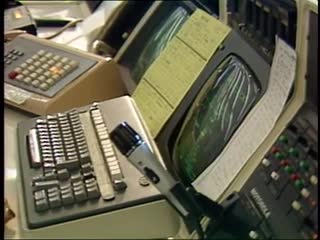
Description: CAMBRIDGE POLICE ANSWERING 911 EMERGENCY CALLS, ALSO BOSTON POLICE HEADQUARTERS
Collection: Ten O'Clock News
Date Created: 07/17/1985
Description: COMMISSIONER FRANCIS ROACHE WILL COMMIT MORE POLICE TO AREA B TO FIGHT DRUG CRIME
Collection: Ten O'Clock News
Date Created: 04/15/1987
Description: BOSTON COPS IN HALLS OF HEADQUARTERS, GOING TO CARS, IN UNIFORMS
Collection: Ten O'Clock News
Date Created: 03/14/1983
Description: MOTORCYCLES PARKED OUTSIDE STATION, POLICE GETTING ON, PULLING OUT IN PAIR
Collection: Ten O'Clock News
Date Created: 03/23/1983
Description: Callie Crossley reports on the documentary film Street Cop, set in Roxbury. Interview with Roxbury community activists Georgette Watson and Ben Haith about the documentary's portrayal of crime and drug traffic in the community. Watson complains about the negative images of Roxbury in the media and about the negative attitude of many police officers toward African Americans. Crossley's report includes footage from Street Cop and footage of Crossley, Watson, and Haith walking in Dudley Square. Interview with Larry Brown of the Boston Minority Police Association, who says that the documentary gave a realistic and effective portrayal of law enforcement. This edition of the Ten O'Clock News also included the following item: David Boeri reports that William Celester has been accused of sexual assault by a female employee of the Police Department
1:00:00: Visual: Footage from Street Cop, a documentary film produced for Frontline. The footage shows a police plainclothes police officer entering a family's apartment. Women and children in the apartment are screaming and crying. Callie Crossley reports that Street Cop is a gritty documentary set in Roxbury; that the documentary profiles police officers from Area B headquarters in Roxbury; that the documentary examines crime and drug traffic. Crossley reports that some Roxbury activists say that the film shows the disrepectful attitude of the police toward citizens in the community. V: Footage of Crossley interviewing Georgette Watson (Roxbury community activist) and Ben Haith (Roxbury community activist). Watson says that police show less respect and restraint in Roxbury than they do in other communities. Watson wonders if the police are helping the community or destroying it. Crossley reports that Watson and Haith are concerned about the portrayal the Roxbury community in the documentary. V: Footage from Street Cop of a police officer breaking down an apartment door with a sledgehammer. Footage of Watson saying that drug problems exist all over the city, not just in Roxbury. Footage of Haith saying that the documentary showed the police attacking the neighborhood as if they were engaged in warfare. Footage from Street Cop of police officers searching for drugs in an apartment. Footage of Crossley, Watson, and Haith walking across the street in Dudley Square in Roxbury. Watson says that there are massive drug deals taking place across from the police station; that police are more concerned with forcefully entering homes to search for nickel bags of marijuana. Footage from Street Cop. Stanley Philbin (Boston Police Department) drives by a depressed housing project in Roxbury, saying that if he were young, black and living in that housing project, he would probably sell drugs; that "being black is no bargain." Crossley reports that Roxbury activists say that comments by police officers in the documentary reflect racist attitudes. V: Footage from Street Cop of a white police officer grabbing an African American girl as he tries to chase some African American kids away from a residential home. Footage of Watson saying that Roxbury needs police officers who understand the community; that police officers from South Boston do not understand the culture of African Americans. Watson says that Roxbury needs police officers who do not have a negative attitude toward African Americans. Footage of Larry Brown (Boston Minority Police Association) saying that the documentary was realistic and effective portrayal of law enforcement. Footage from Street Cop of a police officer reaching down the shirt of an old woman to pull out drugs. Footage of Brown saying that drugs and guns are a huge problem in communities; that police officers need to protect themselves from violence. Footage from Street Cop of police officers making an arrest. Footage of Brown saying that the community needs to support the police officers in the fight against the drug problem; that tough tactics are necessary to eradicate the drug problem. Footage from Street Cop of a uniformed African American police officer in a cruiser.
Collection: Ten O'Clock News
Date Created: 03/31/1987
Description: Jan von Mehren reports that African American community leaders expressed their rage over the handling of the Carol Stuart murder case. Von Mehren notes that the leaders accused city officials, the Boston Police Department and the news media of racism in handling the case. Von Mehren's report includes angry speeches by Don Muhammad (Muhammad's Mosque), Rev. Graylan Hagler (Church of the United Community), and Bruce Bolling (Boston City Council). Von Mehren notes that the African American leaders have accused police of ignoring obvious clues during their investigation. Von Mehren adds that some leaders called for the resignation of Ray Flynn (Mayor of Boston) and Francis "Mickey" Roache (Commissioner, Boston Police Department). Von Mehren interviews Hagler. Hagler says that police officers ignored community residents who approached them with information about the case. Von Mehren concludes by saying that the African American community suffered a grave injustice in the aftermath of the murder.
1:00:04: Visual: Footage of Bill Owens (State Senator) speaking at a press conference. A group of African American community leaders stand behind him. The group includes Graylan Ellis-Hagler (Church of the United Community) and Don Muhammad (Muhammad's Mosque). Owens says that a great injustice has been done to the African-American community. Shots of the attendees at the press conference. Jan von Mehren reports that African American community leaders expressed rage and fury at a press conference today. V: Footage of Ellis-Hagler speaking at the press conference. Ellis-Hagler accuses Ray Flynn (Mayor of Boston) of placing blame too quickly on the African American community. Ellis-Hagler compares Flynn's actions to that of the Ku Klux Klan. The attendees at the press conference give vocal support to Ellis-Hagler's assertions. Footage of Muhammad at the press conference. Muhammad asks if white public officials will call Charles Stuart (murderer of Carol Stuart) "an animal." The crowd cheers. Von Mehren reports that African American leaders believe that Flynn, the Boston Police Department, and the media rushed to conclusions about the Stuart case. Von Mehren notes that the African American leaders say that racism played a huge role in the case. V: Shots of the press conference; of Charles Yancey (Boston City Council) addressing the press conference. Footage of Muhammad at the press conference. Muhammad says that police usually suspect the husband when a woman is killed. Muhammad says that police automatically suspect an African American man when a woman is killed in an African American neighborhood. Von Mehren stands outside of Muhammad's Mosque. Von Mehren reports that African American leaders have accused the police, the mayor, and the media of ignoring vital information about the case. Von Mehren notes that the African American leaders says that the vital information was circulating on the streets of Roxbury on the day after the shooting. V: Footage of Muhammad at the press conference. Muhammad says that there were rumours on the street that Charles Stuart was a drug addict. Muhammad says that police should have investigated those rumours. The crowd cheers. Von Mehren notes that Ellis-Hagler runs a recovery center for drug addicts out of his church in Roxbury. V: Footage of Ellis-Hagler being interviewed by von Mehren. Ellis-Hagler says that the workers in his recovery center told him that Charles Stuart was the murderer on the day after the murder occurred. Ellis-Hagler talks about a man from the community who went to police with information about the murder. Ellis-Hagler says that the man shared information with police which confirmed the alibi of William Bennett (suspect). Ellis-Hagler says that the police told the man that they had a suspect who suited their purposes. Footage of Muhammad at the press conference. Muhammad says that apologies are worthless; that the damage has already been done. Muhammad says that the city has stabbed the African American community in the back. Muhammad says that the African American community has been devastated. Shot of a sign at the press conference. The sign reads, "What does (sic) Boston and South Africa have in common? Stopping and detaining men because of the color of their skin." Von Mehren reports that some African American leaders called for the resignation of Flynn and Francis "Mickey" Roache (Police Commissioner, City of Boston); that some called for restitution to Mission Hill residents. V: Shots of Bruce Bolling (Boston City Council) speaking at the press conference; of attendees at the press conference. Shot of Muhammad at the press conference. Von Mehren adds that the African American community was dealt a grave injustice when police, public officials, and the media were taken in by Charles Stuart's hoax.
Collection: Ten O'Clock News
Date Created: 01/05/1990
Description: Boston mayoral debate from the 1975 campaign. 1975 mayoral campaign debate in WGBH studio, moderated by Pam Bullard, Ed Baumeister, and Gary Griffith, between Mayor Kevin White, Robert Gibbons, Senator Joseph Timilty, and Norman Oliver. Main topic is busing for school integration. Timilty believes that busing is a waste of resources; Gibbons believes that busing was forced by government and should be stopped. Discussion of budget: White is attacked for his handling of state funds. Timilty claims Boston is on verge of bankruptcy. White claims that he has tried to take politics out of City Hall. There is much bickering between Baumeister and Gibbons. Oliver says that Boston Police Department is not operating in the interest of the black community in the city. Timilty gives closing address, talks about type of city citizens want. Oliver closing address: vows to stand up against racism. Gibbons closing address: create neighborhoods for productive working class. White closing address: proud of his record in eight years as mayor. Talks about trying to balance the city fiscally. Ed Baumeister signs off.
Collection: Evening Compass, The
Date Created: 09/02/1975
Description: Evening Compass special. Press conference at Boston City Hall during the second week of Phase I desegregation of Boston schools. Frank Tivnan (Director of Communications for Mayor Kevin White) introduces the speakers at the press conference. John Coakley (Boston School Department) gives school attendance figures and analyzes trends in attendance. Robert Kiley (Deputy Mayor, City of Boston) reports that sixteen people were arrested in South Boston and Roslindale today. Kiley voices his concern about the number of young people involved in violent incidents. Joseph Jordan (Superintendent, Boston School Department) and Charles Barry (Deputy Superintendent, Boston Police Department) report that a bus was stoned while passing the Old Colony Housing Project in South Boston. Jordan and Barry report that 200 people were gathered outside of the housing project in the afternoon. Jordan is optimistic that the tension in South Boston will abate. The officials take questions from reporters about school attendance, police tactics in South Boston and the safety of bus routes.
3:02:56: Visual: Ed Baumeister reports live from Boston City Hall, at a briefing by Mayor Kevin White's office and the Boston School Department, after a day of violence and arrests stemming from court-ordered busing in Boston. Reporters include Walt Sanders and John Henning. 3:03:25: V: Frank Tivnan (Director of Communications for Mayor Kevin White) thanks the media for the opportunity to keep the public informed, then outlines the agenda and introduces the speakers: John Coakley (Boston School Department); Robert Kiley (Deputy Mayor, City of Boston); Joseph Jordan (Superintendent, Boston Police Department); Charles Barry (Deputy Superintendent, Boston Police Department). 3:04:24: V: Coakley reports that 54,000 students (67.4% of projected enrollment) attended classes in grades 1 - 12. Shots of reporters looking at handout sheets and taking notes. Coakley notes that attendance decreased in South Boston High School, Roxbury High School, Gavin and McCormack middle schools and South Boston elementary schools but increased at other schools. Coakley gives further analysis of attendance numbers and notes some logistical issues to be resolved in the schools. 3:06:51: V: Kiley gives an overview of the day's events: 16 arrests in South Boston and Roslindale, and 2 injuries requiring hospital treatment. Shots of reporters taking notes. Kiley notes an upswing in calls from parents reporting bruises and minor injuries to their children in the schools. He says that the city is working hard to control and deter incidents of violence and is concerned at the number of young adolescents (aged 12-13) involved in violent incidents. 3:09:45: V: Superintendent Jordan reports on arrests in South Boston; he notes a slight reduction in tension among citizens. He voices the police commitment to the safety of students, calls the violence "deplorable" and is optimistic that the situation will abate. 3:12:00: V: Deputy Superintendent Barry reports that one student was injured by a projectile thrown at a bus in an incident in front of the Old Colony Project in South Boston; that the fine weather attracted many people to the streets, including 200 people outside of the project. Shots of reporters in audience. Jordan takes the microphone and reports that 2 youths were arrested in Roslindale. 3:13:56: V: The panelists take question from reporters. Kiley responds to questions about a possible NAACP motion for US Marshals to come to Boston. Barry responds to questions about the presence of police or US Marshals on buses. Coakley responds to questions about the accuracy of the school attendance figures. Kiley and Tivnan respond to questions about a communication lag between the site of the incidents in South Boston and the communications center at City Hall. Jordan responds to questions about the reaction of South Boston residents to a police rule banning assembly of large groups of people; about the incident outside the Old Colony Project; about security along bus routes; about new police tactics in the coming weeks; about maintaining personnel on the streets and the possibility of changing the bus routes. 3:22:35: V: The panelists take more questions from reporters. Coakley responds to questions about changes in school enrollment percentages from the day before. Kiley responds to questions about whether African American students are really safe in South Boston; about communication between the city government and community leaders in the Old Colony Project; about whether authorities learned about the incident at the Old Colony Project from MDC police. Barry responds to questions about a possible increased police presence at the Old Colony Project. Jordan responds to questions about whether the increased police presence in South Boston will keep South Boston parents from sending their children to school. Coakley responds to questions about the accuracy of attendance figures at South Boston High School; about whether it is possible to educate students in the environment at South Boston High School. 3:31:30: V: Tivnan closes by asking, "any other questions, gentlemen?" Reporters rise to leave. Kiley comments to Tivnan that there is a woman in the audience. Recording ends.
Collection: Evening Compass, The
Date Created: 09/13/1974
Description: Robert Guiney, head of Boston Police Patrolman's Association, convenes his union to endorse candidacy of George Bush, who accepts in person. Dukakis & Cuomo hold State House PC to decry drug trafficking.
Collection: Ten O'Clock News
Date Created: 09/22/1988
Description: Bunker Hill Monument, exteriors of Charlestown High School, and Charlestown environs. A few police officers are stationed along Monument Square outside of Charlestown High School. Robert Murphy (Headmaster, Charlestown High School) stands in front of the school. School buses, accompanied by a police motorcycle escort, pull up in front of the school. African American students exit the buses and enter the school. Police officer tells camera operator that there is a standing order that the press has to remain across the street. A small number of photographers record the arrival of the buses from across the street. White students walks towards school and enter. Gary Griffith does several takes of reporter standup saying that the arrival of school buses at Charlestown High School was routine.
0:00:18: Visual: Shots of the Bunker Hill Monument; of the exterior of Charlestown High School. Two police officers stand outside of Charlestown High School. A white woman walks into the school. A muffled voice yells out, "No busing." Robert Murphy (Headmaster, Charlestown High School) stands out in front of the high school. Shot of Concord Street. Police motorcycles approach the school. Five police officers on motorcycles receive instructions from a police official. The motorcycles pull away. 0:03:41: V: School buses circle Monument Square and approach the high school. Police motorcycles escort the buses. A police officer stands near a Boston Police Department station wagon parked across the street from the high school. The officer watches the buses pull up in front of the school. African American students exit the buses and enter the school. Shot of the Hudson Bus Lines logo on one of the buses. The school buses pull away from the high school, accompanied by the police motorcycles. Murphy, a police officer, and a few school officials remain in front of the school. 0:07:06: V: White students walk toward the entrance of the school. Murphy and another school official greet a few of the students. A police officer is heard telling members of the media to move across the street. Two police officers stand casually on the corner of Bartlett Street and Monument Square. White students walk toward the school. Fewer than ten members of the media record the scene from the sidewalk across the street. A Hudson Bus Lines airport van pulls up in front of the school. An African American student is inside of the van. The van pulls away. The sidewalk in front of the school is empty. Some members of the media depart as two police officers walk up the opposite side of the street. Murphy speaks to two police officers on the corner of Bartlett Street and Monument Square. A man in a business suit speaks to a two-person camera crew. The street is quiet. Murphy and a police officer walk toward the school. 0:12:11: V: Gary Griffith stands outside of Charlestown High School. Griffith reports on the routine arrival of five buses at the high school this morning. He reports that there is no sign of unrest. The crew does two more takes of Griffith reporting on the story.
Collection: Ten O'Clock News
Date Created: 09/08/1977